

A Doctor’s Guide to Specific Probiotic Strains for Skin Health in 2026
What if the secret to that elusive glow isn't sitting in a jar on your vanity, but is actually waiting to be unlocked inside your digestive tract? As a doctor, I've seen countless patients spend a fortune on topical serums only to be disappointed by temporary results. The truth is that true dermatological transformation begins with the gut-skin axis. To see real change, you need to identify and consume specific probiotic strains for skin health that can survive the harsh environment of your stomach.
I know how frustrating it is to stand in the supplement aisle, staring at dozens of bottles and wondering which one actually works. You've likely felt the sting of wasted money on pills that don't seem to do anything. In this guide, I'm going to cut through the marketing noise and give you a clear list of skin-hero strains like Lactobacillus acidophilus and Bifidobacterium longum. You'll learn why 90% of probiotic skincare products don't even contain live bacteria and how advanced delivery technology ensures these micro-warriors actually reach their destination. By the end, you'll have a simple, science-backed routine to transform your skin from the inside out.
Key Takeaways
- Understand how the gut-skin axis acts as a bidirectional communication highway, making your complexion a direct reflection of your internal microbial ecosystem.
- Identify the specific probiotic strains for skin health that target your unique concerns, moving beyond generic labels to find high-performance strains like L. rhamnosus and B. longum.
- Learn why 90% of standard probiotics fail to reach the gut alive and how to ensure your supplement actually survives the stomach's harsh "acid bath."
- Discover the synergy between 16 diverse probiotic strains and collagen peptides to simultaneously rebuild your skin's structure and its microbial defense.
- Implement a practical, doctor-led 30-day routine that bridges the gap between complex laboratory science and your daily skincare habits.
The Gut-Skin Axis: Why Your Glow Starts in Your Gut
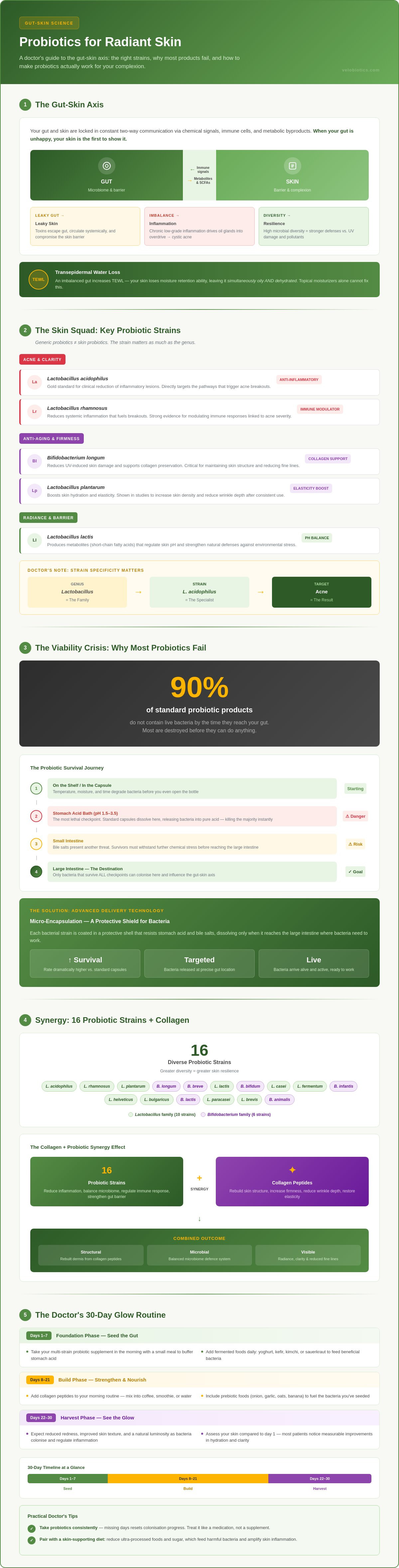
Think of your skin as an internal mirror. It doesn't just sit there looking pretty; it reflects the complex biological environment of your digestive system. This connection is what we call The Gut-Skin Axis, a sophisticated, bidirectional communication highway. Your gut and your skin are constantly chatting through chemical signals, immune cells, and metabolic byproducts. If your gut is unhappy, your skin is usually the first to tell the world about it.
Many of my patients spend years and small fortunes on high-end topical creams. While those can help the surface, relying solely on them is like painting a crumbling wall. You can fix the aesthetics for a day, but the structural damage remains underneath. To truly resolve issues like chronic redness or dullness, we have to look at the foundation. Using specific probiotic strains for skin health allows us to address the root cause rather than just masking the symptoms.
To better understand this concept, watch this helpful video:
A healthy gut lining acts as a strict bouncer, only letting nutrients into your bloodstream while keeping toxins out. When this barrier weakens, often called leaky gut, these toxins escape and circulate through your body. This systemic trash eventually reaches your skin, leading to what I call leaky skin syndrome. This manifests as a compromised skin barrier, making you more prone to irritation and environmental damage.
How Gut Inflammation Becomes a Breakout
When your microbiome is out of balance, your immune system stays on high alert. This chronic state of low-grade inflammation signals your oil glands to go into overdrive, often resulting in painful, cystic acne. An imbalanced gut also increases Transepidermal Water Loss (TEWL). Essentially, your skin loses its ability to hold onto moisture, leaving it both oily and dehydrated at the same time. It's a frustrating cycle that topical moisturizers can't fix alone.
The Microbiome as Your Skin's Immune Shield
Beneficial bacteria in your gut aren't just passive residents; they're active manufacturers. They produce metabolites like short-chain fatty acids that help regulate your skin's pH and strengthen its natural defenses. Research shows that high microbial diversity leads to greater skin resilience against UV damage and pollutants. Using specific probiotic strains for skin health helps build this internal shield. Without this diversity, your gut becomes sterile, leaving your skin sensitive, reactive, and unable to protect itself from the daily grind.
The Skin Squad: Specific Probiotic Strains for Acne, Aging, and Radiance
Most people walk into a health store and grab the first bottle labeled "Probiotic." That's like trying to fix a leaky faucet with a sledgehammer. While generic gut health probiotics focus on motility and bloating, specific probiotic strains for skin health are chosen for their ability to influence the dermal layer. Think of the genus (like Lactobacillus) as a family name, but the strain (like Lactobacillus acidophilus) as the individual with a specific job. If you want results, you need the right specialist for the task.
Research is rapidly advancing in this area. A recent Probiotic Effects on Skin Health Review analyzed hundreds of papers to confirm that certain bacteria do more than just live in your gut; they actively modulate skin inflammation and barrier function. By selecting specific probiotic strains for skin health, we can target the biological pathways that lead to breakouts or premature aging.
Strains for Clarity and Acne Control
If breakouts are your primary concern, focus on these three heavy hitters:
- Lactobacillus acidophilus: This is the gold standard for clinical reduction of inflammatory lesions. It helps calm the immune response that leads to those painful red bumps.
- Lactobacillus rhamnosus: I recommend this for patients struggling with oily skin. It helps balance sebum production from the inside out, making your face a less hospitable place for acne-causing bacteria.
- Bifidobacterium bifidum: This strain acts like an internal shield. It strengthens the skin barrier, helping you resist external pollutants that trigger irritation.
Strains for Hydration and Anti-Aging
As we age, our skin loses its "bounce" and moisture-retaining capacity. These strains help turn back the clock:
- Lactobacillus plantarum: This strain is a powerhouse for improving skin elasticity and moisture. Clinical observations show it helps smooth the appearance of fine lines by supporting the dermal matrix.
- Bifidobacterium longum: If your skin feels "stinging" or reactive to every new product, this is your go-to. It significantly reduces skin sensitivity.
- Hyaluronic Acid Support: These bacteria also encourage the body's natural production of hyaluronic acid, keeping your cells plump and hydrated without the need for heavy fillers.
While single-strain supplements have their place, I've found that a multi-strain approach is far more effective. A diverse 16-strain blend provides a broader spectrum of support by mimicking the natural complexity of a healthy human microbiome. This ensures that while one strain tackles acne, another is busy rebuilding your collagen. If you're looking for a comprehensive way to support your gut-skin axis, consider a high-diversity 16-strain formula to cover all your bases.
The Viability Crisis: Why Your Skin Probiotic Might Not Be Working
I see it every day in my clinic. Patients come in with a bag full of supplements, frustrated because their skin hasn't improved despite taking "50 billion CFUs" of probiotics. Here is the hard truth: most of those bacteria never made it past the front door. Your stomach is designed to be a biological incinerator. Its primary job is to use hydrochloric acid to kill off pathogens, but it doesn't distinguish between "bad" bacteria and the specific probiotic strains for skin health you just swallowed. It's a hostile environment that destroys roughly 90% of standard, unprotected probiotics before they ever reach your lower intestine.
This creates a massive gap between marketing and medicine. Companies love to brag about high Colony Forming Unit (CFU) counts because big numbers sell bottles. However, 100 billion dead bacteria are biologically useless. To activate the gut-skin axis we discussed earlier, these microbes must arrive in your gut alive and ready to colonize. If they're dead on arrival, they can't produce the metabolites needed to calm skin inflammation or strengthen your moisture barrier. Clinical viability is the only metric that actually matters for your complexion.
Micro-Encapsulation: The Doctor's Secret Weapon
To solve this, we utilize a sophisticated technology known as micro-encapsulation. Think of it as a microscopic suit of armor for each individual bacterium. This proprietary shield protects the specific probiotic strains for skin health from the corrosive effects of gastric acid and bile salts. Our technology ensures that 1000x more bacteria reach your gut alive compared to standard, non-encapsulated products. This isn't just about survival; it's about precision. The "time-release" mechanism ensures a steady delivery of active cultures, providing consistent support for your skin's immune system throughout the day.
The Cost of Ineffective Supplements
In the world of internal skincare, "cheap" probiotics are often the most expensive. If you spend money on a supplement that yields zero results because the bacteria died in your stomach, you've wasted every cent. It's better to invest in a system that guarantees biological activity. When you're reading a label, stop looking at the raw CFU count. Instead, look for mentions of "protected delivery" or "clinical survival data."
I always tell my patients to look for a "technological seal" on the packaging. This indicates the product uses a delivery system designed to bypass the acid bath. If you want to see a real difference in your skin's radiance and clarity, you need a formula like our 16-strain digestive capsules, which are specifically engineered for maximum viability. Don't settle for supplements that can't survive the journey; your skin deserves better than a graveyard of dead bacteria.
Synergy in a Scoop: Combining 16 Probiotic Strains with Collagen
If we want to build a sturdy house, we need both the bricks and the bricklayers. In the world of internal skincare, collagen acts as your bricks, providing the structural building blocks, while specific probiotic strains for skin health serve as the workers who manage the site. Without the workers, the bricks just sit in a pile. This is the "structural plus functional" approach that most traditional dermatology misses. By pairing these two powerhouses, you're not just adding material to your skin; you're ensuring your body actually knows how to use it.
I often explain to my patients that probiotics actually improve the bioavailability of collagen. When your gut microbiome is balanced and systemic inflammation is low, your intestinal lining becomes much more efficient at absorbing the specific amino acids found in collagen peptides. This means you see more visible results in your complexion and less wasted supplement in your digestive tract. It's about maximizing every gram of nutrition you consume.
The 16-Strain Advantage for Skin Resilience
Taking a single-strain supplement is like hiring a one-instrument orchestra; it might sound okay, but it lacks depth. A 16-strain approach creates a robust ecosystem that mimics the natural diversity of a healthy human microbiome. This diversity is crucial because it allows your internal environment to survive daily stressors like poor sleep or processed foods. When you use a comprehensive formula like 16 Strains Probiotics Collagen Peptides, you're deploying a diverse team of microbes that work together to protect your gut barrier and, by extension, your skin's radiance.
Collagen Peptides: The Structural Support
While the probiotics manage the environment, collagen peptides handle the heavy lifting of repair. Type I collagen is the primary protein found in your skin's dermal layer, responsible for that youthful firmness we all want to maintain. Type II collagen, meanwhile, supports joint health, ensuring your body feels as good as it looks. This "inside-out" approach is the most effective way to reduce the appearance of fine lines and wrinkles over time. For those who prefer a versatile option, adding Almasi Probiotics Collagen Powder to your daily routine provides the structural support your skin needs to stay resilient against the elements.
If you're ready to stop guessing and start seeing real changes in your skin's texture, it's time to embrace this dual-action strategy. You can view our complete 16-strain collagen range here to find the perfect fit for your lifestyle.
Prescribing Your Glow: A Doctor’s Practical Routine for Radiant Skin
I often tell my patients that achieving radiant skin is a marathon, not a sprint. While we've identified the specific probiotic strains for skin health that drive results, the biological magic happens during the 30-day skin-gut reset. This timeframe isn't arbitrary; it aligns with your natural skin cell turnover cycle, which takes roughly 28 to 30 days. During this month, your internal ecosystem undergoes a "microbial housewarming party" where new, beneficial bacteria begin to colonize and crowd out the inflammatory ones. Consistency is your superpower here. Skipping days is like stopping a workout routine halfway through; it disrupts the momentum your microbiome needs to stabilize.
To get the most out of your internal skincare, you must pair it with a supportive external routine. Stop using harsh, stripping cleansers that destroy your skin's surface pH. When your internal and external environments work together, you'll see faster results. Before you start, use my "Doctor’s Checklist" to ensure your supplement is actually up to the task:
- Strain Specificity: Does it list the exact strains like L. rhamnosus or B. longum?
- Survival Tech: Is there a delivery system to bypass the stomach's acid bath?
- Diversity: Does it offer a broad spectrum, ideally 16 strains, to mimic a healthy gut?
- Purity: Is it free from unnecessary fillers and non-GMO?
Step-by-Step Internal Skincare Routine
Your morning routine sets the stage for dermal health. I recommend taking your probiotics on an empty stomach, about 20 to 30 minutes before breakfast. This allows the encapsulated bacteria to move quickly into the intestines. Hydration is the next critical factor. Water acts as the transport medium for nutrients and helps flush out the toxins your gut is working to eliminate. Finally, feed your new skin strains with "helpers." Fiber-rich foods like oats, flaxseeds, and leafy greens act as prebiotics, providing the fuel your probiotics need to thrive and produce those skin-loving metabolites.
Monitoring Your Progress
Don't just look in the mirror; listen to your body. You'll likely notice "gut changes" before you see "skin changes." This might manifest as better digestion or less bloating within the first week. By week three, you should start to see shifts in skin texture, a reduction in redness, and fewer active breakouts. Tracking these metrics helps you stay motivated through the full 30-day cycle. If you're ready to start your journey with a brand that prioritizes clinical viability, explore the Velobiotics Story and our science-backed formulations to see how we've solved the delivery problem for good.
Your Journey to Dermal Transformation
You've spent years treating your skin from the outside; it's time to honor the biological connection between your microbiome and your complexion. As we've explored, the gut-skin axis is a measurable physiological highway that dictates your skin's resilience and clarity. To see a real difference, you must move past generic supplements and focus on specific probiotic strains for skin health that are actually engineered to survive the journey to your gut. Without clinical viability, even the best ingredients are lost to the stomach's harsh environment.
My goal as a doctor was to solve the viability gap that leaves most probiotics dead on arrival. Our doctor-founded and formulated range utilizes proprietary technology to ensure a 1000x better survival rate than standard probiotics. By delivering 16 clinically studied strains alongside high-quality collagen, we provide the structural and microbial support your body needs to thrive. You don't have to settle for temporary fixes or wasted investments. It's time to choose a routine rooted in empirical science and biological precision.
Shop the 16-Strain Probiotic Collagen Peptides for Radiant Skin and start your 30-day reset today. You have the science; now you just need the consistency. I can't wait to see your glow return from the inside out.
Frequently Asked Questions
Can probiotics really clear up acne?
Probiotics can significantly reduce acne by targeting the gut-skin axis to lower systemic inflammation. Studies have shown that specific probiotic strains for skin health, such as Lactobacillus acidophilus, can reduce total acne lesion counts by 45.2% compared to control groups. This internal approach helps regulate sebum production and prevents the inflammatory triggers that lead to painful, cystic breakouts from the inside out.
How long does it take for probiotics to improve skin?
You should expect to see visible improvements in your skin within 30 to 60 days of consistent use. This timeline reflects the natural biological process of skin cell turnover, which takes nearly a month in healthy adults. While you might feel digestive benefits within the first week, the dermal transformation requires the new microbial balance to stabilize and influence your skin's deeper layers.
What are the best probiotic strains specifically for anti-aging?
The most effective strains for anti-aging are Lactobacillus plantarum and Bifidobacterium longum. L. plantarum is specifically studied for its ability to improve skin elasticity and moisture retention, helping to smooth fine lines. B. longum helps reduce skin sensitivity and the "stinging" sensation often associated with a compromised barrier. These strains work internally to support the structural integrity and hydration of your complexion.
Do I need to keep skin probiotics in the fridge?
You don't need to refrigerate your probiotics if they utilize advanced micro-encapsulation technology. This pharmaceutical-grade shielding protects the bacteria from heat, light, and moisture, ensuring they remain shelf-stable at room temperature. Always check the packaging for a technological seal that guarantees stability. This makes your daily routine much more practical, especially when you're traveling or have a busy morning.
Can I take probiotics if I have sensitive skin?
Probiotics are actually highly recommended for sensitive skin because they help rebuild the skin's natural immune shield. By improving the gut barrier, you reduce the circulation of toxins that often manifest as reactive, sensitive patches. Strains like Bifidobacterium longum are particularly effective at calming the nervous system's response in the skin, leading to a much more resilient and less reactive complexion over time.
Is it better to take probiotics or apply them topically for skin health?
Internal probiotics are generally superior for addressing the root cause of skin issues, though a dual approach is often best. While topical ferments provide surface support, they rarely contain live bacteria due to standard preservative requirements. Taking specific probiotic strains for skin health orally allows live microbes to colonize your gut and manage the systemic inflammation that topical creams simply can't reach.
What is the difference between CFUs and clinical viability?
CFUs represent the total number of bacteria in the capsule at manufacture, while clinical viability refers to how many actually survive the journey to your gut. A high CFU count is meaningless if the bacteria are killed by stomach acid. Focus on products that prioritize viability through delivery technology. This ensures the microbes arrive alive to activate the gut-skin axis and provide real dermatological benefits.
Can I take collagen and probiotics together?
You can, and should, take collagen and probiotics together for maximum efficacy. Probiotics act as the "worker" that improves your gut's ability to absorb the amino acids in collagen, which serves as the "building block" for your skin. This combination ensures that your body has both the structural materials and the healthy microbial environment necessary to rebuild firm, radiant, and youthful-looking skin.

Disclaimer
Information and statements regarding dietary supplements/products have not been evaluated by the Food and Drug Administration, MCC/SAHPRA, MHRA, TGA or any other drug regulatory authority and are not intended to diagnose, treat, cure, or prevent any disease. Information on this website is provided for informational purposes only and is a result of years of practice and experience by the author. This information is not intended as a substitute for the advice provided by your physician or other healthcare professional or any information contained on or in any product label or packaging. Do not use the information on this website for diagnosing or treating a health problem or disease, or prescribing medication or other treatment. Always speak with your physician or other healthcare professional before taking any medication or nutritional, herbal, or homeopathic supplement, or using any treatment for a health problem. If you have or suspect that you have a medical problem, contact your healthcare provider promptly. Do not disregard professional medical advice or delay in seeking professional advice because of something you have read on this website.