

Boric Acid Suppositories Burning Sensation: A Doctor’s Guide to Why It Happens and How to Fix It
If you have ever felt an unexpected "fire" after inserting a treatment, you know the immediate panic it triggers. A boric acid suppositories burning sensation isn't just a nuisance; it's a specific biological signal that your vaginal environment is currently too sensitive for the standard delivery method. You likely turned to this solution to find relief from itching or odor, only to be met with a sharp sting that makes you wonder if you're doing more harm than good.
I understand the anxiety that comes with vaginal health, especially when the remedy feels like the enemy. The truth is that while medical experts recognize boric acid as a second-line treatment for recurrent infections, it can be harsh on a compromised mucosal lining. In this guide, I'll break down the scientific reasons why this irritation occurs and provide you with actionable steps to stop the burn while effectively restoring your internal balance. We will explore the mechanics of your vaginal barrier, the importance of probiotic support, and how to use these tools comfortably to achieve the results you deserve.
Key Takeaways
- Understand the biological interaction between acidic compounds and inflamed vaginal mucosa to identify why your treatment is causing discomfort.
- Learn why a boric acid suppositories burning sensation often signals a compromised moisture barrier rather than a failed product.
- Discover immediate, doctor-recommended steps to halt irritation and safely rinse the area if you experience a sharp sting or redness.
- Explore how Cookie Fresh technology integrates probiotic restoration with pH balance to protect the vaginal epithelium from mechanical friction.
- Follow a structured 7-day reset protocol designed to transition your microbiome from a state of sensitivity to long-term stability.
Why Do Boric Acid Suppositories Cause a Burning Sensation?
Most clinical guides claim that boric acid is "mild" or "generally well-tolerated." If you are currently clutching a cold compress, you know that isn't always the case. A boric acid suppositories burning sensation is a frequent hurdle for women trying to manage recurrent infections. It's usually a byproduct of how the compound interacts with your unique internal chemistry at that exact moment.
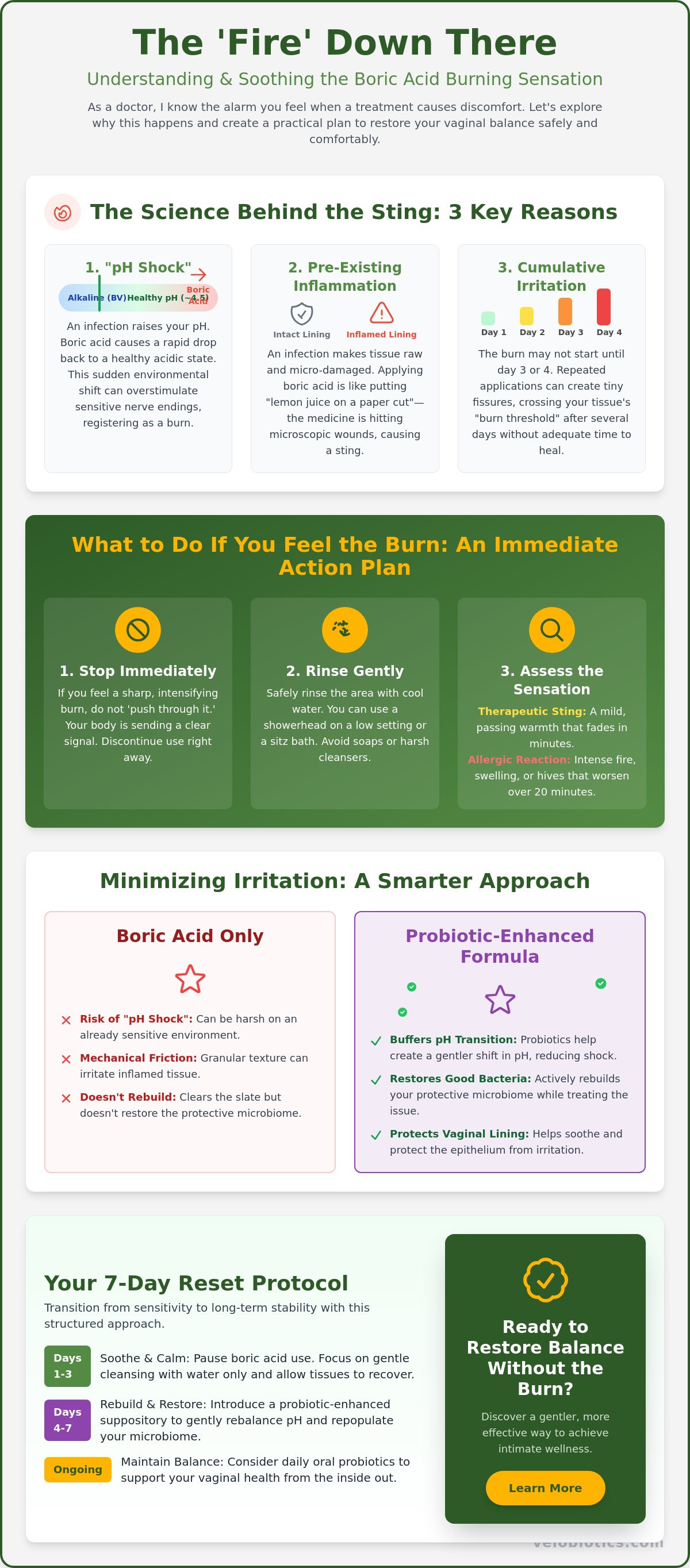
One major reason for this discomfort is a phenomenon I call "pH Shock." When you have an infection like BV, your internal environment becomes more alkaline. Boric acid works by rapidly lowering that pH back to a healthy, acidic level. This sudden shift can overwhelm sensitive tissues that have already been stressed by the infection itself. It's a rapid environmental change that your nerve endings register as heat or stinging.
To better understand why your body might be reacting this way, watch this helpful breakdown from a clinical perspective:
The Role of Pre-existing Inflammation
Think of your vaginal lining, or the epithelium, like the skin on your face. When you have a yeast infection or BV, that tissue becomes raw and micro-damaged. Inserting a dry, granular suppository into this "angry" tissue is like putting lemon juice on a paper cut. The boric acid suppositories burning sensation you feel is often just the medicine hitting a microscopic wound. It's a signal that your vaginal barrier is currently compromised and needs a more sophisticated delivery method to avoid mechanical friction.
Chemical Interaction and pH Fluctuations
Boric acid's primary objective is to reach a stable target pH of approximately 4.5. Scientific literature regarding Boric acid for vaginal use notes that while it is an effective antiseptic, the chemical transition as the capsule dissolves can cause temporary irritation. This is especially prevalent if your starting pH was significantly higher due to bacterial overgrowth. To mitigate this "clean slate" effect, I developed Femina Probiotic Cookie Fresh, which pairs the acid with restorative probiotics to buffer the transition and rebuild the microbiome simultaneously.
You should always distinguish between a "therapeutic sting" and a true allergic reaction. A mild, passing warmth that fades within minutes is usually the environment adjusting. However, if you experience intense swelling, hives, or a fire that intensifies after twenty minutes, stop immediately. That's no longer a pH shift; it's a signal from your immune system that the specific formulation is causing a hypersensitivity response.
The Science of Vaginal Sensitivity: When Boric Acid Meets the Mucosa
Your vaginal epithelium is a marvel of biological engineering. This multi-layered shield is designed to be resilient, yet it relies on a delicate moisture barrier to stay intact. When we discuss a boric acid suppositories burning sensation, we're usually looking at a breach in this protective layer. In a healthy state, the epithelium is thick and robust. However, during an active infection, the "bricks" of this wall become loose and inflamed. This makes the tissue hyper-sensitive to any external substance, even one intended to help.
I often see patients in my clinic who are confused because the burning doesn't start until day three or four of their treatment. This is a common phenomenon discussed in online communities like Reddit, and there's a sound clinical explanation for it. It's called cumulative irritation. The first dose might cause microscopic fissures in the lining. By the third or fourth night, the acid makes direct contact with those tiny raw areas. It's not that the product has suddenly changed; it's that your tissue's "burn threshold" has been crossed after repeated exposure without adequate time for the barrier to repair itself. This is one of the documented side effects of boric acid that occurs when the treatment is effective at killing pathogens but lacks the components to soothe the underlying tissue.
Tissue Thinning and Hormonal Factors
Estrogen is the primary architect of your vaginal wall. It ensures the lining remains thick and well-lubricated. If you're in your luteal phase (the week before your period) or moving through menopause, your estrogen levels naturally dip. Low estrogen leads to a thinner, more fragile epithelium. When the lining is thin, the distance between the boric acid and your nerve endings decreases. This explains why a treatment that felt fine last month might suddenly cause a sharp sting this month. Your hormonal cycle directly dictates how much "pH shock" your body can handle at any given time.
Purity and Fillers in Suppositories
The delivery system is just as important as the active ingredient. Many mass-market products use lower-quality fillers or coarse, granular powders that cause mechanical friction against the mucosa. If the powder is too abrasive, it acts like sandpaper on an already irritated surface. Additionally, some "inactive" ingredients in cheap capsules can trigger contact dermatitis, which mimics the symptoms of an infection. To avoid these mechanical triggers, I recommend using high-purity options like Femina Cookie Fresh Boric Acid Only, which focuses on pharmaceutical-grade purity to minimize unnecessary tissue stress.
Viability is the key to recovery. We must focus not only on the viability of the ingredients we use to kill the "bad" bacteria but also on the viability and health of the vaginal tissue itself. Without a strong, hydrated barrier, even the best antiseptic will feel like an irritant.
Immediate Steps: What to Do if You Feel the Burn
If you experience a sharp sting or an escalating boric acid suppositories burning sensation, your first instinct might be to "tough it out" in hopes the infection clears. As a doctor, my advice is the opposite: stop immediately. This sensation is your body’s way of signaling that the local tissue is being over-taxed. Continuing treatment while the mucosa is inflamed will only deepen the irritation and prolong your recovery time.
Your first step is physical removal of the irritant. Gently rinse the external vulvar area with lukewarm water. Do not use soap, feminine washes, or internal douching, as these can disrupt your natural flora even further. The goal is to dilute any residual powder that has leaked onto the sensitive external skin. Once you have rinsed, pat the area dry with a clean, soft towel; do not rub. Clinical data regarding the side effects of boric acid suppositories confirms that local irritation is the most common complaint, and immediate cessation is the most effective way to prevent secondary contact dermatitis.
After rinsing, monitor your body for signs of a true allergic reaction. While a localized boric acid suppositories burning sensation is usually a pH-related issue, systemic reactions are serious. Check for:
- Intense swelling of the labia or vaginal opening.
- Hives or a rash spreading to other parts of your body.
- Difficulty breathing or significant pelvic cramping.
External Relief Strategies
To manage the lingering heat, apply a cool compress to the labial area for 10 to 15 minutes. This helps constrict local blood vessels and numbs the nerve endings. During this recovery phase, wear loose, breathable cotton underwear to ensure maximum airflow. You should strictly avoid any scented liners, wipes, or "cooling" gels. These often contain alcohols or fragrances that will aggressively sting an already compromised moisture barrier.
When to Call a Healthcare Provider
Most minor burns resolve within a day of stopping the product. However, you should contact your doctor if you experience red flags like fever, unexplained pelvic pain, or vaginal bleeding that isn't part of your menstrual cycle. When you call, be direct. Tell them, "I used a boric acid suppository and experienced significant burning; I'm concerned about a secondary reaction." There is no reason to be embarrassed; clinicians see these reactions frequently and can provide prescription-strength soothing agents if necessary. If you find that standard formulas are too harsh, you might eventually consider a more balanced approach like Femina Probiotic Cookie Fresh, which is designed to support the microbiome while maintaining pH.
Minimizing Irritation: Boric Acid Only vs. Probiotic-Enhanced Formulas
Many women assume that the strongest antiseptic is always the best choice for an infection. However, pure boric acid is effectively a "scorched earth" approach. It's a powerful tool for resetting your pH, but it doesn't distinguish between the harmful pathogens and the beneficial bacteria that keep your tissue healthy. This lack of biological diversity is a primary driver behind a recurring boric acid suppositories burning sensation. When you remove the protective "good" bacteria, you leave your vaginal lining vulnerable to the very acid meant to help it.
By contrast, a restorative approach focuses on a "clean and rebuild" strategy. Probiotics act as a biological buffer, coating the vaginal wall and protecting it while the boric acid does its job. These friendly bacteria naturally produce lactic acid, which helps the environment transition to a healthy pH level much more smoothly than a chemical-only intervention. This cause-and-effect relationship means that the more populated your microbiome is with beneficial strains, the less likely you are to experience sharp irritation during treatment.
The Synergy of Boric Acid and Lactobacillus
The vaginal microbiome needs friendly colonizers to maintain its newfound balance. Without them, the pH will inevitably spike again. My team and I focused on this challenge by developing "Cookie Fresh" technology. This system ensures that while the boric acid manages the overgrowth, the probiotics are delivered simultaneously to begin the restoration process immediately. You can find this dual-action approach in Femina Probiotic Cookie Fresh. We use a sophisticated micro-encapsulation process to ensure the probiotics actually survive the acidic environment of the suppository, allowing them to thrive once they reach their destination.
Why "Boric Acid Only" Can Lead to Recurrence
If you rely solely on pure boric acid, you may find yourself in a cycle of temporary relief followed by a rapid rebound. An empty microbiome is a vacuum; nature hates a vacuum. Pathogens like Gardnerella or Candida are opportunistic and will reinvade the space as soon as you stop the treatment if no beneficial flora are present to hold the line. Over time, this "resetting" without rebuilding can lead to chronic dryness and heightened sensitivity. To break this cycle, you must shift your focus from simply "killing" pathogens to "cultivating" a robust, protected flora. This shift is essential for long-term comfort and the prevention of that persistent boric acid suppositories burning sensation.
Stop the cycle of irritation and start rebuilding your defenses today. Switch to Cookie Fresh and feel the difference of a balanced microbiome.
Restoring Balance Safely: Your Action Plan for Intimate Wellness
Transitioning from acute discomfort to long-term stability requires a shift in how you view your microbiome. You've identified the biological cause of your boric acid suppositories burning sensation; now it's time to implement a protocol that respects your tissue's limits while optimizing its defenses. You aren't "broken" or uniquely sensitive. Your body just needs a more sophisticated approach that prioritizes epithelial health alongside pH correction.
To move forward, follow my 7-day reset protocol designed to stabilize the environment without the sting.
- Days 1-2 (The Firewall): Complete cessation of all internal products. Focus on hydration and allow the natural moisture barrier to begin cellular repair.
- Days 3-5 (The Rebalance): Reintroduce a probiotic-enhanced formula at bedtime. This provides the necessary "friendly" bacteria to buffer the acidity.
- Days 6-7 (The Fortification): Shift focus to internal support. Continue with oral probiotics to strengthen the vaginal-gut axis, which helps maintain long-term resistance to pathogens.
Long-term Maintenance and Prevention
Once your microbiome is stable, you can use suppositories for maintenance without fear of the burn. Many women find success using one after sexual activity or the final day of their period to prevent pH spikes. During these times, staying hydrated is vital. Dehydrated tissues are thinner and more prone to the boric acid suppositories burning sensation. A diet rich in prebiotic fibers also fuels the "good" bacteria you've worked hard to cultivate. Our research-first commitment at the heart of the Velobiotics Story is centered on this very concept: creating products that work with your biology, not against it.
Choosing the Right Product for Your Body
When selecting a product, "more" isn't always "better." While 600mg is the clinical standard for boric acid, higher dosages or formulas with unnecessary fillers can lead to chronic dryness. Always check your labels for pharmaceutical-grade purity and avoid any products containing artificial fragrances or harsh preservatives. Look for delivery systems that emphasize biological viability. If you're ready for a solution that respects your sensitivity, explore our scientifically formulated Femina range at Velobiotics. We've bridged the gap between professional medical knowledge and everyday wellness to ensure you can achieve balance without the burn.
Your Path to Burn-Free Balance
Achieving a balanced microbiome doesn't have to be a painful trade-off. We've established that a boric acid suppositories burning sensation is usually a biological signal of tissue stress caused by rapid pH fluctuations against a sensitive vaginal wall. By moving beyond a "kill-only" approach and prioritizing epithelial restoration, you can manage recurrent issues without the characteristic sting associated with standard treatments.
As a doctor, I believe you deserve a delivery system that respects your body's delicate chemistry. Our team of biotechnology experts specifically designed our formulas to reduce common irritation. We utilize proprietary micro-encapsulation technology to ensure probiotic viability, providing a protective buffer that standard products lack. This research-first methodology ensures that your treatment is as compassionate as it is clinically effective. It's about ensuring the active ingredients are successfully delivered while protecting the environment they reside in.
Switch to the Probiotic-Buffered Cookie Fresh Suppository for a gentler experience and reclaim your intimate health with confidence. You aren't just treating a symptom; you're cultivating a resilient, healthy future.
Frequently Asked Questions
Is it normal for boric acid to burn the first time I use it?
Stinging is common but usually indicates that your vaginal tissue is already inflamed from an active infection. When the mildly acidic powder hits raw mucosa, it triggers a response similar to lemon juice on a paper cut. If the sensation is mild and fades quickly, it's typically a sign of the environment adjusting to a lower pH level. Intense or escalating pain is a signal to stop.
How long does the burning sensation from boric acid usually last?
A standard adjustment burn should subside within 15 to 30 minutes as the suppository dissolves and integrates with your natural fluids. If the discomfort persists for several hours or intensifies overnight, you should discontinue use immediately. Prolonged burning suggests that the concentration is too high for your current tissue integrity or that your moisture barrier is severely compromised and needs time to recover.
Can I use a lubricant with boric acid to stop the stinging?
You can apply a small amount of water-based, pH-balanced lubricant to the capsule to reduce mechanical friction during insertion. This creates a temporary physical buffer between the suppository and the sensitive vaginal opening. Don't use oil-based lubricants or those containing glycerin and scents. These additives often exacerbate irritation and can interfere with the proper breakdown of the capsule shell inside the vaginal vault.
Does burning mean the boric acid is working to kill the infection?
Burning is not an indicator of efficacy; it's a side effect of tissue sensitivity. The boric acid suppositories burning sensation simply means the chemical transition is happening faster than your sensitive mucosa can tolerate. Boric acid works by inhibiting fungal and bacterial growth through pH modulation. This process occurs silently in the background regardless of whether you feel a temporary sting or absolutely nothing at all.
What is the difference between a normal burn and an allergic reaction?
A normal burn is localized stinging that stays within the vaginal vault and fades relatively quickly. An allergic reaction, or hypersensitivity, usually involves significant external swelling, hives, or an itchy rash that spreads to the labia. If you experience systemic symptoms like difficulty breathing or intense pelvic cramping, you should seek immediate medical attention. These are signs of an immune response rather than simple pH adjustment.
Can I use boric acid if I have a small tear or scratch in the vagina?
I recommend waiting until any physical tears or scratches have fully healed before starting your treatment. Boric acid is a crystalline powder that can cause intense pain when it enters an open wound. Using it on broken skin increases the risk of localized chemical irritation and can delay the natural healing process of the epithelium. Focus on gentle external hygiene until the tissue is intact again.
Will probiotics help stop the burning sensation from boric acid?
Probiotics can significantly reduce irritation by acting as a biological buffer and producing soothing lactic acid. When you combine boric acid with specific Lactobacillus strains, you aren't just lowering the pH level; you're also rebuilding the protective biofilm. This dual-action approach prevents the "scorched earth" effect that often leads to a boric acid suppositories burning sensation when using pure, unbuffered formulas.
Should I stop using boric acid if it starts to burn on day three?
Yes, you should pause treatment for 24 to 48 hours if burning begins mid-cycle. This delayed reaction often happens because of cumulative irritation where repeated exposure has finally breached your tissue's sensitivity threshold. Taking a short break allows your vaginal lining to regenerate its natural moisture barrier. This makes subsequent doses much more comfortable and effective for achieving long-term microbiome stability and balance.

Disclaimer
Information and statements regarding dietary supplements/products have not been evaluated by the Food and Drug Administration, MCC/SAHPRA, MHRA, TGA or any other drug regulatory authority and are not intended to diagnose, treat, cure, or prevent any disease. Information on this website is provided for informational purposes only and is a result of years of practice and experience by the author. This information is not intended as a substitute for the advice provided by your physician or other healthcare professional or any information contained on or in any product label or packaging. Do not use the information on this website for diagnosing or treating a health problem or disease, or prescribing medication or other treatment. Always speak with your physician or other healthcare professional before taking any medication or nutritional, herbal, or homeopathic supplement, or using any treatment for a health problem. If you have or suspect that you have a medical problem, contact your healthcare provider promptly. Do not disregard professional medical advice or delay in seeking professional advice because of something you have read on this website.