

Boric Acid Suppositories for Vaginal Odor: What to Know Before Choosing
Could boric acid suppositories for vaginal odor address the problem, or make it easier to miss what’s causing it? A change in scent can feel personal and urgent, so reaching for an over-the-counter product may seem like a straightforward next step. But vaginal odor is a symptom, not a diagnosis: bacterial vaginosis, yeast infections, and some sexually transmitted infections can share symptoms, while odor alone can’t tell you which, if any, is present.
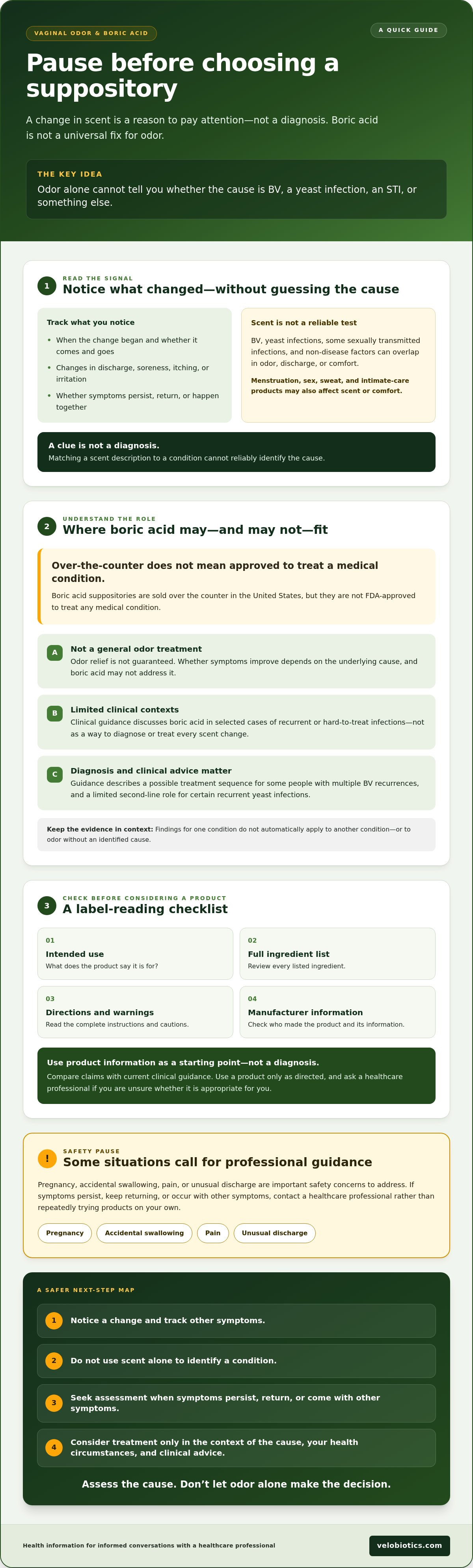
Boric acid suppositories are sold over the counter, but they aren’t FDA-approved to treat a medical condition, and they aren’t a universal fix for odor. The safer choice depends on what’s causing the change, your health circumstances, and the product’s label. This guide explains where boric acid may fit in clinical care, what safety questions to resolve before considering a vaginal suppository, and when an assessment by a healthcare professional is a better next step. You’ll also learn why pregnancy, accidental swallowing, and symptoms such as pain or unusual discharge matter, so you can make an informed decision without guessing or delaying needed care.
Key Takeaways
- Track changes in odor alongside other symptoms; scent alone can’t identify the cause.
- Learn where boric acid suppositories for vaginal odor fit, and why they shouldn’t replace an assessment or a confirmed treatment plan.
- Before considering a vaginal suppository, check its intended use, full ingredient list, directions, warnings, and manufacturer information.
- Use a product only as directed, and get professional advice if you’re unsure whether it’s appropriate for you.
- Compare product claims with current clinical guidance, and treat product information as a starting point, not a diagnosis.
Vaginal Odor: What a Change Can, and Cannot, Tell You
Vaginal scent can vary over time, and a change by itself doesn’t tell you what caused it. If you’re considering boric acid suppositories for vaginal odor, start by treating odor as a signal to pay attention to, not proof that you have a particular condition. Boric acid vaginal suppositories are solid products intended for insertion into the vagina, where they release boric acid; they’re not a way to identify the cause of a new scent.
People may notice a different odor, a change in discharge, discomfort, itching, or irritation. These details can help you decide what to do next, especially if symptoms persist, return, or occur together. They can’t reliably confirm bacterial vaginosis (BV), a yeast infection, or another condition.
A creator video discusses boric acid and odor. Treat it as a personal perspective, not a diagnosis or a substitute for clinical guidance.
What kinds of vaginal odor changes should readers notice?
Notice what’s different from your usual pattern, when it began, whether it comes and goes, and whether discharge, soreness, itching, or irritation changed too. Menstruation, sex, sweat, and intimate-care products may affect scent or comfort. Avoid matching an odor description to a diagnosis: several causes can overlap, and no single scent is a reliable test.
If a change persists or keeps returning, or comes with other symptoms, consider contacting a healthcare professional rather than repeatedly trying products on your own. A clinician can assess the full picture and determine whether testing or treatment is appropriate.
Why odor alone cannot identify the cause
BV, yeast infections, some sexually transmitted infections, and non-disease factors can produce overlapping changes in odor, discharge, or comfort. Self-assessment can’t reliably confirm BV or distinguish it from another cause. For separate context on vaginal bacteria and probiotics, read this doctor’s guide to probiotics for BV.
An odor change is a clue to assess, not a confirmed medical diagnosis. Boric acid has been used vaginally in some clinical contexts, but odor alone doesn’t establish that it’s appropriate. For background on its reported medical uses, see Boric acid medical uses; this overview isn’t a substitute for current clinical guidance. Velobiotics’ Femina Probiotic COOKIE FRESH Suppositories with Boric Acid page is product information, not a diagnosis or evidence that the product treats odor.
How Boric Acid Suppositories Relate to Vaginal Odor
Boric acid has been used vaginally in certain clinical contexts, but that doesn’t make it a general treatment for odor. Clinical guidance discusses it for selected cases of recurrent or hard-to-treat vaginal infections, not as a way to diagnose or treat every possible cause of a scent change. For example, the CDC describes it as one part of a possible treatment sequence for some people with multiple recurrences of bacterial vaginosis, while guidance also recognizes a limited, second-line role for certain recurrent yeast infections. These situations call for a confirmed diagnosis and appropriate clinical advice.
In the United States, boric acid suppositories are sold over the counter, but they aren’t FDA-approved to treat any medical condition. Cleveland Clinic’s Boric Acid Vaginal Suppository guide outlines use and safety considerations. As Cleveland Clinic’s guidance makes clear, information about boric acid’s medical uses is not a recommendation to use a particular product for odor. Odor relief isn’t guaranteed; whether symptoms improve depends on the underlying cause, and boric acid may not address it.
What to verify about the evidence and intended use
Look for evidence and clinical guidance that match the specific condition being discussed. Findings about recurrent yeast infections, for instance, can’t be assumed to apply to BV, another infection, or odor without an identified cause. Before relying on a product claim, check what condition the claim refers to, whether it matches current medical guidance, and whether the product label supports the stated use. A familiar ingredient name alone doesn’t establish effectiveness for your situation.
Boric acid alone versus a boric-acid-and-probiotic product
A combination product isn’t automatically more effective or appropriate than a product containing boric acid alone. Each ingredient needs its own evidence for the intended purpose, and evidence about probiotics doesn’t prove that boric acid works better when paired with one. The confirmed product names include Femina Probiotic COOKIE FRESH Suppositories with Boric Acid and Femina COOKIE FRESH Boric Acid ONLY Suppositories, but names alone don’t establish full ingredients, directions, safety, or outcomes. Review the actual label rather than assuming details from the name.
For a separate explanation of how probiotic delivery is studied, see the science of probiotic delivery. That discussion concerns probiotics, not proof of boric acid efficacy. The selenium collection is also unrelated to vaginal odor and isn’t presented as an odor treatment.
If you’re comparing product information, keep the question specific: does the label explain what’s inside and how it should be used, and does a healthcare professional agree it fits your situation? A product page can help you review details, but it can’t confirm the cause of odor or replace a treatment recommendation.
Compare Boric Acid Suppositories Using Evidence and Label Details
Comparing boric acid suppositories for vaginal odor isn’t about picking the product with the boldest promise. It’s about checking whether the label gives clear, relevant information and whether the intended use fits current clinical guidance. A product name or ingredient list alone can’t show that a suppository is suitable for your symptoms or will relieve odor.
Which label details and claims should you check?
Read the package and product information before considering use. Look for the details below, and pause if anything is missing or confusing.
| Information to check | What to look for |
|---|---|
| Intended use | A clear explanation of what the product is meant for. Be cautious of broad promises to eliminate odor without identifying its possible cause. |
| Ingredients | A complete list, including any additional active or inactive ingredients. Don’t assume a product contains something just because its name suggests it. |
| Directions | Specific instructions for use. Don’t guess about how much to use or how often. |
| Warnings | Contraindications, potential risks, and when to avoid use or seek medical advice. |
| Manufacturer information | A manufacturer name and a way to contact the company with questions about the label. |
Compare any health claims with current clinical guidance, not just advertising language. If directions, ingredients, or warnings aren’t clear, ask a pharmacist or healthcare professional before using the product.
How to assess the two confirmed Femina product names
The confirmed names are Femina Probiotic COOKIE FRESH Suppositories with Boric Acid and Femina COOKIE FRESH Boric Acid ONLY Suppositories. The names distinguish how each product is described, but they don’t establish the complete formulation, directions, safety, clinical evidence, or comparative effectiveness. Don’t infer that a product is more suitable or more effective based on the word “probiotic” or “ONLY.”
You can review the Femina boric acid and probiotic suppositories product information, then compare it with the label and guidance from a qualified clinician. The other confirmed product name is Femina COOKIE FRESH Boric Acid ONLY Suppositories. Check its current product information and packaging directly as well. Neither name is evidence that a product treats the cause of vaginal odor.
A useful comparison answers what’s in the product, how the label says to use it, and what warnings apply. If those answers don’t resolve whether it’s appropriate for you, get professional advice rather than choosing by marketing claims alone.
Safety Checks Before Considering a Vaginal Suppository
Before considering boric acid suppositories for vaginal odor, check whether they’re appropriate for you, not just whether the product is easy to buy. Boric acid is for vaginal use only and can be harmful if swallowed. Follow the exact product label, and don’t treat different vaginal products as interchangeable: ingredients, instructions, and warnings can vary.
When to ask a clinician or pharmacist first
Don’t use boric acid suppositories during pregnancy. Ask a healthcare professional before considering one if you might be pregnant, have open sores or wounds in the vaginal area, have other health concerns, or aren’t sure what’s causing the odor. Boric acid can also cause irritation for some people; stop and seek advice if use brings new or worsening discomfort.
Persistent or recurring odor, or a change accompanied by other symptoms, is a reason to seek professional assessment rather than repeatedly trying a product. Symptoms can overlap across different causes, and a clinician can help determine whether an examination, testing, or another next step is appropriate.
Common mistakes that can delay appropriate care
- Swallowing a suppository: Never take it by mouth. Boric acid is toxic and can be fatal if swallowed in large amounts. Keep it out of reach of children and pets. If someone swallows one, contact Poison Control or emergency medical services promptly for guidance.
- Reusing a previous approach: A returning odor doesn’t confirm that the cause is the same as before. Seek assessment instead of assuming a prior product or treatment is right again.
- Changing the directions: Don’t use more than the label directs, combine treatments, or continue despite irritation without professional advice. If directions are unclear, ask a pharmacist or clinician.
Boric acid may weaken latex condoms and diaphragms, which can reduce their effectiveness; check the product warning and ask a healthcare professional about suitable precautions during use.
Seek professional guidance first if you’re pregnant or might be, have a health concern or unclear symptoms, or experience persistent or recurring changes. For any vaginal suppository, use only as its label directs and confirm with a clinician or pharmacist if you’re unsure it’s suitable.
Choose a Safer Next Step for Vaginal Odor
A clear plan can help turn uncertainty into a useful next step. Rather than choosing boric acid suppositories for vaginal odor based on scent alone, collect the details that can help you and a healthcare professional decide whether assessment or a product is appropriate.
A practical checklist before choosing
- Note what changed. Write down when the odor began, whether it persists or returns, and any changes in discharge, discomfort, itching, or irritation. These details can help guide a conversation with a clinician, but they don’t diagnose the cause.
- Check the product information. Confirm the complete ingredients, intended use, directions, and warnings on the product label. Don’t assume a name tells you everything about the formulation or how to use it.
- Pause if you’re unsure. If symptoms persist, recur, concern you, or come with other changes, seek professional assessment rather than repeatedly selecting a product on your own. Ask a pharmacist or clinician if you can’t interpret a label or aren’t sure a product is suitable.
A product page can help you review available information, but it can’t identify the cause of odor or replace a clinical assessment. The confirmed Femina product pages are Femina Probiotic COOKIE FRESH Suppositories with Boric Acid and Femina COOKIE FRESH Boric Acid ONLY Suppositories. Consider them product-information pages, not recommendations for vaginal odor or proof of treatment effectiveness. Review the current label and discuss suitability with a healthcare professional when needed.
For additional background on bacterial vaginosis and the vaginal microbiome, read this BV guide. It’s educational context, not a way to confirm that BV is causing your symptoms or to choose treatment without assessment.
Keep product categories clear: the selenium collection is a separate product category, not a vaginal-odor product or treatment. If you browse it, do so for selenium products, not as a solution to odor.
The safest next step is the one that matches the evidence and your circumstances. If the cause isn’t clear, getting assessed is more useful than guessing from a symptom or a product description.
Choose Your Next Step With Confidence
A change in vaginal odor is a reason to pay attention, not a diagnosis. The right next step depends on what’s causing it, so boric acid suppositories for vaginal odor shouldn’t be treated as a one-size-fits-all answer. Evidence for boric acid relates to specific clinical situations, and it doesn’t establish that a product will relieve odor in every case.
If you’re reviewing the confirmed Femina boric-acid product names, check the current label for ingredients, intended use, directions, and warnings. The names alone don’t verify a product’s safety, effectiveness, or suitability for your symptoms. If odor persists, returns, or comes with other concerns, professional assessment can help you avoid guessing or delaying appropriate care.
For transparency, the selenium collection is a separate product category, not an intimate-health product or vaginal-odor treatment. Explore it if you’re interested in selenium products, and keep your next step for vaginal odor guided by reliable product information and appropriate clinical advice.
You deserve clear information and care without embarrassment. Take the next step that feels informed and right for your health.
Frequently Asked Questions
Can boric acid suppositories help with vaginal odor?
They may be considered in specific clinical situations, but boric acid suppositories for vaginal odor aren’t a guaranteed or general-purpose solution. Boric acid has a limited role in care for certain recurrent vaginal infections, which requires identifying the cause and getting appropriate guidance. Odor can have different causes, and a suppository may not address yours. If the change persists, returns, or comes with other symptoms, seek professional assessment rather than relying on odor alone.
Is vaginal odor always a sign of an infection?
No. Odor can vary, and a change by itself doesn’t confirm an infection. Infections and non-disease factors can produce overlapping changes in scent, discharge, or comfort, so smell alone can’t reliably identify the cause. Notice when the change started and whether other symptoms appeared. If the odor concerns you, persists, or recurs, a healthcare professional can help determine whether an assessment or testing is appropriate.
How do I know whether boric acid suppositories are right for me?
Don’t decide from odor alone. Check whether current clinical guidance supports boric acid for the specific condition diagnosed, then read the product label for intended use, full ingredients, directions, and warnings. Your circumstances matter too: boric acid shouldn’t be used during pregnancy, and a clinician or pharmacist can advise about health concerns or unclear instructions. If the cause of your symptoms isn’t known, get assessed before choosing a suppository.
Can I use boric acid suppositories during pregnancy?
No. Current safety guidance advises against using boric acid suppositories during pregnancy because of potential harm to the fetus. If you’re pregnant, might be pregnant, or are planning a pregnancy, don’t start one without speaking with a qualified healthcare professional. Ask a clinician about the odor or other symptoms and what options are appropriate for your situation. If you’ve already used a suppository and are concerned, contact your healthcare provider for individualized advice.
What happens if vaginal odor returns after using a suppository?
A returning odor doesn’t prove that the original cause is still present or that it’s the same cause as before. Symptoms can overlap, and a product may not address the underlying reason for the change. Avoid automatically repeating or extending use. Note when the odor returned and any accompanying changes, then seek professional assessment, especially if symptoms persist, recur, or are worrying you.
Are boric-acid-only suppositories better than boric acid with probiotics?
Not based on the formulation name alone. The presence of a probiotic doesn’t establish that a product is more effective, safer, or more suitable, and a boric-acid-only label doesn’t prove superiority either. Check the complete ingredients, directions, warnings, and evidence for the specific product and intended use. If you’re unsure how a product fits your circumstances, ask a clinician or pharmacist before using it.
When should I seek medical advice about vaginal odor?
Seek professional advice if the odor persists, returns, concerns you, or occurs with changes such as unusual discharge, itching, irritation, or discomfort. These symptoms don’t identify a particular condition, but they may help a clinician decide whether an assessment or testing is needed. Don’t keep trying suppositories or assume a previous diagnosis still applies. If symptoms feel severe or worsen quickly, seek prompt medical care.

Disclaimer
Information and statements regarding dietary supplements/products have not been evaluated by the Food and Drug Administration, MCC/SAHPRA, MHRA, TGA or any other drug regulatory authority and are not intended to diagnose, treat, cure, or prevent any disease. Information on this website is provided for informational purposes only and is a result of years of practice and experience by the author. This information is not intended as a substitute for the advice provided by your physician or other healthcare professional or any information contained on or in any product label or packaging. Do not use the information on this website for diagnosing or treating a health problem or disease, or prescribing medication or other treatment. Always speak with your physician or other healthcare professional before taking any medication or nutritional, herbal, or homeopathic supplement, or using any treatment for a health problem. If you have or suspect that you have a medical problem, contact your healthcare provider promptly. Do not disregard professional medical advice or delay in seeking professional advice because of something you have read on this website.