

Children's Probiotic Supplements: A Doctor-Founder’s 2026 Buying Guide to Gut Health
What if I told you that nearly 90% of the beneficial bacteria in your current probiotic are destroyed by stomach acid before they ever reach the gut? As a doctor and founder, I've met so many parents who invest in children's probiotic supplements only to see zero results because the delicate microorganisms couldn't survive the journey through the digestive system. It's frustrating to spend your hard earned money on products that don't deliver, especially when you're trying to help your child recover from antibiotics or build a stronger immune system for the school season.
I understand that deciphering clinical labels feels like reading ancient hieroglyphics, and the last thing you need is another battle over swallowing pills. In this 2026 guide, you'll learn exactly how to choose a supplement that actually survives gastric acid to provide real immune and digestive support. We'll explore the breakthrough science of micro-encapsulation, the specific strains that target constipation, and the precise markers of quality that ensure those beneficial bacteria reach your child's gut alive with 1000x more delivery than standard brands.
Key Takeaways
- Discover why your child’s microbiome is their most vital "invisible organ" and how to shield it from the gut-stripping effects of modern processed diets.
- Learn why a high CFU count is only half the story and how the "Stomach Acid Barrier" kills 90% of unprotected bacteria before they can help.
- Navigate the "candy trap" with a doctor’s guide to choosing children's probiotic supplements that prioritize real survival over sugary taste.
- Use our clinical checklist to match specific strains to your child’s needs, targeting everything from "tummy troubles" to robust immune defense.
- Find out how patented micro-encapsulation ensures 16 diverse strains actually reach the gut alive, delivering 1000x more potency than standard brands.
Why Your Child’s Microbiome is Their Most Important 'Invisible Organ'
Think of your child's gut as a bustling internal city. This complex ecosystem, known as the microbiome, consists of trillions of bacteria that work around the clock to digest food, produce vitamins, and even regulate mood. It's their most important invisible organ. As a doctor and founder, I've seen how the foundation for this "gut garden" is laid during the first 1,000 days of life. This window, from conception to a child's second birthday, is a critical period for seeding the beneficial bacteria that will protect them for decades. When this garden flourishes, your child's health often follows suit.
Our modern world presents unique challenges to this delicate balance. We live in increasingly sterile environments that limit a child's exposure to diverse, helpful microbes. Pair this with a diet often high in processed sugars and the frequent, though sometimes necessary, use of antibiotics, and you have a recipe for a depleted microbiome. This is why many parents are now looking toward children's probiotic supplements to help bridge the gap and restore microbial diversity.
To better understand this concept, watch this helpful video:
The Gut-Immune Connection Explained
It's a medical fact that 70% to 80% of the immune system resides directly in the gut lining. These immune cells aren't just sitting there; they're constantly communicating with the bacteria in the microbiome. Think of "good" bacteria as drill sergeants that train the immune system to recognize real threats, like a nasty flu virus, while ignoring harmless triggers like pollen or certain foods. The gut-immune axis is the body's internal security training center. Research into Probiotics in children suggests that supporting this axis can lead to fewer seasonal sniffles and may even help manage skin sensitivities like eczema by calming overactive immune responses.
When Does a Child Actually Need a Supplement?
You don't need to supplement every child every day, but you should watch for specific signs of an imbalanced gut. Common red flags include persistent bloating, irregular bowel movements, or intense cravings for sugary snacks, which often feed the "bad" bacteria. Another major factor is the "Antibiotic Gap." While a five-day course of antibiotics can clear an ear infection, it can also wipe out vast colonies of beneficial microbes. This leaves a vacancy that opportunistic bacteria are happy to fill. Using high-quality children's probiotic supplements during and after antibiotic treatment provides the necessary reinforcements to ensure a healthy microbial community can rebuild quickly and effectively.
The Probiotic Survival Gap: Why CFU Counts Can Be Deceiving
Most parents look at a bottle of children's probiotic supplements and head straight for the biggest number. They see "50 Billion CFU" and assume it's automatically superior to a product with "5 Billion." As a doctor, I'm here to tell you that this is a common marketing trap. CFU stands for Colony Forming Units, which is a head count of the live bacteria present at the time of bottling. However, that number is only half the story. If those bacteria don't reach the lower intestine alive, they're effectively useless. This expert dietician answers all your questions about why the sheer volume on the label isn't the only factor you should consider when shopping.
The real challenge is what I call the "Stomach Acid Barrier." Your child's stomach is a harsh, highly acidic environment designed to break down food and kill harmful pathogens. Unfortunately, gastric acid doesn't distinguish between "bad" bacteria and the "good" probiotics you just purchased. Research indicates that up to 90% of unprotected probiotics are destroyed by stomach acid within minutes of ingestion. This creates a massive gap between the "input" (what the label promises) and the actual "delivery" (what reaches the gut). If a supplement starts with 10 billion units but 9 billion die in the stomach, your child won't receive the clinical dose required to see actual health improvements.
The Science of Micro-encapsulation
To solve this survival problem, we utilize a patented technology called Velobiotics™. Think of it as a microscopic survival suit for delicate bacteria. We use a unique fatty acid complex to shield each individual cell from moisture and acid. Our specific process ensures 1000x more delivery of live bacteria to the gut compared to standard, non-encapsulated brands. When the bacteria reach the alkaline environment of the lower intestine, the protective layer dissolves. This allows the probiotics to colonize and flourish exactly where they're needed most. Reaching the gut alive is the only way to ensure the clinical benefits of the supplement are actually realized.
Reading Labels Like a Pro
Don't just look for a generic name like "Lactobacillus." You should look for the specific strain designation, such as GG or HN019. These letters and numbers are the "social security numbers" of bacteria, identifying the exact version used in successful clinical trials. It's also vital to check for "shelf-stability" versus "at time of manufacture" claims. Many brands only guarantee the CFU count the day the product is made, meaning the bacteria might be dead before you even open the bottle. For a formula specifically engineered to survive the journey from the shelf to the gut, you can explore our Biokid chewable probiotics which use our patented delivery system to maintain maximum potency.
Gummies, Powders, or Tablets? A Format Comparison for 2026
Choosing the right format for children's probiotic supplements isn't just about what your child will actually swallow. It's about ensuring the "good guys" actually survive the journey to the gut. As a doctor and a founder, I've seen parents struggle with this choice for years. In 2026, the technology has evolved, but the marketing traps remain the same. We need to look past the bright packaging and focus on the delivery system.
- Liquid Drops: These are essential for newborns and infants who cannot chew. However, they usually lack strain diversity, often providing only one or two specific strains.
- Powders: These offer flexibility for mixing into cold food. The downside is that dosing becomes a guessing game once you're dealing with active toddlers who might only eat half their meal.
- Chewable Tablets: This is the gold standard for stability. They allow for complex, multi-strain formulas that stay potent on the shelf.
The Hidden Cost of Gummy Probiotics
Most parents reach for gummies because they're easy. However, these are often just glorified candy. A typical gummy can contain 2 to 3 grams of sugar or corn syrup. This is a massive clinical oversight because sugar actually feeds the "bad" bacteria you're trying to crowd out. Furthermore, the manufacturing process for gummies involves heat and moisture. These are the natural enemies of probiotics. By the time your child chews that gummy, the CFU count has often plummeted due to exposure to air and light. If you want the full breakdown on this survival issue, check out my Children's Probiotic Gummies Comparison.
Why Chewable Tablets Win for School-Aged Kids
For children aged four and up, chewable tablets are the clinical winner. They provide a stable, dry environment for complex formulas. Unlike gummies, tablets can be manufactured using advanced micro-encapsulation. This technology protects the delicate bacteria from harsh gastric acid, ensuring they reach the gut alive. I formulated BioKid Chewable Probiotics specifically to solve this "survival gap" that many brands ignore.
Using a dry compression process keeps the strains dormant and protected until they hit the right spot in the digestive tract. This allows us to include 10 or more diverse strains in a single serving. It's the most reliable way to support a developing microbiome without the stability issues found in liquids or the sugar found in gummies. When you choose a tablet, you're choosing a delivery system that prioritizes biology over confectionery appeal.
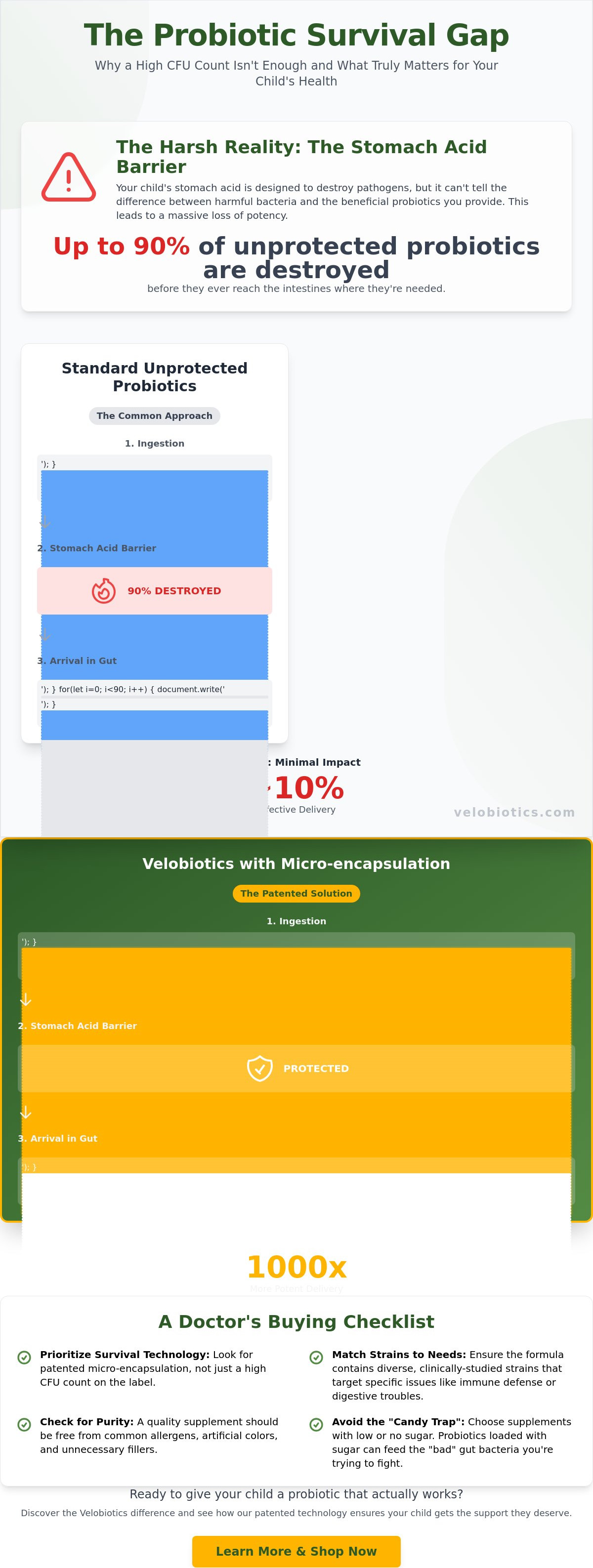
A Doctor’s Buying Checklist: Matching Strains to Health Goals
Choosing children's probiotic supplements shouldn't feel like a guessing game. As a doctor, I look at the microbiome through a lens of clinical precision. Different health goals require specific bacterial "specialists" to get the job done. If you want results, you must match the strain to the struggle.
- Immune Support: Look for Lactobacillus rhamnosus and Bifidobacterium animalis lactis. Research shows these strains help prime the immune system, which is vital since nearly 80 percent of immune cells live in the gut.
- Digestive Comfort: For "tummy troubles" and irregular bowel movements, specific Bifidobacterium strains help break down food and keep things moving. This reduces the bloating and discomfort that often disrupt a child's day.
- The Antibiotic Shield: Antibiotics are necessary but can act like a forest fire in the gut. You need high-potency recovery strains during and after medication. Our Velobiotics technology ensures 1000x more delivery of these beneficial bacteria, helping them reach the gut alive to repair the damage.
- Picky Eaters: If your child avoids fiber, their good bacteria are likely starving. This is where prebiotics come in, acting as the essential fertilizer for your child’s internal garden.
Age-Specific Recommendations
Toddlers aged 1 to 3 require gentle colonization. Their microbiomes are still forming, so focus on immune priming and basic digestive support. You can find more detail in this guide on Probiotics for 2 Year Olds. For school-aged children (4 to 12), the focus shifts to resilience. They face schoolyard germs and more diverse, sometimes processed, diets. They need robust strains that can survive the harsh environment of the stomach to provide real protection.
The Prebiotic Factor
A high-quality supplement shouldn't arrive alone. It needs prebiotics like Inulin or Fructooligosaccharides (FOS). Think of probiotics as the seeds and prebiotics as the nutrient-rich soil. Without this "food," even the best bacteria might struggle to flourish once they arrive. Prebiotics ensure that the beneficial colonies have the energy to multiply and crowd out harmful pathogens. For a deeper dive into these "gut fertilizers," check out this Prebiotics for Kids Guide.
When you select children's probiotic supplements, remember that survival is the only metric that matters. If the bacteria die in the stomach acid, they can't help your child. Our micro-encapsulation process solves this "probiotic gap" by shielding every cell until it reaches the lower GI tract.
The Velobiotics Difference: Why We Built a Better Probiotic
I spent years in clinical practice watching parents struggle to find children's probiotic supplements that actually produced results. Most products on the market suffer from what I call the Probiotic Gap. This is the massive discrepancy between the billions of cultures printed on the label and the tiny fraction that actually survive the journey to the colon. I founded Velobiotics to bridge this gap using hard science rather than marketing fluff. We didn't just want to make another supplement; we wanted to engineer a delivery system that works.
A child's microbiome is a complex, evolving ecosystem. Diversity is the cornerstone of a resilient gut, which is why we include a 16-strain advantage. While many brands rely on one or two cheap strains, we provide a broad spectrum of beneficial bacteria to mirror the natural diversity found in a healthy human gut. Every batch is non-GMO, gluten-free, and undergoes rigorous third-party testing. We believe parents deserve absolute peace of mind regarding the purity of what they give their kids.
Our secret weapon is our patented Velobiotics™ technology. This micro-encapsulation process protects the delicate bacteria from the two biggest probiotic killers: heat and moisture. Whether the bottle sits in a warm pantry or travels in a backpack, the bacteria remain dormant and protected. Once swallowed, this shield also defends against harsh gastric acid, ensuring the probiotics reach your gut alive where they can actually do their job.
BioKid: Clinical Grade, Kid-Approved
We designed BioKid to be the gold standard for pediatric gut health. It features 16 diverse strains that are all protected by our signature Velobiotics™ technology. We've eliminated the sugar found in most gummies, creating a clean, delicious formula that kids look forward to taking every morning. Our 1000x more delivery guarantee provides the ultimate parent's peace of mind, ensuring your child receives the full potency promised on the bottle.
Start the Gut Health Journey Today
The best way to see results is consistency. I recommend making BioKid a morning ritual alongside breakfast. This helps build a habit that supports long-term wellness. When starting children's probiotic supplements, it's normal to notice a brief adjustment period of 3 to 5 days where your child might experience slight changes in digestion. This is a sign the microbiome is rebalancing. Within a few weeks, the long-term benefits of improved digestion and immune support become much more evident.
Ready to support your child's microbiome with science-backed technology? Shop BioKid Chewable Probiotics today and experience the 1000x delivery difference.
Empower Your Child’s Microbiome Today
Building a resilient foundation for your child's health starts with looking past the flashy marketing on the supplement aisle. You've learned that high CFU counts are meaningless if the bacteria don't survive the harsh environment of gastric acid. By 2026, the scientific standard for children's probiotic supplements has shifted from "how many" to "how many actually arrive alive." We've identified that a diverse profile of 16 clinical strains provides the broad-spectrum support your little one's "invisible organ" requires to flourish.
I founded Velobiotics to solve the survival gap. Our patented Velobiotics™ technology uses a unique micro-encapsulation process to ensure 1000x more delivery of good bacteria directly to the gut compared to non-encapsulated alternatives. This doctor-formulated approach isn't about guesswork; it's about verified clinical protection that fits into your daily routine. You can move forward with the confidence that you're providing the best possible support for their developing immune system and digestive health.
Give your child's gut 1000x more protection with BioKid™
Your journey toward better family wellness is a marathon, not a sprint, and I'm honored to help you navigate the science every step of the way.
Frequently Asked Questions
Are children's probiotic supplements safe for every day use?
Yes, daily children's probiotic supplements are generally safe and effective for long term gut support. A 2023 clinical review confirmed that healthy children can safely consume these beneficial bacteria for 180 consecutive days without adverse effects. Consistent dosing helps maintain a balanced microbiome. Our micro-encapsulation technology ensures these colonies survive the harsh journey through the stomach, providing 1000x more delivery than standard options.
What is the best time of day for a child to take a probiotic?
The most effective time for your child to take a probiotic is 30 minutes before breakfast or right as they start a meal. Studies published in the Journal of Food Science indicate that bacterial survival rates are highest when stomach acid is at its lowest pH levels. By timing the dose correctly, you ensure more "good bugs" reach the intestinal tract alive. This simple routine helps the microbiome flourish throughout the busy school day.
Can my child take probiotics while on antibiotics?
You should absolutely give your child probiotics during an antibiotic course, provided you space the doses by at least 3 hours. Research from 2022 shows that co-administration reduces the risk of antibiotic-associated diarrhea by 52 percent. Antibiotics act like a forest fire for gut bacteria, so replenishing those colonies is vital. Using a protected delivery system ensures the probiotic survives long enough to provide that essential protection during recovery.
How long does it take to see results from a children's probiotic?
Most parents observe improvements in their child's digestive comfort within 7 to 14 days of consistent use. For deeper immune system benefits, a 2021 study showed that it takes approximately 28 days for the microbiome to reach a new, stable equilibrium. Don't expect an overnight miracle. It's a biological process of "re-seeding" the gut. Consistency is the secret to seeing those 1000x delivery benefits manifest in real-world vitality.
Do children's probiotics need to be refrigerated?
It depends on the technology, but children's probiotic supplements using Velobiotics™ technology are shelf-stable at room temperatures up to 25 degrees Celsius. Traditional probiotics often lose 90 percent of their potency within 60 days if left on a counter. Our patented micro-encapsulation protects the delicate bacteria from heat and moisture. This means you can keep them in the pantry or a backpack without worrying about the bacteria dying before they reach the gut.
Can a child get too many probiotics?
It's very difficult to "overdose" on probiotics, though exceeding 50 billion CFU might cause temporary gas or mild bloating in some kids. The National Institutes of Health suggests that a daily dose of 5 to 10 billion CFU is the "sweet spot" for pediatric health. If your child accidentally eats an extra gummy, they'll likely be fine. Just monitor them for 24 hours. The goal is balance, not just sheer volume.
What should I look for on a probiotic label to ensure it's effective?
You must look for the specific strain designation, such as Lactobacillus rhamnosus GG, and a "live arrival" guarantee. Over 80 percent of standard probiotics perish in gastric acid before they can help your child. Check for clinical evidence of survival or micro-encapsulation technology. A high CFU count doesn't matter if the bacteria don't reach the gut alive. Our 1000x more delivery system solves this "probiotic gap" directly.

Disclaimer
Information and statements regarding dietary supplements/products have not been evaluated by the Food and Drug Administration, MCC/SAHPRA, MHRA, TGA or any other drug regulatory authority and are not intended to diagnose, treat, cure, or prevent any disease. Information on this website is provided for informational purposes only and is a result of years of practice and experience by the author. This information is not intended as a substitute for the advice provided by your physician or other healthcare professional or any information contained on or in any product label or packaging. Do not use the information on this website for diagnosing or treating a health problem or disease, or prescribing medication or other treatment. Always speak with your physician or other healthcare professional before taking any medication or nutritional, herbal, or homeopathic supplement, or using any treatment for a health problem. If you have or suspect that you have a medical problem, contact your healthcare provider promptly. Do not disregard professional medical advice or delay in seeking professional advice because of something you have read on this website.