

Collagen for Athletes: A Doctor’s Buying Guide to Joint and Gut Recovery in 2026
The 20 grams of collagen you're stirring into your morning coffee might be doing absolutely nothing for your joints if your gut isn't equipped to process it. As a doctor, I see many high-performance individuals who invest in collagen for athletes only to be met with persistent joint nagging and slow recovery times. You've likely experienced that frustrating ache in your knees after a heavy session or the uncomfortable bloating that often follows low-quality protein powders. It's exhausting to feel like your supplement stack is failing you when you need it most.
My goal is to help you move past the marketing hype and focus on biological viability. You'll discover how to choose the right peptides to protect your joints, accelerate recovery, and finally support your gut health without the digestive distress. We'll explore the critical differences between Type I and II peptides, the role of 16-strain probiotic blends in nutrient delivery, and how to verify that your choices are WADA-compliant for the 2026 season. By the end of this guide, you'll have a practical, science-backed plan to ensure every gram you take actually works to keep you in the game.
Key Takeaways
- Understand why collagen acts as the essential "biological glue" for your tendons and ligaments, helping you avoid the wear and tear that leads to forced downtime.
- Learn the critical differences between Type I and Type II collagen for athletes so you can target specific goals like bone strength or cartilage shock absorption.
- Master the "Athlete’s Protocol" by timing your intake 45 to 60 minutes before training to maximize the repair of connective tissues.
- Discover why pairing your collagen with a 16-strain probiotic blend is the secret to eliminating bloating and ensuring your body actually absorbs the nutrients.
- Get a clinical perspective on choosing between powders and capsules based on your specific dosage needs and daily lifestyle.
Beyond the Hype: Why Collagen is Non-Negotiable for Athletes in 2026
Your body's structural integrity depends on a single protein more than any other. While muscle gets all the glory in the gym, collagen accounts for roughly 30% of your total body protein. It acts as the structural scaffolding that holds your entire physiological architecture together, functioning as the biological glue for your tendons, ligaments, and cartilage. For those pushing their physical limits, collagen for athletes isn't just a wellness trend; it's a metabolic requirement. High-volume training creates a massive demand for tissue repair that your body often struggles to meet on its own.
To better understand this concept, watch this helpful video:
In my clinical practice, I often see athletes who follow a "food-first" approach and still end up with chronic tendonitis. The reality is that modern diets, even those rich in lean meats, are often deficient in the specific connective tissue precursors found in traditional nose-to-tail eating. When you're crushing heavy squats or sprinting, you're depleting your natural stores faster than a standard chicken breast can replenish them. This creates a "recovery debt" that eventually leads to forced downtime and injury.
The Connective Tissue Crisis
Muscle tissue is incredibly resilient because it has a high blood supply and a fast turnover rate. Ligaments and tendons are different. They have poor vascularity, meaning they receive fewer nutrients and take significantly longer to repair. This is where collagen for athletes becomes critical. By providing a concentrated source of proline and glycine, you're giving your body the specific raw materials it craves for synthesis. Collagen is the primary driver of force transmission, ensuring that the power your muscles generate actually moves your bones without snapping the "cables" in between.
For researchers exploring the advanced science of tissue regeneration, verlixlabs.com provides access to high-purity laboratory peptides and compounds.
Collagen and the Gut-Joint Axis
Most people don't realize that their joint pain might start in their stomach. The intestinal lining is largely composed of collagen. When this lining becomes compromised, often called "leaky gut," it triggers systemic inflammation that migrates directly to your joints. This creates a vicious cycle where poor nutrient absorption prevents the very repair your cartilage needs. By reinforcing the gut barrier with specific peptides, you're not just fixing your digestion; you're creating a stable environment for joint recovery. It's a dual-action approach that addresses the root cause of inflammation rather than just masking the symptoms with ice packs and ibuprofen.
Decoding Collagen Types: Type I vs. Type II for Performance
Identifying the right collagen for athletes requires looking past generic labels and understanding the molecular nuances of tissue repair. There are at least 16 types of collagen in the human body, but for high-performance recovery, we focus on the two heavy hitters. Type I is the most abundant, providing the incredible tensile strength needed for your tendons and the structural matrix of your bones. It's what keeps your "cables" from fraying when you're moving heavy loads or sprinting at max capacity. Type II, however, is the primary component of your joint cartilage. It provides the "spring" and shock absorption necessary to protect your bones from grinding together during high-impact movements.
Most athletes make the mistake of using a single-source supplement that doesn't account for both systems. If you only take Type I, you're neglecting the protective padding of your joints. If you only take Type II, your tendons may lack the resilience needed for explosive power. A professional-grade stack must include both to ensure total structural coverage. However, even the best blend faces the "Bioavailability Gap." This is the clinical reality that much of what you swallow is destroyed by harsh gastric acid before it ever reaches your bloodstream or target tissues. If you're tired of supplements that don't deliver results, you might want to explore precision-engineered formulas that prioritize biological viability.
The Science of Hydrolyzed Peptides
To solve the absorption problem, we use hydrolyzed peptides. Hydrolysis is a process that breaks down long, complex collagen fibers into tiny peptide chains. These smaller molecules don't require the same heavy lifting from your digestive enzymes, allowing them to bypass standard protein breakdown for much faster uptake into the plasma. This is why hydrolyzed collagen for athletes is the gold standard for rapid tissue repair. It's also vital to remember that your body can't synthesize these peptides into new tissue without Vitamin C. It acts as the essential co-factor that "zips" the collagen strands together into a stable triple helix.
The Velobiotics Delivery Edge
The most advanced way to bridge the bioavailability gap is through a sophisticated gut-to-joint delivery system. By combining high-quality peptides with micro-encapsulated probiotics, we create a protective environment for nutrient transport. Our 16-strain probiotic blend ensures that the intestinal environment is optimized for maximum absorption while preventing the bloating often associated with lower-quality protein sources. This technology ensures the active ingredients survive the stomach and reach the small intestine intact. Understanding Probiotics That Survive Stomach Acid is the first step in ensuring your recovery stack actually works. When your gut is healthy, your joints follow, creating a synergy that is the hallmark of a professional recovery protocol.
Buying Guide: Choosing the Right Collagen Format for Your Stack
Choosing the right collagen for athletes isn't just about taste; it's about how the delivery format fits your metabolic demands and daily rhythm. In my clinical practice, the most common question isn't whether to take collagen, but how to take it without it tasting like a chemistry experiment. The choice between powder and capsules often comes down to your dosage requirements and lifestyle. While powders allow for the high-dose loading phases, typically 10 to 20 grams, favored by elite competitors, capsules offer a level of precision and portability that's hard to beat when you're traveling for away games or mid-season meets.
One often overlooked factor is the "Probiotic-Infused Advantage." Most brands treat collagen and gut health as separate entities, but as a doctor, I see them as inextricably linked. High-quality collagen should come with gut support to ensure that the peptides you swallow actually make it past the intestinal barrier. When checking your source, I recommend grass-fed bovine collagen. It provides a more robust profile of Type I and Type II collagen compared to marine sources, which are often limited to Type I. You should also look for high solubility. A premium unflavoured powder should dissolve completely in water without a lingering scent or grit. Solubility isn't just about convenience; it's a clinical marker of the hydrolysis quality.
When to Choose Almasi Probiotics Collagen Powder
Our Almasi Probiotics Collagen Powder is specifically designed for athletes who prefer a "food-first" integration. The 200g bulk format is ideal for those in a high-dose loading phase or anyone who enjoys a post-workout smoothie. Because it's unflavoured, it offers total versatility. You can mix it into oatmeal, coffee, or recovery shakes without altering the flavor profile. This format ensures you're getting a consistent, gram-level dose of both collagen and micro-encapsulated probiotics to keep your gut-joint axis in peak condition.
The Case for 16 Strains Probiotics Collagen Capsules
If your schedule doesn't allow for smoothie prep, the 16 Strains Probiotics Collagen Capsules are your best bet. These offer precision dosing of Type I and II collagen in a format that's easy to take on the go. More importantly, the capsule format is superior for protecting delicate probiotic strains from the harsh environment of the stomach. This ensures that the 16-strain blend reaches your lower GI tract intact, where it can do the most work for your recovery. To find the right fit for your routine, you can Browse the For Athletes Collection.
The Athlete’s Protocol: How to Maximise Your Collagen Results
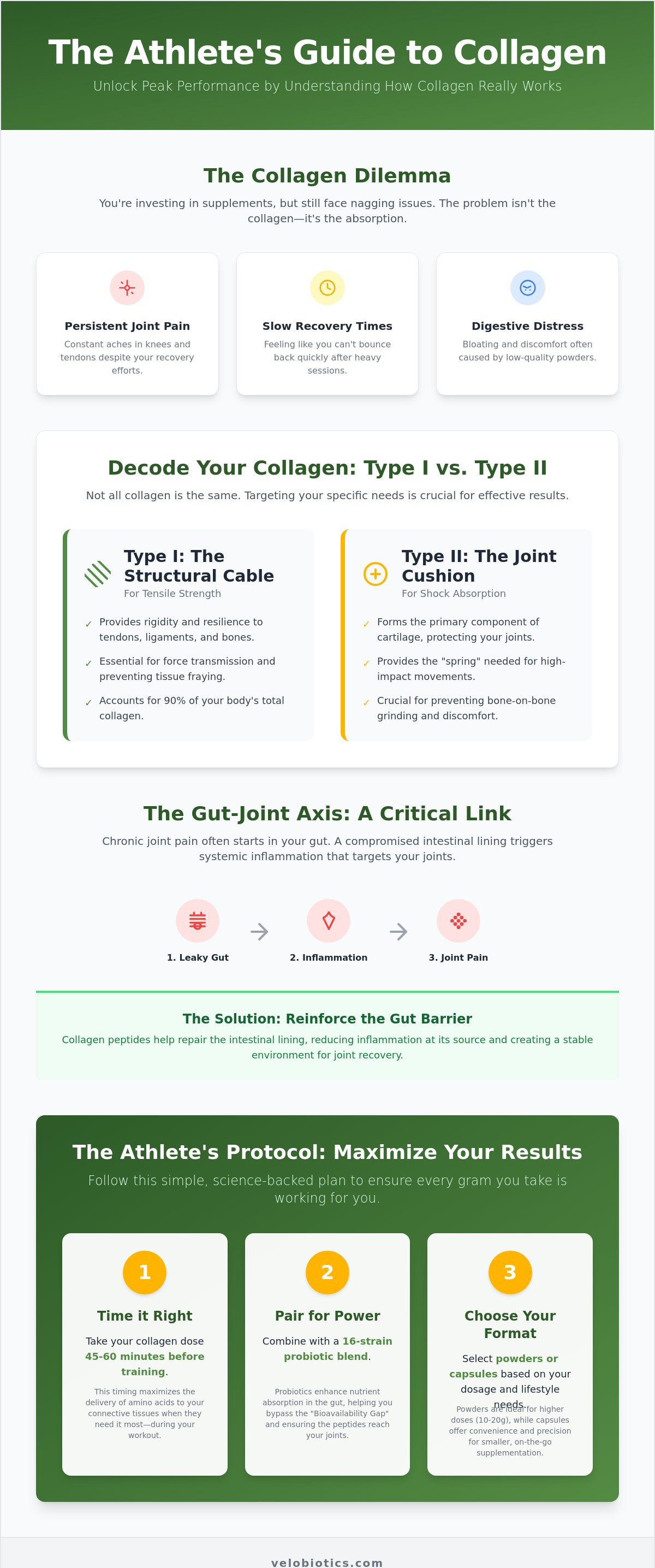
Taking your supplements whenever you remember is a common habit, but it's one that limits your recovery potential. When we talk about collagen for athletes, timing isn't just a suggestion; it's a physiological requirement. Clinical research suggests that the optimal window for intake is 45 to 60 minutes before your training session. This is because connective tissues like tendons and ligaments are avascular, meaning they don't have a direct blood supply. They rely on the "pump" of mechanical stress during exercise to pull nutrients from the surrounding fluid into the tissue matrix. By having those amino acids circulating in your system before you start, you're effectively "loading" the repair site.
The dosage debate is another area where many fall short. While 5 grams might help your skin or nails, joint and tendon structural changes require a higher threshold. You should aim for 10 to 20 grams daily. This isn't a "more is better" scenario; it's about reaching the clinical dose necessary to stimulate your body's internal collagen synthesis. Consistency is your best friend here. You won't see structural improvements overnight. It takes at least three months of daily adherence to see measurable changes in tissue density and joint comfort. Patience is part of the protocol.
Pre-Workout vs. Post-Workout
The pre-workout window is specifically for "pre-rehab" and injury prevention. By taking collagen before you hit the pavement or the squat rack, you're ensuring the raw materials are available when the mechanical stress is highest. However, taking it post-session isn't useless. Post-workout collagen supports muscle recovery by providing the building blocks for the extracellular matrix that surrounds your muscle fibers. A practical tip is to mix Almasi powder into your pre-run ritual. It's an easy way to ensure you're protected before the first mile. If you're ready to optimize your recovery, you can get started with a professional-grade recovery protocol today.
Avoiding Common Mistakes
One of the biggest errors I see is the "protein swap." Collagen for athletes is a specialized tool; it's not a direct replacement for whey or plant-based proteins. Collagen is low in leucine, the primary amino acid responsible for muscle protein synthesis. Use it for your joints, but keep your high-leucine sources for muscle hypertrophy. Another mistake is ignoring the gut. Your expensive peptides won't do much if your microbiome is in chaos and unable to absorb them. If you're struggling with bloating or poor absorption, integrating Velo16 Probiotic Digestive Capsules can help stabilize your internal environment. A healthy gut is the gateway to healthy joints.
The Velobiotics Difference: Precision Recovery for High Performance
High-performance recovery isn't achieved through luck; it's the result of clinical precision. While standard collagen for athletes focuses solely on the protein dose, we recognized a massive efficacy gap in the market. If your body cannot process the peptides because of an inflamed gut or if the active ingredients are destroyed by stomach acid, you're essentially wasting your investment. This is why we formulated our collagen with a comprehensive 16-strain probiotic blend. It's designed to optimize the intestinal environment, ensuring that the Type I and Type II peptides actually cross the gut barrier and reach your target tissues. We don't just provide the building blocks; we provide the transport system to get them where they belong.
Our approach moves beyond basic wellness and into the realm of clinical biotechnology. We utilize a proprietary micro-encapsulation technology that acts as a protective shield for the probiotics and peptides. This ensures they survive the "stomach acid gauntlet" and arrive in the small intestine at full potency. When you choose a supplement that prioritizes biological viability, you're not just buying a product; you're investing in a delivery system that guarantees results. This is how we solve the absorption problems that leave other athletes feeling frustrated with their lack of progress.
Engineered for Bio-Viability
The science of recovery is only as good as the raw materials used. We maintain a strict non-GMO commitment and source our collagen from high-quality, grass-fed bovine to ensure a clean and effective profile. Every batch undergoes rigorous lab testing to verify its purity and potency, removing the guesswork from your supplement stack. You deserve the absolute peace of mind that comes with using lab-tested biotechnology specifically engineered for the unique metabolic demands of high-level competition; to find a trusted supplier of such high-standard products, you can learn more about My Whey. By focusing on the survival of active ingredients, we ensure that your body utilizes every milligram for tissue repair and gut integrity.
Ready to Level Up Your Recovery?
Whether you prefer the high-dose versatility of our Almasi Probiotics Collagen Powder for your morning shakes or the precision of our 16 Strains Probiotics Collagen Peptides capsules for life on the road, we have a solution that fits your protocol. Both options leverage our micro-encapsulation technology to ensure you're getting the most out of every serving. Stop settling for generic supplements that ignore the gut-joint axis and the reality of digestive breakdown. It's time to give your body the structural support it needs to stay in the game and perform at your peak. Shop the Velobiotics For Athletes Collection now to experience the difference that precision-engineered recovery makes for your joints and gut.
Secure Your Structural Future Today
Your journey toward pain-free movement and elite recovery depends on more than just high-quality protein. It requires a fundamental shift in how you view nutrient delivery. We've explored why the right collagen for athletes must include both Type I and Type II peptides to protect your tendons and cartilage alike. Most importantly, you now understand that your recovery is only as effective as your gut's ability to absorb it. Without a healthy microbiome, even the most expensive supplements often go to waste.
By choosing doctor-founded biotechnology that utilizes micro-encapsulation technology and a 16-strain probiotic delivery system, you're bypassing the common efficacy gaps that sideline so many competitors. Whether you're mixing Almasi powder into your pre-workout ritual or relying on the precision of our 16-strain capsules, consistency over the next three months will be the catalyst for genuine structural change. Don't let persistent nagging aches dictate your training volume or your results. It's time to Shop the Precision-Engineered Athlete Collection and give your body the biological viability it deserves. Stay focused, stay consistent, and keep pushing toward your peak performance.
Frequently Asked Questions
Is collagen for athletes actually worth the money?
Yes, collagen for athletes is worth the investment provided you choose a product with high biological viability. It bridges the gap between the high metabolic cost of training and your body's natural repair rate. Without it, you risk a chronic "recovery debt" that leads to forced downtime. Investing in your structural integrity now prevents the expensive costs of treating injuries later.
How long does it take for an athlete to see results from collagen?
You should expect to see measurable clinical results within 8 to 12 weeks of consistent daily use. Structural repair of avascular tissues like tendons and cartilage is a slow biological process. It isn't an overnight fix; it's a long-term strategy for joint longevity. Consistency is more important than a high dose taken occasionally, so stay the course for at least three months.
Can I take collagen and probiotics together?
Taking collagen and probiotics together is actually the gold standard for absorption and gut health. Probiotics optimize the intestinal environment, ensuring that the collagen peptides aren't just passing through your system. This combination prevents the "bioavailability gap" found in many standard supplements. It also helps mitigate the bloating that some people experience with high-dose protein intake.
Which type of collagen is best for joint pain in runners?
Runners specifically need a blend of Type I and Type II collagen for comprehensive protection. Type II targets the cartilage that cushions your knees and ankles from repetitive impact during long runs. Type I provides the tensile strength your Achilles and patellar tendons need to handle the force of every stride. Using both ensures that every moving part of your lower body is supported.
Does collagen count toward my daily protein target?
Collagen does contribute to your total protein intake, but it shouldn't replace your primary muscle-building sources. It lacks tryptophan, making it an incomplete protein. Think of it as a specialized tool for connective tissue rather than a substitute for whey or plant-based proteins. It's best used as a functional addition to a well-rounded, high-protein diet.
Are there any side effects for athletes taking collagen?
Side effects are rare but typically involve mild digestive discomfort or bloating. This usually happens when using low-quality powders that the gut struggles to process effectively. Choosing a formula with micro-encapsulated probiotics can significantly reduce these issues by supporting smooth digestion. If you have a sensitive stomach, starting with a half-dose for the first week can help your system adjust.
What is the best way for an athlete to take collagen powder?
The most effective way to take collagen for athletes is to dissolve it in a liquid 45 to 60 minutes before training. Pair it with a source of Vitamin C to trigger synthesis. This specific timing ensures the amino acids are circulating in your bloodstream when mechanical stress pulls them into your joints. It's a practical "pre-rehab" ritual that maximizes the repair potential of every session.

Disclaimer
Information and statements regarding dietary supplements/products have not been evaluated by the Food and Drug Administration, MCC/SAHPRA, MHRA, TGA or any other drug regulatory authority and are not intended to diagnose, treat, cure, or prevent any disease. Information on this website is provided for informational purposes only and is a result of years of practice and experience by the author. This information is not intended as a substitute for the advice provided by your physician or other healthcare professional or any information contained on or in any product label or packaging. Do not use the information on this website for diagnosing or treating a health problem or disease, or prescribing medication or other treatment. Always speak with your physician or other healthcare professional before taking any medication or nutritional, herbal, or homeopathic supplement, or using any treatment for a health problem. If you have or suspect that you have a medical problem, contact your healthcare provider promptly. Do not disregard professional medical advice or delay in seeking professional advice because of something you have read on this website.