

Feeling Hopeless About Recurring Yeast Infections? A Doctor’s Guide to Breaking the Cycle
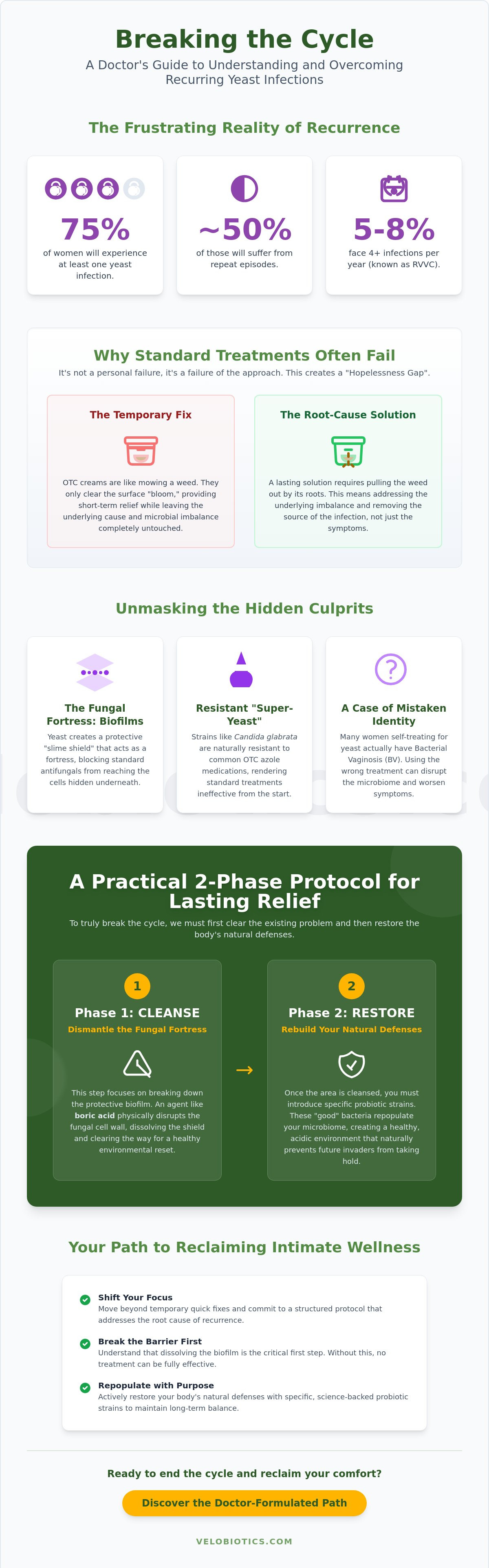
Did you know that while 75% of women will face a yeast infection at least once, nearly half will deal with the frustration of a second or third episode? If you're currently feeling hopeless about recurring yeast infections, please know that you aren't alone. Statistically, 5% to 8% of women experience four or more infections every single year, a condition medically defined as recurrent vulvovaginal candidiasis. It's incredibly draining to spend your money on over-the-counter creams that only provide a few days of peace before the familiar itching returns. You've likely followed all the standard advice, yet the cycle remains unbroken.
I'm here to tell you that this isn't a failure of your hygiene or your body; it's often a failure of standard treatments to address "biofilms." These are protective barriers yeast builds to shield itself from traditional antifungals. In this guide, I'll explain the scientific reasons why your previous efforts haven't stuck and provide a practical, doctor-led strategy to reclaim your intimate health. We'll look at the latest 2026 clinical data and explore how to move beyond temporary fixes to reach the actual root cause of your discomfort.
Key Takeaways
- Learn why your symptoms might actually be Bacterial Vaginosis or a resistant strain of yeast that standard antifungal creams simply can't touch.
- Discover how "biofilms" act as a protective shield for yeast, and why breaking this barrier is the critical first step to stopping the cycle of recurrence.
- Stop feeling hopeless about recurring yeast infections by shifting from temporary quick fixes to a structured two-phase protocol that cleanses and restores your microbiome.
- Understand the scientific mechanism behind boric acid and how it physically disrupts fungal cell walls to reset your internal environment.
- Identify the specific probiotic strains needed to repopulate your natural defenses and maintain a balanced, healthy intimate environment for the long term.
The Exhausting Cycle of Recurring Yeast Infections: Why OTCs Often Fail
Many women come into my office feeling completely defeated. They've spent a fortune on generic creams and three day treatments, only to have the itching return within weeks. If you are feeling hopeless about recurring yeast infections, I want to reassure you that your body isn't working against you; it's likely that you're dealing with a highly resistant microbiome. In clinical medicine, we define this as Recurrent Vulvovaginal Candidiasis (RVVC). This is characterized by four or more symptomatic episodes within a single 12 month period, affecting approximately 5% to 8% of women globally.
The problem with most over the counter (OTC) treatments is that they only address the "bloom" but ignore the roots. Think of it like mowing a weed without pulling it out. These creams kill the yeast on the surface, but they often fail to penetrate deeper layers of tissue or address the underlying imbalance that allowed the overgrowth to happen. This creates a "hopelessness gap" where your clinical symptoms disappear for a few days, but the biological environment remains primed for the next flare up. To break this cycle, we have to look past the surface symptoms.
To better understand this concept, watch this helpful video:
The Emotional Toll of Chronic Intimate Issues
Living with chronic discomfort isn't just a physical burden; it's an emotional one too. It's hard to feel confident or be present with a partner when you're constantly monitoring your body for the next sign of trouble. Many patients describe a form of "medical gaslighting" where they're told to just "wear cotton underwear," as if that could solve a complex microbial war. If your current doctor isn't listening, find a provider who will perform a culture to identify the specific strain of Vaginal yeast infection you're fighting. Getting the right data is the first step toward reclaiming your self esteem.
The Biofilm Factor: Why Your Yeast is Hiding
A biofilm is a protective "slime shield" created by Candida that acts as a microscopic fortress, preventing standard antifungal treatments from reaching the yeast cells underneath.
Because these biofilms are so resilient, a "fortress-breaking" approach is required for permanent relief. You cannot simply kill the yeast; you must dissolve the shield and then restore the protective bacteria that keep the environment acidic and hostile to invaders. This is why many women find success with advanced delivery systems like Femina Probiotic COOKIE FRESH Suppositories, which are designed to handle both the cleanup and the restoration phases simultaneously.
Unmasking the Culprits: Why Your Infection Might Keep Returning
When you're feeling hopeless about recurring yeast infections, it’s easy to think you’re doing something wrong. Maybe you’ve swapped your soap three times or given up on tight leggings, yet the symptoms persist. The truth is that recurrence is rarely about your laundry habits; it’s about a complex microbial environment that has been pushed out of balance. To fix the cycle, we have to identify why the standard "one size fits all" treatments are failing you. Often, the culprit isn't even the yeast you think it is.
Misdiagnosis is a massive hurdle in clinical practice. Research suggests that a significant number of women who self-treat for yeast actually have Bacterial Vaginosis (BV) or a combination of both. Using an antifungal cream on a bacterial imbalance is like trying to put out a grease fire with water; it simply won't work and can actually irritate the tissue further. Additionally, we're seeing a rise in "non-albicans" strains like Candida glabrata. These stubborn species are naturally resistant to the azole medications found in most drugstores. This is why the scientific community is increasingly looking toward Boric Acid for Recurrent Vaginal Infections because it offers a broader mechanism of action that these resistant strains can't easily bypass.
We also have to consider the "Antibiotic Trap." If you’ve recently treated a urinary tract infection, those antibiotics acted like a scorched earth policy in your microbiome. They killed the bad bacteria in your bladder but also wiped out the Lactobacillus in your vagina. These "good" bacteria are your primary defense; they produce lactic acid to keep your pH low and hostile to yeast. Without them, yeast has an open invitation to overgrow. When this is coupled with high estrogen levels, which increases the sugar (glycogen) available in the vaginal walls, you have the perfect storm for a chronic issue. To help restore this delicate balance, many women find success by introducing specialized probiotics for women to repopulate those protective guardians.
The Sugar Connection: Feeding the Fungal Fire
Yeast is a fungus, and fungi thrive on sugar. When you consume a high-glycemic diet, your blood sugar spikes can actually alter the chemical composition of your vaginal secretions. This provides high-octane fuel for Candida reproduction. If you're in the middle of a flare, I recommend a "Low-Sugar Week." Try cutting out refined carbs and processed sweets for seven days to lower the available fuel supply while you work on resetting your internal pH levels.
Resistant Strains and the Need for Better Testing
If you've failed two or more rounds of standard treatment, a simple visual exam isn't enough. I tell my patients to demand a "culture and sensitivity" test. This lab work doesn't just confirm it's yeast; it identifies the exact species and tells us which specific medications will actually kill it. Don't settle for a guess when you can have data-driven results that lead to a real cure.
Breaking the Fungal Fortress: The Science of Boric Acid and Biofilms
If you’re feeling hopeless about recurring yeast infections, it’s likely because you’ve been fighting an invisible fortress. Standard antifungals like fluconazole are like targeted missiles; they work exceptionally well if they can hit the target. However, as we discussed earlier, yeast often hides under a biofilm, a sticky "slime shield" that standard drugs cannot penetrate. This is where the science of boric acid becomes a total game changer for clinical management.
Boric acid isn't a pharmaceutical drug in the traditional sense. It's a mineral compound that acts as a powerful desiccant and acidifier. When introduced into the vaginal environment, it performs a dual action. First, it physically disrupts the fungal cell wall, causing the yeast cells to collapse. Second, and perhaps most importantly, it acts as a surfactant that dissolves the extracellular matrix of a biofilm. By melting away this protective shield, boric acid exposes the hidden yeast, making it impossible for the infection to remain in a "dormant" state. The CDC treatment guidelines for recurring yeast infections actually highlight boric acid as a vital tool for handling non-albicans species that have become resistant to azole medications.
Safety is paramount when using these protocols. While boric acid is incredibly effective for vaginal health, it is strictly for topical use via suppository. You must never take it orally. It is toxic if swallowed, so keep your suppositories clearly labeled and stored separately from your oral supplements. When used correctly as a suppository, it provides a localized reset that helps clear the path for long term recovery.
Why Boric Acid is a Game-Changer for RVVC
Boric acid has been used for over 100 years as a medically-backed treatment for resistant vaginal infections. Unlike "one-hit wonder" over the counter treatments, it is a broad-spectrum agent. This means it doesn't just target one type of fungus; it addresses various yeast species and even helps manage certain bacterial imbalances. When choosing a solution, medical grade purity is essential. You want a product designed specifically for delicate mucosal tissue to ensure you aren't introducing impurities into an already sensitive environment.
The Probiotic Partner: Why Killing Yeast Isn’t Enough
I often explain the "Vaginal Vacuum" to my patients. When you use an agent as effective as boric acid, you essentially clear the biological field. But nature hates an empty space. If you kill the yeast but don't immediately replace it with "good" bacteria, the yeast will simply grow back even faster. This is why the restoration phase is non-negotiable. You need specific Lactobacillus strains to move in and start producing the lactic acid and hydrogen peroxide that maintain a healthy, acidic pH. For a deeper look at this restorative process, read our guide on Probiotics for BV and vaginal balance.
Beyond the Quick Fix: A Practical 3-Step Protocol for Long-Term Balance
If you have been feeling hopeless about recurring yeast infections, you aren't looking for another three day cream. You want a permanent exit strategy. Breaking the cycle requires a methodical approach that respects your biology rather than just attacking it. In my practice, I recommend a three step protocol designed to clear the slate and then fortify your defenses against future invaders.
Step 1: The Cleanse Phase. This is about hitting the reset button. We use boric acid to dissolve those biofilms I mentioned earlier. It’s like clearing the weeds from a garden before you plant anything new. Step 2: The Restore Phase. Once the environment is reset, you must reintroduce specific Lactobacillus strains. Without these guardians, the "weeds" will just grow back. Step 3: The Maintenance Phase. This involves supporting your microbiome during high risk times, like your period or after a course of antibiotics, to prevent new overgrowth from taking hold.
One of the most powerful tools I give my patients is a "Trigger Diary." Most women don't realize their flares often follow a pattern. Start tracking your menstrual cycle, high sugar meals, high stress events, and even the type of laundry detergent you use. By documenting these variables, you can identify your personal "red zones" and intervene before a full blown infection starts. This data driven approach takes the guesswork out of your health and puts you back in control.
Actionable Hygiene and Lifestyle Adjustments
Your environment matters as much as your medicine. Fabric choice is a non-negotiable factor; breathable cotton is the only way to go. Synthetic fabrics like polyester trap heat and moisture, creating a literal greenhouse for yeast. I also suggest a "Detergent Detox." Switch to fragrance-free, hypoallergenic detergents because harsh chemicals can strip your natural protective oils and irritate delicate tissue. Finally, establish a post-intimacy protocol. Urinating and a gentle external rinse with plain water helps maintain a stable pH after the introduction of alkaline fluids.
Supplements That Support the Vaginal Microbiome
Not all probiotics are created equal. Many of the supplements you find in the grocery store are designed for gut health, but your vaginal microbiome requires specific strains like Lactobacillus rhamnosus. Additionally, the delivery system is crucial. Standard capsules often dissolve in the stomach, killing the bacteria before they can do any good. Look for advanced technology like micro-encapsulation which ensures the probiotics survive the journey through your digestive tract. For targeted support, you might consider Femina Probiotic Capsules with Cranberry, which are formulated specifically for this delicate balance.
Ready to stop the cycle for good? Start your doctor-led reset today.
Reclaiming Your Intimate Wellness: The Doctor-Formulated Path to Relief
As a doctor and the founder of Velobiotics, my mission has always been to solve the fundamental biological problems that the massive pharmaceutical companies often ignore. I saw too many patients feeling hopeless about recurring yeast infections because they were caught in a loop of "half-solutions." Most products on the market focus purely on the volume of ingredients, but they fail to address the critical concept of viability. If the probiotics in your supplement are dead before they ever reach the vaginal mucosa, they are nothing more than expensive dust.
We built our company on the science of survival. We utilize a sophisticated, proprietary micro-encapsulation technology that acts as a protective shield for our active ingredients. This technology intervenes against internal environmental factors like heat, moisture, and pH shifts that typically destroy standard probiotics. By ensuring the "good bugs" stay alive and potent, we bridge the gap between a clinical promise and a tangible health result. This isn't just wellness; it's high-tech innovation focused on long-term human well-being.
Femina Cookie Fresh: The Dual-Action Solution
In the past, following a complete "cleanse and restore" protocol was a logistical headache for most women. You had to time your boric acid use and then wait days before starting a separate probiotic. We realized that for a treatment to be truly effective, it had to be practical for everyday life. This led to the creation of Femina Probiotic COOKIE FRESH Suppositories with Boric Acid.
This product exploits a powerful synergy that few others offer. While the medical-grade boric acid is busy melting away the fungal biofilms and resetting the pH, the micro-encapsulated probiotics are ready to immediately repopulate the area. This "one-step" approach is not only more convenient but biologically superior because it prevents the "Vaginal Vacuum" we discussed earlier. You are clearing the path and rebuilding the wall at the exact same time.
What to Expect When Starting Your Recovery Journey
Breaking a chronic cycle requires patience and a steady rhythm. While many of my patients report a significant reduction in itching and burning within the first 24 to 48 hours, consistency over a 7 to 14 day period is vital for success. This duration allows the Lactobacillus strains to firmly establish themselves and begin producing the lactic acid necessary for a self-sustaining environment.
Signs of a successful recovery include a return to clear or milky discharge, a total absence of odor, and the end of that "phantom" irritation that often lingers between infections. You now have the clinical insights and the advanced technology required to reclaim your intimate wellness. Shop the Femina Collection and reclaim your comfort today.
Take Control of Your Intimate Health Today
We've explored how stubborn biofilms protect yeast from standard treatments and why a structured cleanse and restore protocol is the only way to achieve lasting results. You now understand that simply killing the yeast isn't enough; you must also rebuild your natural bacterial defenses. If you've been feeling hopeless about recurring yeast infections, please remember that a scientifically formulated strategy can change everything. You don't have to stay trapped in a cycle of temporary fixes that never reach the root cause.
As a doctor, I designed our solutions with proprietary micro-encapsulation to ensure that the "good bugs" actually survive to do their job. This technology is what sets our doctor-founded formulas apart from generic options. Over 1,000 women have already used these scientifically backed protocols to restore their balance and reclaim their daily comfort. You deserve a solution that respects your biology and provides the long-term relief you've been searching for.
Break the cycle with Femina Probiotic Cookie Fresh Suppositories and start your journey toward a healthier, more balanced microbiome. You have the tools and the clinical knowledge to end the cycle of recurrence once and for all. It's time to stop worrying about the next flare up and start living your life with confidence again.
Frequently Asked Questions
Can stress cause a recurring yeast infection?
Is it safe to use Boric Acid suppositories every day?
Boric acid is typically used daily for 7 to 14 days during an active "cleanse phase," but it shouldn't be used daily indefinitely without a doctor's guidance. Once the initial infection is cleared, many clinicians recommend a maintenance schedule of one or two suppositories per week. This prevents the "rebound" effect without over-irritating the vaginal tissue. Always listen to your body and stop use if you experience significant redness or discomfort.
How is a recurring yeast infection different from a one-time infection?
A recurring infection is medically defined as having four or more symptomatic episodes in a year, whereas a one-time infection is usually an isolated event caused by a temporary trigger. Recurring cases often involve "biofilms," those protective slime shields we discussed earlier, or non-albicans yeast strains that ignore standard over the counter creams. This complexity is why a specialized, multi-phase approach is necessary for those dealing with chronic symptoms.
Do I need to change my diet to stop getting yeast infections?
Reducing your intake of refined sugars and processed carbohydrates can significantly impact your vaginal health because yeast thrives on glucose. While you don't need a permanent, restrictive diet, a "Low-Sugar Week" during a flare up can starve the yeast and help your body reset. Focus on whole foods and high-quality proteins to keep your blood sugar stable, which in turn helps maintain a healthy, acidic vaginal pH level.
Can my partner give me a yeast infection back and forth?
Yes, partners can pass yeast back and forth, even though it isn't classified as a sexually transmitted infection. If you're treating yourself but your partner is carrying yeast on their skin or in their system, you might experience a "ping-pong" effect. If your infections keep returning after intimacy, it's worth having your partner checked for symptoms. Using protection during your treatment phase can also help break this specific cycle of reinfection.
What happens if I use boric acid and I am actually pregnant?
You must never use boric acid suppositories if you are pregnant or trying to conceive. Boric acid is considered toxic to a developing fetus and can lead to serious complications. If you suspect you're pregnant and are feeling hopeless about recurring yeast infections, consult your OB-GYN for pregnancy-safe alternatives like specific topical antifungals. Always perform a pregnancy test before starting a boric acid regimen if there's any chance you could be expecting.
How long does it take for probiotics to restore vaginal balance?
It generally takes about 7 to 14 days of consistent use for probiotics to begin colonizing and restoring the vaginal microbiome. However, achieving a truly stable environment that can withstand hormonal shifts usually requires a few months of maintenance. The key is using a delivery system that ensures the bacteria stay alive. Our micro-encapsulation technology is designed specifically to protect these "good bugs" so they can successfully reach and repopulate the area.
Why do I get a yeast infection every time I have my period?
Your period causes a natural shift in vaginal pH because blood is slightly alkaline, which temporarily neutralizes the acidity that keeps yeast in check. Additionally, the drop in estrogen right before your period can change the glycogen levels in your vaginal walls. This combination creates a perfect window for yeast to bloom. Using a restorative probiotic or a maintenance dose of boric acid during your cycle can help counteract these predictable monthly fluctuations.

Disclaimer
Information and statements regarding dietary supplements/products have not been evaluated by the Food and Drug Administration, MCC/SAHPRA, MHRA, TGA or any other drug regulatory authority and are not intended to diagnose, treat, cure, or prevent any disease. Information on this website is provided for informational purposes only and is a result of years of practice and experience by the author. This information is not intended as a substitute for the advice provided by your physician or other healthcare professional or any information contained on or in any product label or packaging. Do not use the information on this website for diagnosing or treating a health problem or disease, or prescribing medication or other treatment. Always speak with your physician or other healthcare professional before taking any medication or nutritional, herbal, or homeopathic supplement, or using any treatment for a health problem. If you have or suspect that you have a medical problem, contact your healthcare provider promptly. Do not disregard professional medical advice or delay in seeking professional advice because of something you have read on this website.
1 comment
THERE IS ABSOLUTE 100% CURE FOR HIV
I know I’m not supposed to share my information online but i can’t stay silent why others waloe in pain, I have been a patient of this deadly virus (hiv) for 16years, i have be taking antiviral drugs all these years trying to get rid of this virus (hiv) not until an African friend of mine who leaves in my neighbourhood told me about his uncle and how power African herbs are, with joy in my heart hearing this for the first time i quickly persuaded him to get in touch with his uncle and he agreed, it’s just a months now of using this African herbs and I’m gladly saying it to the public that I’m finally cured from hiv permanently, my doctor confirmed it after multiple test in different lab, if you are out there seeing this and you want similar help worry no more, here is the healer information, email dr.ogedegbe6@gmail.com or WhatsApp +2349121737553. Tell him I directed you to him and you will gladly share Same testimony as mine.