

How Probiotics Improve Multivitamin Absorption: A Doctor’s Guide to Nutrient Bioavailability
Your expensive multivitamin might just be creating the world's most expensive urine if your gut isn't primed to receive it. It's a frustrating reality for many of my patients who feel like their supplement routine is a waste of money, often accompanied by nagging digestive discomfort. You've likely heard conflicting advice on timing or dosage, but the clinical truth lies in the environment of your digestive tract. Understanding how probiotics improve multivitamin absorption is the key to ensuring those vital nutrients actually reach your bloodstream instead of passing right through you.
I understand the skepticism that comes with a crowded $11.3 billion probiotic market, but the science of bioavailability doesn't lie. You deserve to feel the surge of energy and clarity that high-quality vitamins promise. In this guide, I'll break down the biological synergy between beneficial bacteria and essential nutrients. We'll explore how to simplify your routine and use proprietary delivery systems to maximize every milligram you ingest. It's time to stop guessing and start fueling your body with scientific precision.
Key Takeaways
- Learn why your body treats some vitamins as waste and how probiotics act as "enzymatic factories" to pre-digest complex nutrients for better uptake.
- Discover how probiotics improve multivitamin absorption by repairing and protecting the intestinal villi, the tiny "gates" that allow nutrients into your bloodstream.
- Identify the specific strains, like Lactobacillus reuteri, that are biologically essential for metabolizing critical vitamins like B12 and Folate.
- Understand why micro-encapsulation technology is the non-negotiable standard for ensuring your supplements survive harsh stomach acid to reach their target.
- Get practical advice on timing your doses or switching to an all-in-one hybrid system to streamline your daily routine and maximize biological viability.
The Bioavailability Problem: Why Your Multivitamin Might Be Wasted
In my clinical practice, I see patients daily who take handfuls of supplements but still present with nutrient deficiencies. This paradox is rooted in bioavailability; the actual portion of a nutrient that enters your systemic circulation to do its job. Most people assume that a high-dosage label guarantees a high-impact result, but the body isn't a simple funnel. If your internal environment isn't optimized, those expensive capsules often result in nothing more than "expensive urine" as your kidneys work overtime to flush out what your gut couldn't catch.
The secret to breaking this cycle lies in understanding how probiotics improve multivitamin absorption. These microscopic allies transform your digestive tract from a passive tube into an active processing plant. Without a thriving community of human gut microorganisms, your body lacks the biological machinery needed to break down complex compounds and transport them across the intestinal lining. When patients ask me how probiotics improve multivitamin absorption, I explain that these beneficial bacteria are the logistics managers of your digestive system.
To better understand this concept, watch this helpful video from Doctor Mike:
Barriers to Absorption in the Modern Gut
Chronic inflammation is perhaps the most significant hurdle to nutrient uptake. It creates a physical wall of mucus and cellular debris that blocks vitamin pathways. When the gut lining is inflamed or "leaky," the specialized transport proteins required to carry vitamins into the blood simply can't function. This is often compounded by issues with stomach acid. If your acid levels are too low, the multivitamin tablet won't dissolve properly. If they're too high, the delicate nutrients might be destroyed before they even reach the small intestine. A sterile gut, or dysbiosis, means you lack the microbial workers to finish the job of digestion, leaving vitamins trapped in forms your body can't recognize.
The Doctor’s Perspective: It’s Not What You Take, It’s What You Keep
I've always believed that health is a matter of biological viability. It's not about the sheer volume of vitamins you ingest; it's about the percentage that actually makes it into your cells. The Velobiotics' story started because we saw a massive efficacy gap in the industry. We realized that standard delivery systems were ignoring the harsh reality of the human digestive journey. To truly improve your health, you have to view supplementation as a delivery challenge. You need a system that survives the acid, bypasses the inflammation, and uses probiotics to unlock the gates. Stop focusing on the dose and start focusing on the delivery.
The Microbiome-Nutrient Axis: How Probiotics Unlock Vitamins
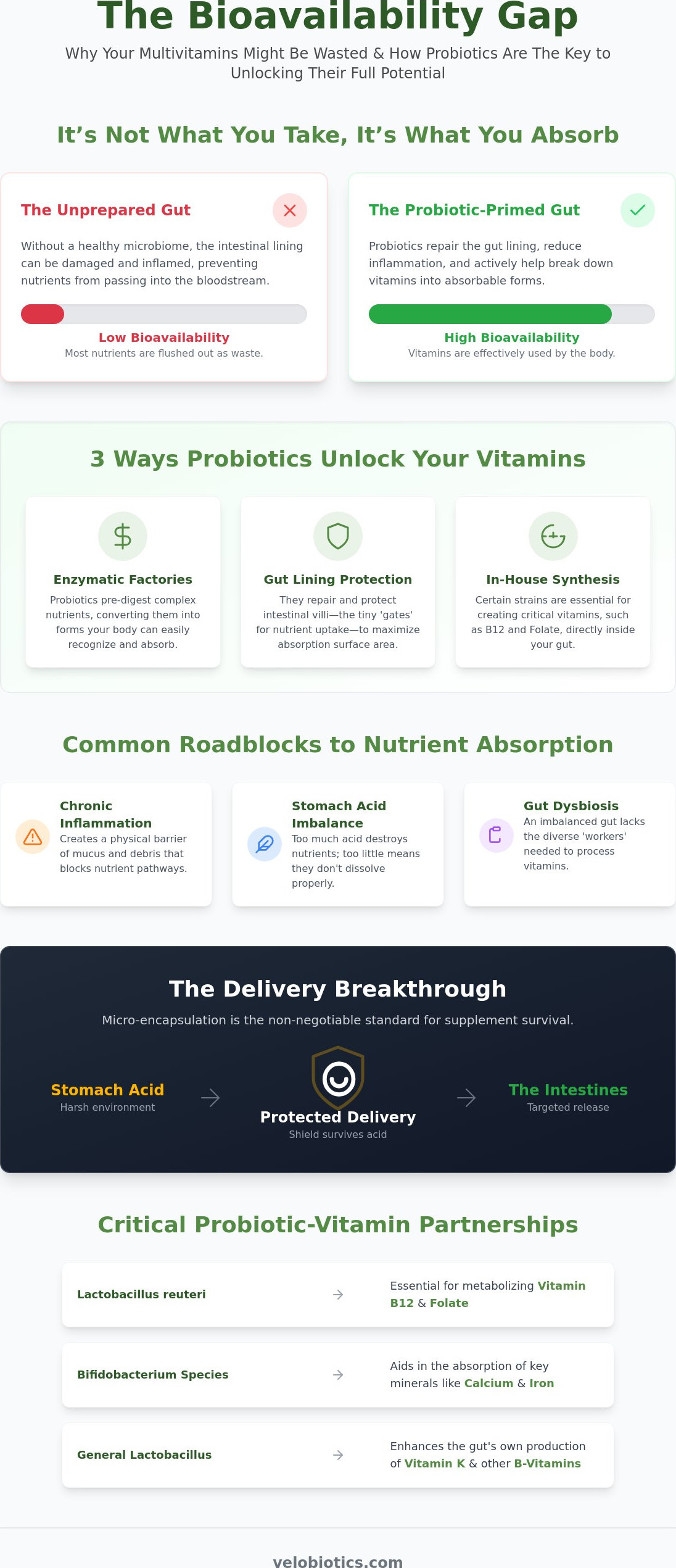
The gut is often viewed as a simple transit system, but it's actually an intricate biological exchange. To understand how probiotics improve multivitamin absorption, we have to look at the "microbiome-nutrient axis." This isn't just a fancy term; it's the physical and chemical interaction between your beneficial bacteria and the nutrients you ingest. These microbes act as enzymatic factories. They don't just sit there; they actively pre-digest complex vitamins and minerals before they even reach your intestinal wall. This microbial "prep work" is essential for converting supplements into a form your cells can actually recognize.
Beyond chemical breakdown, probiotics maintain the physical landscape of absorption. Your small intestine is lined with microscopic, finger-like projections called villi. These villi are your primary absorption zones. When your microbiome is balanced, these villi stay healthy and upright, maximizing the surface area available for nutrient uptake. Conversely, a damaged gut lining shrinks this surface area, leading to the malabsorption issues I see so often in clinical practice. Recent research highlights the microbiome's role in nutrient absorption, showing that certain bacteria even engage in "cross-feeding," where they synthesize vitamins like K2 and various B vitamins themselves, effectively acting as an internal supplement manufacturer.
Enzymatic Assistance: Breaking Down the Tough Stuff
Many people don't realize that plant-based diets contain phytates, which act like "anti-nutrients" by binding to minerals. Probiotics produce an enzyme called phytase that unlocks these minerals, making them available for your body to use. This enzymatic support is also crucial for the metabolism of fat-soluble vitamins like A, D, E, and K, which require specific microbial interactions for optimal uptake. Nutrient transporters are the specialized biological vehicles that probiotics help maintain to ferry these vitamins into your system. If you want to ensure your body actually utilizes these tools, consider a high-quality 16-strain probiotic formula to diversify your enzymatic workforce.
pH Modulation and Mineral Solubility
The chemical environment of your gut dictates whether a mineral stays in a liquid, absorbable state or turns into a solid crystal. An overly alkaline gut environment is a common culprit for poor mineral uptake. Lactic acid-producing bacteria, like those found in the Lactobacillus family, create a localized "micro-climate" with the perfect acidity level. This acidic shift keeps minerals like Iron and Calcium soluble, preventing them from forming unabsorbable crystals that simply pass through your system. By modulating the pH, probiotics ensure the "gates" for mineral absorption remain wide open. It's a perfect example of how probiotics improve multivitamin absorption by managing the very chemistry of your internal environment.
The Synergy Breakdown: Specific Probiotic Strains and Their Vitamin Partners
General gut health is a great starting point, but the real clinical magic happens when we match specific probiotic strains to their vitamin counterparts. Think of these strains as biological "key masters" that unlock specific doors for your nutrients. In my practice, I don't just recommend any probiotic; I look for the specific metabolic workers that target a patient's deficiencies. This targeted approach is a primary reason why understanding how probiotics improve multivitamin absorption is a game-changer for your daily health routine. It moves us away from guesswork and toward a precise, evidence-based strategy.
Take Lactobacillus reuteri as a prime example. This specific strain is a powerhouse for B-vitamin metabolism, particularly for Vitamin B12 and Folate. Without it, your body might struggle to convert these vitamins into their active, usable forms. Similarly, Bifidobacterium strains are essential for the synthesis of Vitamin K2. While you might ingest K1 from greens, your gut bacteria are responsible for the "cross-feeding" that produces the K2 your bones and heart require. We also see a profound effect with Lactobacillus plantarum, which has been shown to significantly boost iron absorption by increasing ferritin levels, a critical factor for anyone struggling with low energy or anemia.
The B-Vitamin Power Couple
B-vitamins are notoriously difficult to absorb because they often require activation in the colon. Clinical research indicates that probiotics significantly promoted the absorption of several B-complex vitamins by altering the enzymatic environment of the gut. This is why a high-potency, 16-strain blend like Velo16 is so effective. It provides a broad spectrum of microbial "helpers" that cover the diverse metabolic needs of the entire B-vitamin family. Taking a B-complex without a supporting probiotic is often a half-measure that leaves your cells starving for the very energy they need.
Minerals and the Acid-Base Balance
Minerals like Calcium and Magnesium often compete for the same absorption pathways, which can lead to "mineral competition" where one blocks the other. Probiotics act as biological traffic controllers, managing the acid-base balance in your intestines to keep these minerals soluble. This is vital for maintaining bone density and preventing the formation of unabsorbable crystals. If you're managing bone health or iron levels, don't just increase your dose. Focus on how probiotics improve multivitamin absorption to ensure those minerals actually reach your skeletal system and bloodstream. It's a more sophisticated, and ultimately more successful, way to supplement.
When building a more sophisticated supplement routine, it is also important to source pure, high-quality ingredients. Sunshine Valley provides a range of natural food supplements, including powdered MSM and Niacinamide, that can be seamlessly integrated into a health plan focused on maximum biological viability.
Optimization Strategies: Delivery Systems and Timing
Knowing which strains you need is only half the battle. If your supplements don't survive the journey to your small intestine, they can't do their job. This is where most people fail in their daily routine. To truly master how probiotics improve multivitamin absorption, you must focus on four critical pillars of optimization: delivery technology, timing, fuel, and solvents. Without these factors in place, your body's "logistics team" never even makes it to the warehouse.
First, you must choose supplements with protected delivery. Most "naked" probiotics face a 95% mortality rate when they hit the stomach acid gauntlet. Second, timing is everything. While many people take vitamins on an empty stomach, taking probiotics and multivitamins together during a meal creates a synergistic environment for uptake. Third, you need to provide prebiotics, like soluble fiber, which act as the fuel for your microbial workers. Finally, you must ensure the presence of healthy fats and proper hydration. Without these solvents, fat-soluble vitamins like A, D, E, and K simply cannot be transported across the gut barrier.
The Science of Survival: Why Micro-encapsulation Matters
The human stomach is designed to be a hostile environment for bacteria. This "stomach acid gauntlet" is a major reason why generic supplements often yield disappointing results. At Velobiotics, we developed a proprietary micro-encapsulation technology that acts as a biological shield. This seal protects both the live bacteria and the sensitive vitamins from being destroyed by gastric juices. This ensures they reach the alkaline environment of the small intestine where they can begin the work of nutrient transport. For a deeper look at the data behind this, read our guide on Probiotics That Survive Stomach Acid.
A Doctor’s Daily Routine for Maximum Uptake
My morning ritual is designed for biological viability, not just convenience. I always recommend taking your supplements with a breakfast that includes a small amount of healthy fat, such as avocado or olive oil. This is a practical necessity because fat triggers the release of bile, which is required to dissolve and transport fat-soluble nutrients. You should also be wary of "absorption killers." The polyphenols in coffee and tea can bind to minerals like iron and calcium, making them unabsorbable. I advise patients to wait at least an hour after their supplements before reaching for their morning caffeine. Taking supplements with a meal is a biological necessity because the presence of food triggers the release of bile and digestive enzymes required for nutrient transport. If you're ready to stop wasting your nutrients, explore our advanced delivery systems to see the difference clinical precision makes.
The Future of Supplementation: Integrated Probiotic Multivitamins
The supplement industry is currently undergoing a massive paradigm shift. We're finally moving away from the "scattered cabinet" approach where consumers are forced to play amateur chemist, mixing and matching dozens of bottles with no regard for biological compatibility. The future lies in integrated, all-in-one systems that respect the microbiome-nutrient axis. By combining these elements into a single, protected delivery vehicle, we remove the friction of timing and the risk of nutrient competition. This evolution is driven by a deeper clinical understanding of how probiotics improve multivitamin absorption, ensuring that the $11.3 billion global market actually delivers on its promises of health and vitality.
Even the regulatory landscape is shifting to meet this demand for higher efficacy. As of July 2026, the FDA is actively reviewing nearly 1,000 public comments regarding the modernization of "dietary substances." This policy update could expand the scope for even more advanced probiotic strains to be included in your daily routine. This modernization reflects what I've seen in my clinic for years: your gut health is the foundational layer for every other health goal. Without it, even the most expensive vitamins are just passing through. Transitioning to a hybrid system isn't just about convenience; it's about honoring the biological reality of how your body processes nutrition.
Gender-Specific Synergy: His-Biotics and Her-Biotics
Men and women have distinct physiological requirements that dictate their absorption needs. Women, for example, often require higher support for iron levels, bone density, and urinary tract health. Products like Femina Probiotic Capsules are designed with this specific synergy in mind, pairing cranberry extract with strains that thrive in the female microbiome to protect and nourish simultaneously. For men, the focus often shifts toward zinc-probiotic synergy and optimized energy metabolism. By using gender-specific hybrids like His-Biotics or Her-Biotics, you ensure the "logistics team" in your gut is specialized for your unique biological terrain. For those who apply this same level of care to their animals, you can learn more about Healthy Horses Inside Out and their methodical approach to equine nutrition.
Starting Your Journey to Better Bioavailability
If you're ready to transition to a more streamlined routine, I recommend a "30-Day Gut Reset." When you first start using an integrated system, your body begins to repair the physical barriers to absorption and repopulate the enzymatic factories we've discussed. Within the first two weeks, my patients often report a significant decrease in digestive discomfort and a steady rise in baseline energy. By day 30, the improved bioavailability usually manifests as better mental clarity and physical resilience. Track your progress by noting your energy levels three hours after your morning dose and monitoring for a reduction in post-meal bloating. It's time to stop treating your supplements as a chore and start seeing them as a high-tech delivery system for total-body fueling. Explore our clinical-grade probiotic multivitamins to start your journey toward true biological viability.
Take Control of Your Biological Viability
Your journey to better health shouldn't be stalled by poor absorption or ineffective delivery systems. We've explored how a thriving microbiome acts as the ultimate logistics team, using enzymatic factories to pre-digest nutrients and maintaining the perfect pH for mineral solubility. By now, the clinical evidence is clear: understanding how probiotics improve multivitamin absorption is the single most important step you can take to stop wasting your money on supplements that never reach your bloodstream.
It's time to move past the "expensive urine" phenomenon and embrace a routine built on empirical evidence. As a doctor, I've spent years developing a solution that bridges the gap between dose and delivery. Our clinically formulated hybrids use proprietary micro-encapsulation to ensure 1000x more viable bacteria survive the stomach acid gauntlet compared to standard offerings. Don't settle for supplements that don't work for your body. Upgrade your supplement routine with Velobiotics Probiotic Multivitamins and start experiencing the energy and vitality that come from true nutrient utilization. You have the tools; now it's time to fuel your best life with scientific precision.
Frequently Asked Questions
Is it better to take probiotics and multivitamins at the same time?
Yes, taking them simultaneously is highly beneficial because probiotics act as the on-site enzymatic crew that helps break down vitamins as they arrive. This is exactly how probiotics improve multivitamin absorption by ensuring the microbes are present when the nutrients need to be transported across the gut barrier. Taking them together with a meal further optimizes this process by triggering the release of bile and digestive enzymes.
Can probiotics cause vitamin deficiencies if the wrong strains are used?
No, standard probiotic strains don't cause deficiencies; however, a severe microbial imbalance can lead to competition for nutrients. Using a clinically formulated, diverse 16-strain blend ensures you're supporting the microbiome rather than creating a monoculture that might prioritize its own growth over your nutrient uptake. It's about creating a balanced ecosystem where bacteria work for your health, not against it.
Do I need to take probiotics every day to see an improvement in absorption?
Yes, daily supplementation is essential because the gut microbiome is a dynamic environment that requires consistent reseeding to maintain its metabolic functions. Since most probiotics are transient and don't permanently colonize the gut, a daily dose ensures the enzymatic factories remain open for business every time you take your multivitamin. Consistency is the only way to maintain the localized pH needed for mineral solubility.
Which probiotic strain is best for Vitamin B12 absorption?
Lactobacillus reuteri is widely considered the gold standard for B12 and Folate metabolism. This specific strain produces specialized enzymes that help convert these vitamins into their active, methylated forms. Without these microbial partners, your body might struggle to utilize the B12 found in standard multivitamin tablets. Understanding these strain-specific roles is a core part of how probiotics improve multivitamin absorption in clinical settings.
How long does it take for probiotics to improve my gut's nutrient uptake?
Most patients begin to notice a shift in energy levels and digestive comfort within 14 to 30 days of consistent use. This timeframe allows the probiotics to repair the intestinal lining and lower localized inflammation. It's a biological process of renovating your absorption zones, so patience and daily adherence are key to seeing measurable results in your serum nutrient levels.
What happens if I take vitamins but have a 'leaky gut'?
If your gut barrier is compromised, your body often triggers an inflammatory response that blocks the specialized transport proteins needed for vitamin uptake. In this scenario, many of the nutrients you ingest are either excreted or pass into the bloodstream in an unrefined state. This can trigger further immune sensitivity instead of providing the nourishment your cells require for energy production.
Can kids take probiotic multivitamins for better growth?
Yes, pediatric-specific probiotic multivitamins can be highly beneficial for ensuring children absorb critical minerals like calcium and iron needed for skeletal development. Since children's microbiomes are still maturing, providing a gentle, micro-encapsulated formula helps protect their sensitive digestive tracts. This ensures they get the maximum biological viability from their supplements during these crucial windows of physical and cognitive growth.
Are there any vitamins that should NOT be taken with probiotics?
There are no known vitamins that negatively interact with probiotics; in fact, the synergy is almost universally positive. The real concern isn't the vitamins themselves but the absorption killers like high-tannin coffee or tea. These substances can bind to minerals and neutralize the beneficial environment that probiotics work so hard to create. Always space your caffeine at least an hour from your supplement routine.

Disclaimer
Information and statements regarding dietary supplements/products have not been evaluated by the Food and Drug Administration, MCC/SAHPRA, MHRA, TGA or any other drug regulatory authority and are not intended to diagnose, treat, cure, or prevent any disease. Information on this website is provided for informational purposes only and is a result of years of practice and experience by the author. This information is not intended as a substitute for the advice provided by your physician or other healthcare professional or any information contained on or in any product label or packaging. Do not use the information on this website for diagnosing or treating a health problem or disease, or prescribing medication or other treatment. Always speak with your physician or other healthcare professional before taking any medication or nutritional, herbal, or homeopathic supplement, or using any treatment for a health problem. If you have or suspect that you have a medical problem, contact your healthcare provider promptly. Do not disregard professional medical advice or delay in seeking professional advice because of something you have read on this website.