

How to Improve Skin Elasticity from Within: A Doctor’s Guide to the Gut-Skin Axis
What if the secret to that youthful snap in your skin isn't sitting on your bathroom vanity, but is actually hidden in your digestive tract? You've likely spent a small fortune on expensive topical creams only to find your reflection still looks a bit tired and lacks the elasticity you remember. It's incredibly frustrating to feel like aging is an inevitable process that's completely out of your control. However, the science of the gut-skin axis reveals that the real work happens deep beneath the surface. I want to teach you how to improve skin elasticity from within by optimizing your internal biology to support your skin's natural architecture.
In this guide, we'll move past vague wellness trends and dive into the empirical evidence that connects your microbiome health to visible skin firmness. You'll discover the clinical secrets to restoring your skin's resilience through advanced collagen peptides and a targeted daily routine. We'll demystify the confusion surrounding different collagen types and provide a clear, actionable plan to reduce sagging. By the end, you'll understand exactly how to create an internal environment that doesn't just hold onto collagen, but actively protects and utilizes it for a visible, lasting glow.
Key Takeaways
- Learn why your skin's "internal mattress" loses its bounce and how to repair the biological springs that keep it firm.
- Discover how to improve skin elasticity from within by using probiotics as the biological keys that unlock better nutrient delivery.
- Master the science of biological viability to ensure your collagen supplements actually survive digestion and reach their target destination.
- Uncover the truth about "sugar sag" and how to protect your elastin fibers from the snapping effect caused by glycation.
- Follow a simple, doctor-approved daily routine designed to prime your gut and provide internal protection for your skin's structure.
Understanding Skin Elasticity: Why Your Internal 'Springs' Lose Their Snap
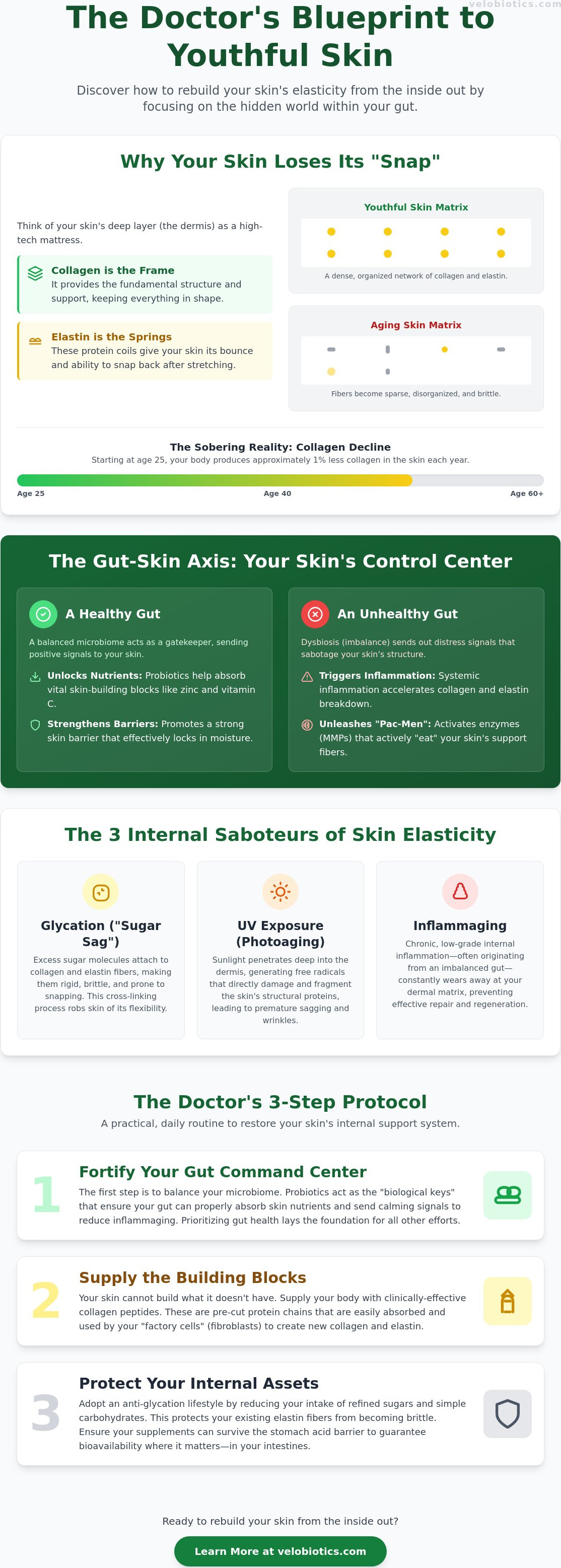
Skin elasticity, or what we clinically call elastosis when it’s lost, is your tissue's biological ability to stretch and then snap right back to its original position. Think of your skin like a high-end mattress. Collagen acts as the sturdy wooden frame; it provides the essential shape and support. Elastin, however, represents the coiled metal springs that give the mattress its bounce. When those springs wear out, the bed sags. This is exactly what happens to your face and neck as the dermal matrix degrades over time.
To better understand this concept, watch this helpful video:
The Biological Trio: Collagen, Elastin, and Hyaluronic Acid
These three components don't work in isolation; they form a synergistic matrix that determines your dermal density. Your fibroblasts are the "factory cells" responsible for churning out these internal springs. While collagen and elastin provide the structure, hyaluronic acid acts as the essential lubricant. Without proper internal hydration, your elastin fibers become brittle and prone to snapping under the pressure of daily facial movements. Keeping these cells healthy is the first step in maintaining that youthful bounce.
Intrinsic vs. Extrinsic Aging: What You Can Control
We distinguish between intrinsic aging, which is your chronological clock, and extrinsic aging, often called "photoaging" from UV exposure. A major driver of visible sagging is "inflammaging," or chronic internal inflammation that eats away at your dermal matrix. This is where The Gut-Skin Axis becomes vital. Your gut is the primary regulator of systemic inflammation. If your microbiome is out of balance, your skin pays the price through accelerated breakdown. Understanding how to improve skin elasticity from within requires a focus on cooling that internal fire to protect your existing elastin and support new growth.
The Gut-Skin Axis: How Your Microbiome Controls Your Glow
Your gut is essentially the command center for your body's largest organ. The Gut-Skin Axis represents a sophisticated, two-way communication pathway where your intestinal bacteria send signals directly to your skin cells. When this system is optimized, probiotics act as "biological keys." They unlock the specific transport mechanisms that allow your body to absorb the Nutritional Building Blocks, such as zinc and vitamin C, required for collagen synthesis. This is a fundamental part of understanding how to improve skin elasticity from within.
However, when your microbiome falls into a state of dysbiosis, or imbalance, the consequences are visible. This often results in "leaky skin," a condition where the skin barrier becomes increasingly permeable and loses its ability to hold moisture. You lose hydration at an accelerated rate, and your skin's "snap" begins to fade. Even worse, certain gut imbalances trigger the overproduction of Matrix Metalloproteinases (MMPs). These are enzymes that effectively act like microscopic "Pac-Men," eating away at your collagen and elastin fibers before they can even mature.
Bioavailability: Why Your Supplements Might Be Wasted
You might be taking the most expensive nutrients in the world, but if they don't survive the "Stomach Acid Barrier," they're essentially wasted. The harsh, acidic environment of the stomach can destroy up to 90% of standard probiotic cultures and many delicate peptides. This is why choosing probiotics that survive stomach acid is critical for results. By utilizing clinical-grade micro-encapsulation, we can ensure that skin-boosting peptides and live cultures reach the small intestine intact, where they can actually be absorbed into the bloodstream.
Microbiome Diversity and Dermal Thickness
Clinical research shows that a diverse gut microbiome correlates directly with increased skin hydration and dermal thickness. Your beneficial bacteria produce Short-Chain Fatty Acids (SCFAs) like butyrate. These SCFAs act as systemic messengers that signal your skin cells to begin the repair process. To support this, I recommend diversifying your fiber intake. Aim for 30 different plant-based foods per week to "feed" the specific bacteria that keep your skin resilient. If you're looking for a comprehensive way to prime your system, consider a high-potency formula like our 16-strain probiotic blend to support this internal ecosystem.
Nutritional Building Blocks: The Clinical Guide to Collagen Peptides
Most patients I see are surprised to learn that collagen isn't a single, uniform substance. It’s a complex family of proteins, and simply consuming more of it doesn't guarantee it will ever reach your dermis. If you truly want to understand how to improve skin elasticity from within, you have to look at molecular weight. Standard collagen molecules are often too large for the human gut to absorb efficiently. This is why we use hydrolyzed peptides, which are broken down into smaller, "bioactive" chains. These microscopic sequences bypass the usual digestive breakdown, allowing them to enter the bloodstream intact and signal your fibroblasts to start production.
Think of these peptides as the raw materials for a construction project. However, even the best materials need a foreman to oversee the work. Vitamin C is that foreman. It's the non-negotiable co-factor required for collagen synthesis. Without adequate Vitamin C, your body simply cannot "knit" these amino acid chains into the triple-helix structure that gives skin its strength. If you're supplementing with collagen but ignoring your Vitamin C levels, you're essentially delivering bricks to a job site with no one there to lay them.
Type I vs. Type II Collagen: A Structural Comparison
While there are over 28 types of collagen, two are vital for your structural integrity. Type I is the powerhouse of the group, accounting for roughly 90% of your body's total collagen supply. It provides the dense, tightly packed fibers that keep your skin, hair, and nails firm. Type II is often associated with joint health, but it acts as the essential "scaffolding" that supports the skin from underneath. By taking a multi-type approach, you ensure that you're reinforcing both the visible surface and the deep structural layers that prevent sagging in the first place.
The Power of Synergy: Probiotics + Collagen
The latest clinical research into the gut-skin axis reveals that your microbiome is the gatekeeper of your beauty routine. Even the highest quality peptides can be wasted if your gut environment is plagued by inflammation or poor absorption. This is where a multi-strain approach becomes a game changer. Probiotics help reduce the oxidative stress that would otherwise degrade your existing collagen fibers.
By integrating a specialized formula like 16 Strains Probiotics Collagen Peptides, you're creating a superior delivery system. These 16 specific strains optimize the metabolic environment, ensuring that the peptides are actually utilized by the body rather than just passing through. This combination also solves a common patient complaint: the bloating and digestive heaviness often associated with high-protein powders. When your gut bacteria are primed to process these proteins, you get all the structural benefits without the gastrointestinal discomfort. It's a practical, evidence-based strategy for anyone serious about long-term skin resilience.
The Anti-Glycation Lifestyle: Protecting Your Skin from 'Sugar Sag'
Glycation is a silent thief of your skin's resilience. It occurs when excess sugar molecules in your bloodstream bond to your collagen and elastin fibers. This chemical reaction creates "Advanced Glycation End-products," aptly known as AGEs. These compounds act like biological glue, hardening your skin's flexible "springs" until they become brittle and snap. This is the primary cause of deep, cross-hatched wrinkles that don't respond to topical treatments. Learning how to improve skin elasticity from within means you must actively prevent these AGEs from forming and accumulating in your tissue.
Chronic stress also plays a destructive role in your dermal health. When your body is flooded with cortisol, it enters a catabolic state where it breaks down structural proteins for energy. High cortisol levels effectively act as a "collagen-dissolving" hormone. This stress response specifically inhibits the production of new hyaluronic acid, which is the essential lubricant that keeps your elastin fibers from becoming dry and prone to snapping. Protecting your internal biology from these factors is just as critical as your supplement routine.
The Blood Sugar-Skin Link
Think of the "Toasted Marshmallow" analogy. When you expose a marshmallow to heat and sugar, it turns brown, stiff, and loses its squishy texture. That is exactly what happens to your dermal matrix during a glucose spike. High-glycemic foods are the number one internal enemy of your skin's bounce. To combat this, try a simple clinical trick: consume a tablespoon of apple cider vinegar in water or a high-fiber starter before your largest meal. These tools blunt the glucose response. By managing your glycemic load, you are essentially mastering how to improve skin elasticity from within at a molecular level.
Cortisol Management for Firm Skin
I recommend implementing a five-minute daily "stress reset," such as box breathing or a short walk, to lower systemic cortisol. Supporting your adrenal-skin axis with adaptogens can also help shield your dermal matrix from stress-induced thinning. Finally, don't overlook the "Sleep-Skin Connection." Melatonin is a potent internal antioxidant that facilitates dermal repair while you rest. If you're struggling to manage the metabolic factors that lead to "sugar sag," our GutSlim Probiotics GLP-1 Booster is specifically designed to support healthy metabolic signaling and protect your system from the inside out.
The Doctor’s Protocol: A Practical Daily Routine for Elastic Skin
Consistency is the final, non-negotiable ingredient in your journey toward resilient skin. While topical treatments might provide a temporary plumping effect, true structural changes take time. In my clinical experience, it takes approximately 12 weeks of consistent internal support to see a measurable change in dermal density. This timeline aligns with the natural turnover of your structural proteins and the stabilization of your microbiome. By following this structured protocol, you'll master how to improve skin elasticity from within using a science-backed, daily rhythm.
Your morning should focus on creating a "Bio-Viable" foundation. Before you consume caffeine or a heavy breakfast, you need to prime your gut environment to ensure maximum nutrient absorption. Mid-day is about protection. I recommend incorporating "internal sunscreen" through polyphenol-rich foods like green tea, dark berries, or pomegranate. These compounds act as biological shields that protect your existing elastin fibers from UV-induced degradation. Finally, your evening phase is dedicated to repair. This is when you should support your body's natural melatonin production with magnesium and strict sleep hygiene to facilitate the deep-tissue knitting of new collagen fibers.
The Daily Supplement Stack
To see real results, your supplement routine must prioritize delivery over dosage. Most people focus on how many milligrams they take, but I focus on what actually reaches the cells. Follow these three steps:
- Step 1: Start your day with a high-viability probiotic to ensure your digestive health is optimized for nutrient transport.
- Step 2: Incorporate Almasi Probiotics Collagen Powder into your morning routine. This provides the specific Type I and II peptides we discussed in earlier sections.
- Step 3: Supplement with high-quality Omega-3 fatty acids. These essential fats maintain the lipid barrier, preventing the "leaky skin" moisture loss that leads to sagging.
Measuring Your Progress
You don't need a lab to track your results. I recommend the "Snap Test" as a simple at-home clinical metric. Gently pinch the skin on the back of your hand or your cheek; it should return to its original position instantly. If it lingers, your elasticity needs work. As you learn how to improve skin elasticity from within, watch for secondary markers. Improved nail strength and a noticeable increase in hair luster often appear before the full dermal "snap" returns. Always take "before" photos in the same natural lighting every 30 days. This is the only objective way to track the gradual, rewarding increase in your skin's structural integrity.
Take Control of Your Biological Clock
Real results require ingredients that actually survive the journey through your digestive system. Our medical team developed a solution that bridges the gap between clinical science and daily convenience. Our formula features a 16-strain probiotic blend and is micro-encapsulated for 1000x better survival compared to standard supplements. This ensures that every bioactive peptide reaches its destination to support your gut-skin axis effectively. Restore your skin's snap with our Doctor-formulated Probiotic Collagen Peptides. You have the tools and the knowledge to reclaim your glow; it's time to let your internal health reflect on the outside.
Frequently Asked Questions
How long does it take to improve skin elasticity from within?
You should expect to see visible results after approximately 12 weeks of consistent internal support. This duration is necessary because it aligns with the natural turnover rate of your dermal cells and the time required for new collagen fibers to fully mature. While some patients report improved hydration within the first month, the structural restoration of your skin's "snap" requires a steady, long-term commitment to your protocol.
Can I really restore lost elastin, or is it gone forever?
While elastin is more difficult to replace than collagen, you can definitely improve the quality and resilience of your existing fibers. The secret lies in protecting your current elastin from enzymatic breakdown and supporting your fibroblasts to produce new, healthy springs. By cooling systemic inflammation and optimizing your microbiome, you create a biological environment where your skin can effectively repair its structural matrix and regain its bounce.
What is the best type of collagen for skin elasticity?
Type I collagen is the most effective choice for skin because it accounts for about 90% of the collagen found in your body's connective tissues. To ensure it actually works, you must choose hydrolyzed peptides with a low molecular weight. These smaller chains are the only ones capable of surviving digestion and entering your bloodstream to signal your skin cells to begin the rebuilding process.
Does drinking more water actually help with skin bounce?
Hydration is vital, but water alone cannot fix sagging skin if your internal "moisture tank" is broken. You need adequate levels of hyaluronic acid and healthy lipid barriers to hold that water within your dermis. Think of water as the lubricant that prevents your elastin fibers from becoming brittle. Without the proper structural proteins to trap that moisture, the water you drink simply passes through your system without benefiting your skin.
Can probiotics really make my skin look younger?
Probiotics make your skin look younger by acting as the primary regulators of the gut-skin axis. They help seal the intestinal lining, which prevents inflammatory markers from leaking into your bloodstream and attacking your collagen. When your microbiome is diverse and healthy, it also improves the absorption of essential minerals like zinc, which are non-negotiable for maintaining a firm and youthful dermal appearance.
What foods should I avoid if I want to keep my skin firm?
You should avoid high-glycemic sugars and ultra-processed carbohydrates that trigger the glycation process. These foods create sticky molecules called AGEs that harden your elastin fibers and make them snap. Additionally, excessive alcohol and high-sodium foods should be limited. These substances dehydrate your tissue at a cellular level, which leaves your internal springs vulnerable to damage and accelerates the visible signs of aging.
Is there a difference between marine and bovine collagen for skin?
Marine collagen is often sourced from fish and is rich in Type I collagen, which is highly compatible with human skin structure. Bovine collagen, which holds a 54.3% market share in 2026, provides a robust mix of Type I and Type III collagen. Both are effective as long as they are hydrolyzed. The most critical factor for success is the delivery system, ensuring the peptides survive stomach acid to reach the absorption site.
How does menopause affect skin elasticity and what can I do?
Menopause causes a sharp decline in estrogen, which can lead to a loss of up to 30% of your skin's collagen in the first five years. This hormonal shift makes learning how to improve skin elasticity from within a top priority for maintaining firmness. I recommend increasing your intake of omega-3 fatty acids and high-potency probiotics to help stabilize your internal environment and shield your dermal matrix from rapid thinning.

Disclaimer
Information and statements regarding dietary supplements/products have not been evaluated by the Food and Drug Administration, MCC/SAHPRA, MHRA, TGA or any other drug regulatory authority and are not intended to diagnose, treat, cure, or prevent any disease. Information on this website is provided for informational purposes only and is a result of years of practice and experience by the author. This information is not intended as a substitute for the advice provided by your physician or other healthcare professional or any information contained on or in any product label or packaging. Do not use the information on this website for diagnosing or treating a health problem or disease, or prescribing medication or other treatment. Always speak with your physician or other healthcare professional before taking any medication or nutritional, herbal, or homeopathic supplement, or using any treatment for a health problem. If you have or suspect that you have a medical problem, contact your healthcare provider promptly. Do not disregard professional medical advice or delay in seeking professional advice because of something you have read on this website.