

How to Prevent BV After Sex: A Doctor’s Practical Guide to pH Balance
What if the reason you're struggling with recurring discomfort isn't a lack of hygiene, but a fundamental misunderstanding of your body's internal chemistry? Many of my patients feel a deep sense of frustration when they realize that common advice like "peeing after sex" simply isn't enough to stop the cycle of embarrassing odors and irritation. It's an exhausting struggle, and it often leaves women feeling disconnected from their own bodies during what should be their most intimate moments.
Understanding how to prevent bv after sex requires us to look past surface-level cleaning and focus on the delicate pH balance of your microbiome. Semen is naturally alkaline, which acts as a biological "pH shock" to your acidic vaginal environment, often allowing opportunistic bacteria to flourish. I'm here to share the clinical science behind this shift and provide a step-by-step medical protocol to keep your microbiome resilient. We'll explore the precise mechanisms of post-sex disruption and outline a reliable, evidence-based routine to ensure you maintain a fresh, healthy balance every single day.
Key Takeaways
- Understand the 'pH shock' caused by semen and why maintaining a specific acidic range of 3.8 to 4.5 is your primary defense.
- Master a medical protocol detailing how to prevent bv after sex.
- Learn how boric acid provides immediate acidification while probiotics build a durable shield of beneficial bacteria.
- Identify hidden intimacy triggers like glycerin-based lubricants that feed harmful bacteria.
- Transition from reactive crisis management to a sustainable daily defense routine that prioritizes long-term biological viability.
The Chemistry of Intimacy: Why Sex Triggers BV
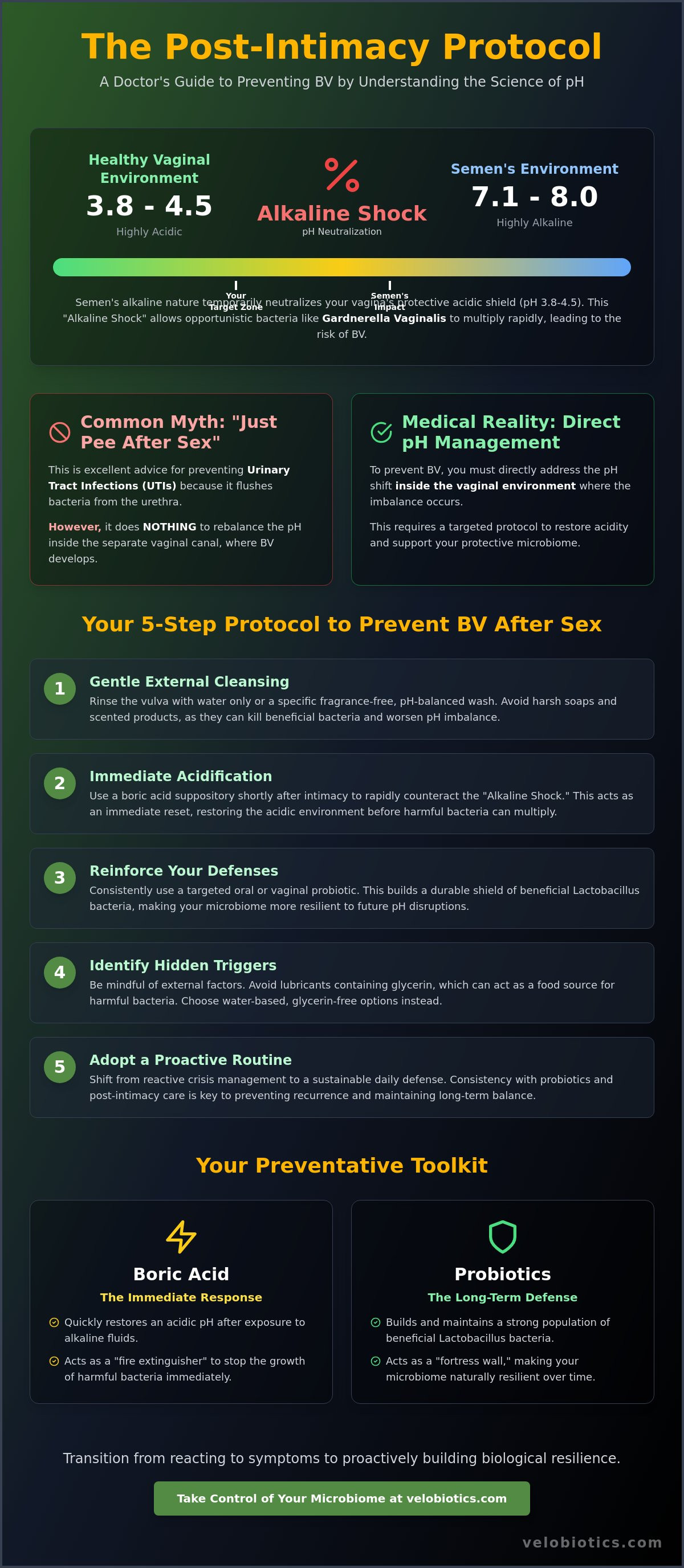
Your vagina is a high-performance biological machine. To keep it running smoothly, it relies on a very specific, highly acidic environment. We measure this using the pH scale, where a healthy range sits between 3.8 and 4.5. For context, that's roughly the same acidity as a tomato or a lemon. This 'sour' environment isn't an accident; it's a deliberate defense mechanism designed to stop harmful pathogens in their tracks. When we talk about Bacterial vaginosis (BV), we're really talking about what happens when that defense system is compromised.
The biggest disruptor to this system is often intimacy. While your body is designed for sex, the biological reality of semen is quite different from your own. Semen is naturally alkaline, with a pH typically ranging from 7.1 to 8.0. When these two fluids meet, it creates a phenomenon I call 'Alkaline Shock.' This sudden shift neutralizes the protective lactic acid produced by your resident Lactobacillus bacteria, effectively leaving the door wide open for unwanted invaders. Learning how to prevent bv after sex starts with recognizing that this chemistry shift is a biological certainty, not a personal failing.
To better understand this concept, watch this helpful video:
pH 101: The Battle Between Acid and Base
Imagine a scale from 0 to 14. Your vaginal environment should be down near the lemon juice end, while semen sits closer to baking soda. When you introduce a base to an acid, they neutralize. It can take your body several hours, or even a full day, to naturally restore that 'sour' state. If you're having frequent sex, your system might never get the chance to reset. This is why many women find themselves in a cycle of recurrence; the protective barrier never has time to rebuild its acidic strength before the next disruption occurs.
The Role of Gardnerella Vaginalis
Meet Gardnerella vaginalis. It's an opportunistic bacterium that lives in many women without causing issues. However, it's a 'fair-weather' pathogen. When your pH climbs above 4.5, Gardnerella stops being a quiet neighbor and starts multiplying rapidly. This is why you might notice a fishy scent shortly after sex. It's not just a 'post-sex smell'; it's the sound of bacteria throwing a party because the acid guard has left the building. If you want to know how to prevent bv after sex, you have to learn how to keep these party crashers from taking over by using tools like targeted pH support to restore order immediately after exposure.
The Post-Coital Protocol: 5 Steps to Prevent BV After Sex
Now that we've identified the "Alkaline Shock" caused by intimacy, we need a practical strategy to neutralize it. Knowing how to prevent bv after sex isn't about being obsessive; it's about being biologically strategic. Your body is resilient, but it occasionally needs a targeted assist to restore its natural defenses after a significant pH shift. This five-step protocol is designed to bridge the gap between clinical theory and your evening routine.
Why 'Peeing After Sex' Doesn't Stop BV
It's one of the most common pieces of advice given in locker rooms and doctors' offices alike: "Just pee after sex." While this is excellent advice for preventing urinary tract infections (UTIs), it does absolutely nothing for your vaginal microbiome. The anatomy is distinct. Your urethra, where urine exits, is a separate canal from the vaginal vault. When you urinate, you are mechanically flushing bacteria out of the urinary tract to prevent them from reaching the bladder. However, that "mechanical flush" never enters the vaginal canal where Mayo Clinic on BV risk factors notes that bacterial imbalances actually occur. To stop BV, we have to address the vaginal environment directly.
Gentle External Cleansing Techniques
The goal after sex is to remove external biological fluids without disrupting the internal ecosystem. I always tell my patients to follow the "Water Only" rule for the vulva, or to use a very specific, fragrance-free, pH-balanced external wash. Fragrances are a primary enemy of your microbiome because they often contain alcohols and chemicals that kill off your protective Lactobacillus. Once you've rinsed, the next step is moisture management. Pat the area dry with a clean, soft towel rather than rubbing. Excess moisture trapped against the skin can create a localized humidity that encourages the growth of opportunistic pathogens.
To truly master how to prevent bv after sex, follow this structured routine:
- Step 1: The UTI Flush. Go ahead and urinate to protect your urinary tract. It's a good habit, even if it doesn't solve the BV problem.
- Step 2: External Rinse. Use lukewarm water to clean the vulva. Avoid douching, which pushes alkaline fluids and bacteria deeper into the canal.
- Step 3: Immediate pH Reset. This is the most critical step. Using a targeted boric acid suppository can help instantly bring the pH back down to an acidic level.
- Step 4: Breathable Fabrics. Skip the synthetic lace and opt for 100% cotton underwear. Air circulation is vital for maintaining a dry, stable environment.
- Step 5: Probiotic Reinforcement. Introduce beneficial bacteria early. Probiotics help replenish the "good" flora that might have been crowded out during the pH spike.
By following these steps, you are proactively managing the internal environment before bacteria have a chance to colonize. It's much easier to maintain a healthy state than it is to treat an established infection.
Boric Acid and Probiotics: Your Preventative Toolkit
To master the art of how to prevent bv after sex, we have to move beyond simple washing and look at active biological intervention. Think of your microbiome as a garden. Sex, specifically the introduction of alkaline semen, is like a sudden heatwave that wilts your prize roses (the Lactobacillus) and allows weeds (the Gardnerella) to take over. To keep the garden healthy, you need two specific tools: a way to cool the soil quickly and a way to replant the good seeds. This is where boric acid and probiotics come into play as your primary defensive duo.
Boric acid serves as the biological "reset button." It is a mineral with natural acidifying properties that works to instantly lower the vaginal pH back into that safe, acidic zone. But its most impressive trick is its ability to disrupt biofilms. Bacteria are clever; they build protective "forts" called biofilms that shield them from your immune system. Boric acid acts as a wrecking ball to these structures, making it much harder for opportunistic bacteria to establish a permanent residence after intimacy. For the best results, I recommend using a suppository within 12 to 24 hours of intercourse to neutralize the "Alkaline Shock" before the bad bacteria can multiply.
The Power of Boric Acid Suppositories
While some online forums suggest using boric acid for seven days straight, that's a treatment protocol for an active infection. When we're talking about how to prevent bv after sex, we're focused on maintenance. A single, targeted dose is often all that's required to restore the environment. For a more comprehensive approach, products like Femina Probiotics Cookie Fresh with Boric Acid Suppositories offer dual-action protection by acidifying the environment while simultaneously introducing beneficial flora. It's a clinical-grade strategy that addresses the problem from two different angles at once.
Choosing the Right Probiotic Strains
Not all probiotics are created equal. If you want to protect your vaginal health, you need specific strains like L. rhamnosus and L. reuteri. These are the "security guards" of your microbiome. The challenge is ensuring these bacteria actually reach their destination alive. Many standard supplements lose their potency in the stomach or on the shelf. This is why I focus so heavily on micro-encapsulation technology; it acts as a protective seal that ensures biological viability, so the active ingredients actually work once they reach your system. You can learn more about this in my detailed Probiotics for BV: A Doctor’s Guide. Whether you choose oral or vaginal delivery, the priority is always the survival and colonization of these protective strains.
Managing External Triggers: Lubes, Condoms, and Partners
If you've followed the pH reset protocol but still find yourself dealing with symptoms, it's time to look at the external variables you're introducing to the equation. While we've focused on internal chemistry, external triggers like lubricants and partner hygiene play a massive role in how to prevent bv after sex. It's a common medical oversight to ignore these factors, but they can be the difference between long-term balance and constant frustration.
Choosing Microbiome-Friendly Lubricants
Many lubricants on the market contain glycerin, which is a sugar alcohol. To a pathogen like Gardnerella, glycerin is an all-you-can-eat buffet. Using these products is essentially feeding the very bacteria you're trying to suppress. You also need to consider osmolality, which refers to the concentration of particles in the fluid. If a lube has a higher osmolality than your vaginal cells, it will actually pull water out of your tissues. This dehydration causes microscopic damage to the vaginal lining, creating entry points for bacteria to take hold. I recommend looking for silicone-based options or water-based formulas that explicitly state they are glycerin-free and pH-balanced to maintain biological viability.
The Partner Factor: A Shared Microbiome
Intimacy is a biological exchange, and your partner's own microbial makeup can influence yours. Recent research into the penile microbiome indicates that bacteria associated with BV can reside on the skin and within the urethra of male partners. While they may not show symptoms, they can act as a reservoir for recurrence. This is why condoms are such an effective tool for those wondering how to prevent bv after sex; they act as a physical barrier against both alkaline semen and external bacterial colonies. For couples struggling with recurrence, I often suggest that both partners focus on hygiene before intimacy. A simple wash can significantly reduce the bacterial load being introduced during sex.
Finally, don't overlook your equipment. Sex toys made from porous materials like "jelly" or soft plastics have microscopic pits that can harbor bacteria even after a thorough wash. These materials are nearly impossible to fully sanitize. Stick to non-porous materials like medical-grade silicone, glass, or stainless steel. These options can be properly cleaned with soap and water or specialized toy cleaners, ensuring you aren't re-introducing pathogens into your delicate ecosystem.
If you're ready to take control of your microbiome health with clinical-grade support, explore our targeted probiotic formulations for women.
Building Long-Term Resilience: The Velobiotics Philosophy
Building a resilient microbiome is very much like training for a marathon. It requires consistency rather than just a sprint when things go wrong. Most women spend years in a cycle of "crisis management," only addressing their vaginal health when an odor or irritation appears. Learning how to prevent bv after sex is an essential first step, but the ultimate goal is to move toward "daily defense." This means creating an internal environment so robust that opportunistic bacteria like Gardnerella simply can't find a foothold, even after a pH disruption.
The Velobiotics Difference in Delivery
The biggest challenge with standard probiotics is biological viability. Many shelf-stable products contain billions of bacteria, but they often die in the bottle or get destroyed by stomach acid before they ever reach the vaginal tract. Our proprietary technology uses a specialized delivery system that acts as a protective shield for the active ingredients. This ensures that the specific strains you need actually survive the journey and colonize where they are needed most. For systemic support that works alongside your post-sex routine, I often recommend Femina Probiotic Capsules with Cranberry. This formulation provides a steady stream of protective flora to reinforce your natural defenses from the inside out.
A Practical Lifestyle Checklist for BV Prevention
Clinical interventions are most effective when supported by smart lifestyle choices. If you're serious about how to prevent bv after sex, these three habits are non-negotiable:
- The Breathability Rule: Stick to 100% cotton underwear. Synthetic fabrics trap heat and moisture, creating a "greenhouse effect" that encourages bacterial overgrowth.
- The Sugar Connection: High sugar intake can spike your blood glucose levels, which in turn can alter the secretions in the vaginal canal. This provides a fuel source for both yeast and the bacteria associated with BV.
- Symptom Tracking: Keep a simple log of your cycle and when symptoms occur. Many women find they are more susceptible to BV right after their period because blood is also alkaline, which compounds the "pH shock" of intimacy.
Finally, it's important to know when to stop the DIY approach. While a proactive routine can manage most cases of post-sex imbalance, it isn't a substitute for professional medical care if an infection has already taken hold. If you experience persistent pain, high fever, or symptoms that don't improve within 48 hours of using a pH reset protocol, please see a specialist. Chronic recurrence sometimes requires a dual approach of prescription antibiotics to clear the "biofilm" followed immediately by our clinical-grade probiotics to prevent the vacancy from being filled by the wrong bacteria again.
Reclaim Your Intimate Confidence Through Science
Mastering how to prevent bv after sex isn't about luck; it's about applying biological principles to your daily routine. We've explored how the alkaline nature of semen disrupts your natural acidity and why traditional hygiene habits like simply peeing aren't enough to protect your microbiome. By implementing a targeted pH reset and choosing microbiome-friendly products, you can stop the cycle of frustration and maintain a healthy, resilient environment that supports your lifestyle.
I founded this brand to bridge the gap between complex clinical research and practical wellness solutions. Our products utilize proprietary micro-encapsulation technology to ensure that active ingredients reach their target with full biological viability. With over 1,000 5-star wellness reviews, we've helped countless women move from reactive crisis management to proactive daily defense. You don't have to choose between intimacy and your health. Take the first step toward long-term balance today. Shop Femina Cookie Fresh: The MD-Formulated Reset for Your Microbiome. You deserve to feel fresh, confident, and completely in control of your body.
Frequently Asked Questions
Can I use boric acid every time I have sex to prevent BV?
Yes, you can use a single boric acid suppository as a preventative measure immediately after intercourse. It acts as a targeted pH reset to neutralize the alkaline impact of semen before harmful bacteria can multiply. While it's safe for intermittent use, it shouldn't replace a long-term strategy of replenishing your natural Lactobacillus population through high-quality probiotics.
Why does my BV keep coming back even after I finish antibiotics?
Antibiotics often fail to prevent recurrence because they are non-selective, meaning they kill both the "bad" pathogens and the "good" bacteria that protect you. This leaves your vaginal ecosystem vacant and vulnerable to reinfection. Additionally, bacteria like Gardnerella can form a protective biofilm that shields them from medication, allowing them to resurface once the treatment ends.
Does my partner need to be treated if I keep getting BV after sex?
Current clinical guidelines don't standardly require male partner treatment, but research suggests they can harbor BV-associated bacteria. If you are stuck in a cycle of recurrence, focusing on how to prevent bv after sex through barrier methods is highly effective. Using condoms prevents the exchange of alkaline fluids and external bacteria, which significantly reduces the triggers for a new infection.
Is it safe to use probiotics and boric acid at the same time?
Yes, combining these two tools is a powerful clinical strategy for maintaining a balanced microbiome. Boric acid works to instantly lower the pH to an acidic level, which creates the ideal environment for beneficial bacteria to thrive. When you introduce probiotics simultaneously, you are acidifying the "soil" while planting the "seeds" for a healthy, resilient internal garden.
Can certain types of birth control make me more prone to BV after sex?
Yes, certain contraceptives like the copper IUD or hormonal pills can alter your vaginal secretions and internal chemistry. Some studies indicate that the copper IUD may slightly increase the risk of bacterial imbalance by changing the local environment. If you notice a clear pattern of infections starting after a change in birth control, it's worth discussing alternative options with your specialist.
How soon after sex should I use a preventative suppository?
You should ideally use a preventative suppository within 12 to 24 hours after intimacy. This timeframe is critical because it allows you to intervene during the "Alkaline Shock" phase before pathogens have the opportunity to colonize. Acting within this window ensures that your pH returns to its protective acidic range of 3.8 to 4.5 as quickly as possible.
Does oral sex also trigger BV, or is it just intercourse?
Oral sex can absolutely trigger an imbalance because human saliva has a pH of approximately 6.5 to 7.5, which is quite alkaline. Saliva also introduces a unique set of foreign bacteria from the mouth into the vaginal canal. For patients learning how to prevent bv after sex, I always emphasize that any fluid with a neutral or alkaline pH can disrupt your delicate microbiome.
What is the difference between post-sex odor and a real BV infection?
Post-sex odor is typically a temporary scent caused by the mixing of semen and vaginal fluids, whereas a real BV infection involves a persistent fishy smell and gray discharge. If the odor disappears after a gentle external rinse or a few hours, it's likely a transient chemistry shift. However, if the scent lingers for several days or is accompanied by irritation, you're likely facing a bacterial overgrowth.

Disclaimer
Information and statements regarding dietary supplements/products have not been evaluated by the Food and Drug Administration, MCC/SAHPRA, MHRA, TGA or any other drug regulatory authority and are not intended to diagnose, treat, cure, or prevent any disease. Information on this website is provided for informational purposes only and is a result of years of practice and experience by the author. This information is not intended as a substitute for the advice provided by your physician or other healthcare professional or any information contained on or in any product label or packaging. Do not use the information on this website for diagnosing or treating a health problem or disease, or prescribing medication or other treatment. Always speak with your physician or other healthcare professional before taking any medication or nutritional, herbal, or homeopathic supplement, or using any treatment for a health problem. If you have or suspect that you have a medical problem, contact your healthcare provider promptly. Do not disregard professional medical advice or delay in seeking professional advice because of something you have read on this website.