

How to Talk to Your Partner About BV: A Doctor’s Guide to Stress-Free Conversations
Nearly 29% of women in the U.S. are currently navigating the biological imbalance of bacterial vaginosis, yet it remains one of the most avoided topics in the bedroom. Understanding how to talk to your partner about bv is essential because this isn't a hygiene failure or an STI; it's a complex disruption of your internal ecosystem. I know the anxiety that comes with this diagnosis. You might worry your partner will think you're "dirty" or feel frustrated when intimacy seems to trigger those familiar symptoms.
I'm here to help you explain the science of your microbiome with total confidence. We'll debunk the myths once and for all and show you how to turn this medical hurdle into a bonding experience. In this guide, we'll explore the latest 2025 clinical findings on partner treatment, provide you with word-for-word scripts for the conversation, and outline a clear path to resuming intimacy without fear. It's time to bridge the gap between clinical facts and your everyday connection.
Key Takeaways
- Master the clinical facts and scripts for how to talk to your partner about bv so you can ditch the shame and clear up the STI myth for good.
- Understand the pH clash between acidic vaginal environments and alkaline semen to see exactly why intimacy can sometimes throw your system out of whack.
- Get the doctor-approved no-go list for sex during treatment to ensure your body has the time and space it needs to heal properly.
- Discover how 2025 research into partner treatment can help you both work together to stop the frustrating cycle of recurrent infections.
- Learn why simply killing bad bacteria isn't enough and how to use advanced delivery technology to rebuild a thriving, protective microbiome.
The 'Mood Killer' Reality: Why Talking About BV Feels So Scary
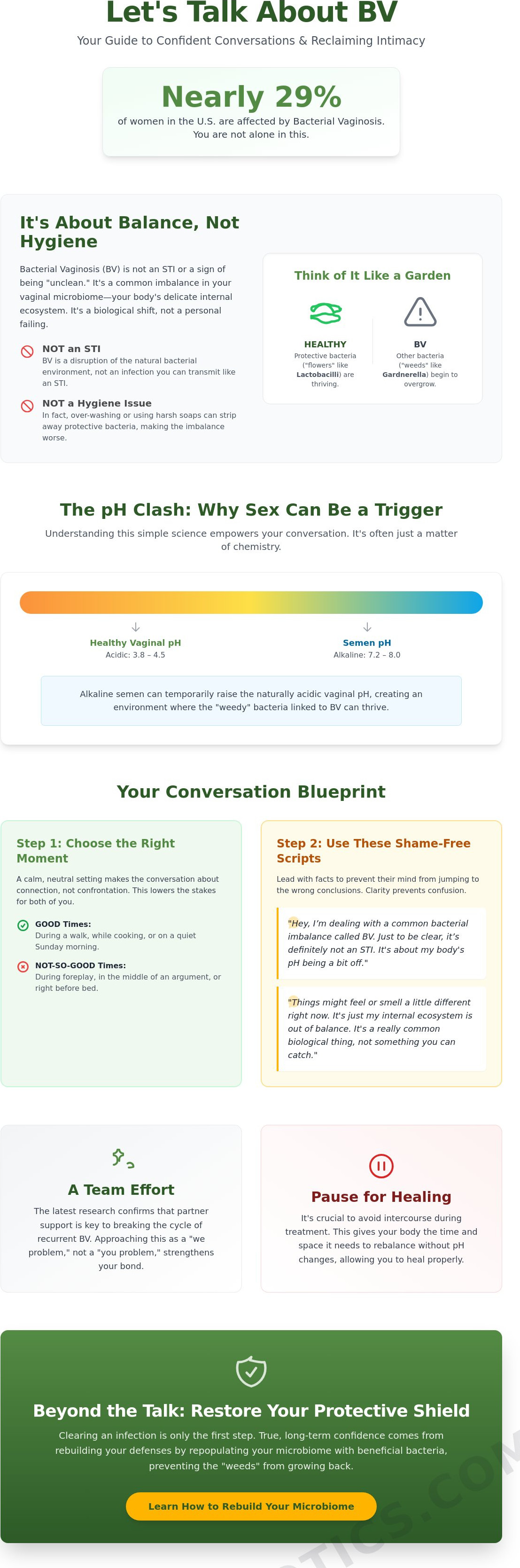
Let's talk about the elephant in the room. There's a persistent, heavy shame associated with vaginal odor and discharge that often makes a simple conversation feel like a monumental hurdle. As a doctor, I see this every day. It's frustrating because the symptoms are intrusive. Let's be honest; Rihanna wasn't exactly singing about the nuances of a fishy odor when she talked about finding love. But here's the clinical reality: Bacterial Vaginosis (BV) is the most common vaginal condition for women of reproductive age. It affects nearly 29% of women in the U.S. alone. You're not alone, and you're certainly not "abnormal."
Silence doesn't just protect your privacy; it fuels the stigma. When we don't talk about it, we let the anxiety grow. Talking about it, however, builds a layer of intimacy and trust that can actually strengthen your relationship. It shifts the dynamic from a "you problem" to a "we problem."
To better understand why the conversation matters and how the science works, watch this helpful video:
Breaking the 'Dirty' Stigma
One of the biggest hurdles in learning how to talk to your partner about bv is the fear of being labeled "dirty." We need to draw a clear line between hygiene and biology. BV isn't about how many times you shower. In fact, over-washing or using harsh soaps often triggers the condition by stripping away protective bacteria like Lactobacilli. Think of your vaginal microbiome like a garden. BV isn't a sign that the garden is "gross"; it just means a few weeds have started to outgrow the flowers. You don't need a bulldozer; you just need to restore the balance. When you explain it this way, you remove the "hygiene" blame from the table immediately.
The Anxiety of the 'First Talk'
The fear that a partner might mistake your symptoms for an STI is a major source of stress. This anxiety is almost always much worse than the reality of the conversation. Most partners are incredibly supportive once they understand the science of pH and bacterial balance. They want you to feel comfortable and healthy. We've seen this time and again. We actually built the Velobiotics story around this exact need for clarity and clinical integrity. When you approach how to talk to your partner about bv with facts rather than apologies, you replace their potential confusion with genuine understanding.
The Conversation Script: How to Explain BV Without the Blame
Timing is everything. When you're deciding how to talk to your partner about bv, the environment matters as much as the message. Don't bring it up during foreplay or in the heat of a moment. That's a high-stress environment where any medical talk feels like a rejection. Instead, choose a neutral, relaxed setting like a Sunday morning walk or while cooking dinner. This lowers the stakes and allows for a calm exchange of information rather than an emotional confrontation.
Start with a clear disclaimer to lower their guard immediately. Tell them, "Hey, I’m dealing with a common bacterial imbalance called BV, and just so you know, it’s definitely not an STI." This simple sentence prevents their mind from jumping to conclusions. You can find excellent patient-friendly information on BV to share if they want to see the clinical facts. Explain that it's all about the microbiome. Most people understand gut health; explain that the vagina has its own ecosystem too. Usually, protective bacteria called Lactobacillus keep everything in check, but sometimes "weedy" bacteria like Gardnerella take over. It’s a biological shift, not a hygiene issue.
Exact Phrases to Use
If you're stuck on the wording, try these direct scripts to keep the conversation focused and shame-free:
- Script 1: "My pH is a bit off right now, which is why things might smell or feel different. It’s a common bacterial imbalance, not an infection you can catch or pass back and forth."
- Script 2: "I’m using a clinical treatment to reset my vaginal flora, so I need to take a break from certain types of intimacy for a few days while things balance out."
- Script 3: "It’s basically like having a 'cold' but in my vagina. It's totally normal and common, it just needs a little extra care right now."
Handling Their Questions
Your partner might have questions, and having science-backed answers ready will help you feel more in control. If they ask if they need treatment, explain that while men don't usually get BV, their biology can sometimes affect your pH levels. If they wonder where it came from, explain that triggers are often internal. Stress, changes in diet, or even new laundry detergents can disrupt the environment. Use this quotable sentence: "BV is a shift in the existing bacterial community, not a pathogen introduced from the outside." If you're looking for a way to support that internal balance, you might consider probiotic suppositories to help manage the microbiome directly. Mastering how to talk to your partner about bv becomes much easier when you realize you're just sharing a biological update. For more resources on maintaining health, check out advanced microbiome solutions.
It’s a Team Effort: How Your Partner’s Biology Impacts Your pH
When we look at how to talk to your partner about bv, we have to address the literal chemistry happening during intimacy. This isn't just about your body; it's about how two different biological systems interact. To understand why your symptoms might flare up after sex, we need to look at the pH scale. A healthy vaginal environment is naturally acidic, typically sitting between 3.8 and 4.5. This acidity is your primary defense mechanism, powered by Lactobacillus, which produces lactic acid to keep "bad" bacteria away.
In contrast, semen is significantly more alkaline, with a pH ranging from 7.1 to 8.0. This alkalinity is essential for sperm survival, but it acts like a chemical shock to the acidic vaginal canal. When semen enters the environment, it temporarily neutralizes your natural acidity. For many women, the body recovers quickly. However, if your microbiome is already leaning toward an imbalance, this alkaline "flood" can provide the perfect window for BV-linked bacteria to thrive. Framing the conversation around "our sex life's chemistry" instead of "my problem" removes the burden of individual failure and turns it into a shared health goal.
The Role of Semen in Recurrent BV
Semen doesn't just change the pH; it can actually act as a playground for bacteria that cause imbalance. Research shows that certain bacteria can hitch a ride or find a more hospitable home when the vaginal acidity is lowered. This is why using barrier methods like condoms or practicing "pulling out" isn't just about preventing pregnancy; it’s a strategic move for pH protection. It’s also vital to understand that a partner’s skin flora can influence your vaginal balance, as bacteria can be transferred through physical contact. By using barriers, you're essentially putting up a shield that allows your natural flora to remain undisturbed while you work on long-term restoration.
What Your Partner Can Actually Do
Your partner can take active steps to support your recovery without feeling like they're being "treated." Simple changes in hygiene make a massive difference. Encourage them to use gentle, unscented soaps rather than harsh, antibacterial body washes that can leave residues. Hand and oral hygiene before intimacy are non-negotiable for maintaining a stable environment. If they're curious about the science behind your recovery, suggest they read our guide on probiotics for BV. It’s a great way to help them understand the complexity of the microbiome and why how to talk to your partner about bv is the first step toward a healthier, more consistent connection.
Intimacy During Treatment: Setting Boundaries and Exploring Alternatives
Intimacy doesn't have to vanish just because you're in the middle of a treatment cycle. When you're navigating how to talk to your partner about bv, it's helpful to view this period as a pivot rather than a full stop. My advice as a clinician is straightforward: establish clear "No-Go" zones early on. Penetrative sex is generally off-limits while you are actively treating the infection. This isn't about being uninterested; it's about protecting your healing tissue and ensuring the treatment has the best chance of success.
The "Why" behind this boundary is purely biological. BV causes inflammation of the vaginal mucosa, making the tissue more sensitive and prone to irritation. Friction from penetration can exacerbate this inflammation and disrupt the medication's ability to stay in contact with the vaginal walls long enough to be effective. Instead, explore "outer-course" activities like sensual massage or manual play that don't involve internal contact. This keeps the physical connection alive while your protective Lactobacillus population works to regain control of the environment. Reintroducing sex should happen slowly, only once the "good bacteria" are back in charge and symptoms have fully resolved.
Using Suppositories and Sex
Safety is paramount when you're using a boric acid suppository. You must avoid penetrative sex while the capsule is dissolving to prevent irritation for both you and your partner. Beyond the potential for discomfort, there is a serious safety risk; boric acid is toxic if swallowed. This means oral sex is strictly prohibited until the treatment has completely cleared from your system. I typically recommend a wait time of at least 24 hours after your last dose before resuming any internal activity. This ensures the active ingredients have done their job and your pH has begun to stabilize without interference.
Rebuilding Confidence Post-Treatment
Many women experience a lingering "fear of the smell" returning during sex even after the infection is gone. This anxiety is a major hurdle in how to talk to your partner about bv, but it can be managed with the right tools. To mitigate this, reintroduce intimacy slowly and use a pH-balanced lubricant that mimics your natural acidity. Many commercial lubricants are too alkaline or contain sugars that can actually feed bad bacteria, triggering a new cycle of imbalance. Focus on the pleasure of the experience rather than monitoring your body's "plumbing." Once you see that your system is resilient, your confidence will naturally follow. For those looking to maintain this balance long-term, exploring advanced vaginal health solutions can provide that extra layer of clinical security.
Beyond the Talk: Restoring Your Microbiome for Long-Term Confidence
Mastering how to talk to your partner about bv is a massive victory for your relationship, but it's only half the clinical battle. Clearing the overgrowth with antibiotics or initial treatments is like weeding a garden; it's necessary, but it leaves the soil bare. If you don't actively repopulate that space with "good" bacteria, the "bad" ones will simply move back in. This cycle of recurrence affects up to 50% of women within 12 months of treatment. To break this loop, you must transition from a reactive mindset to being the CEO of your own health.
Think of vaginal health as a proactive routine, similar to your skincare regimen or gym sessions. You don't wait for a breakout to wash your face. The challenge with traditional oral probiotics is biological viability. Most standard supplements die in the harsh acidic environment of the stomach before they ever reach their destination. This is where clinical innovation intervenes. Using proprietary micro-encapsulation technology ensures that active probiotic strains are shielded, resulting in a delivery system that is 10x more viable than standard market offerings. When the bacteria actually survive the journey, they can finally do the work of protecting your pH.
The Power of Boric Acid + Probiotics
To achieve a true biological reset, we developed Femina Cookie Fresh. This dual-action approach is unique because it uses Boric Acid to clear out the imbalance while simultaneously providing the probiotics needed to repopulate the flora. It's a "reset and repopulate" mechanism that addresses the root cause of the hurdle. For daily maintenance and to keep those protective barriers high, Femina Probiotic Capsules offer a consistent way to support your microbiome from the inside out, ensuring your internal environment remains hostile to "weeds."
A Doctor's Final Word on Partnership
At the end of the day, a partner who truly loves and respects you will support your health journey without hesitation. They won't see a medical hurdle as a burden, but as an opportunity to show they care about your comfort and well-being. You deserve to feel confident, comfortable, and "Cookie Fresh" every single day. Now that you know how to talk to your partner about bv and have the clinical tools to manage your microbiome, you can resume your life with total peace of mind. Your health is a team effort, and you have the expertise to lead the way.
Explore our full range of women's wellness solutions.
Take Charge of Your Biological Balance
You now have the clinical tools and scripts to navigate how to talk to your partner about bv with absolute confidence. We've established that this condition is a biological imbalance of the microbiome, not a reflection of your hygiene or character. By explaining the science of pH and setting clear boundaries during treatment, you're protecting your internal ecosystem while strengthening your relationship. Remember that clearing the symptoms is only the first step; restoring your protective flora is what prevents the cycle from repeating.
As a doctor, I've seen how the right technology changes the recovery journey. Our research-backed, dual-action formula uses Boric Acid to reset and probiotics to repopulate. As a doctor-founded brand, we utilize proprietary micro-encapsulation technology to ensure 10x more bacterial viability compared to standard market offerings. This ensures the "good guys" actually reach their destination. You deserve to feel resilient and refreshed every single day.
Shop Femina Cookie Fresh: The Doctor-Formulated Reset for Your Vaginal Microbiome
Frequently Asked Questions
Can I give BV to my male partner?
Men don't develop BV because the condition is specific to the vaginal ecosystem. While they don't experience symptoms, their presence in your microbiome can influence your bacterial balance. This is why knowing how to talk to your partner about bv is helpful; it explains why you might need a temporary break from intimacy even though they aren't "infected."
Is it okay to have sex while I have BV symptoms?
It is generally recommended to abstain until your symptoms fully resolve. Friction against inflamed vaginal walls causes significant discomfort and can delay the healing process. Additionally, introducing alkaline semen into an already struggling environment can cause the "bad" bacteria to multiply faster, making your clinical treatment less effective.
How do I explain the fishy smell to my partner without being embarrassed?
Lead with the clinical facts to remove the stigma. Explain that the odor is a chemical byproduct of specific bacteria, like Gardnerella, interacting with vaginal fluids. It's a biological metric, not a hygiene failure. Comparing it to a "cold" in your microbiome takes the personal shame out of the equation and keeps the focus on recovery.
Do I need to stop using boric acid if I want to be intimate?
You must wait at least 24 hours after using a suppository before having any form of sex. Boric acid is toxic if ingested, making oral sex dangerous, and the powder can be physically irritating during penetration. Safety is the priority, so ensure the treatment has fully dissolved and cleared before resuming a physical connection.
Can my partner's sperm cause my BV to keep coming back?
Semen has a high pH of 7.1 to 8.0, which can "shock" your naturally acidic environment. This sudden shift allows BV-associated bacteria to thrive in the neutral environment. If you struggle with recurrence, using barrier methods or rinsing immediately after sex can help maintain your protective 3.8 to 4.5 pH level.
What happens if my partner reacts poorly to the conversation?
If the reaction is negative, stay calm and lean on the clinical data. Remind them that nearly 29% of women in the U.S. deal with this imbalance at some point. A poor reaction usually stems from a lack of education about how to talk to your partner about bv, so providing them with medical resources can help bridge that gap.
Should my partner also take probiotics for my BV?
While BV is a vaginal condition, maintaining a healthy bacterial balance for both partners is a smart strategy. We offer His-Biotics Probiotics Original Multivitamin for men to help support their own microbiome. A healthy partner environment makes it much easier for your vaginal flora to stay stable and resilient over the long term.
Is BV a sign that someone has been unfaithful?
BV is absolutely not a sign of infidelity. It is an internal shift of bacteria that already live in your body. Triggers can include anything from a change in laundry detergent or high stress levels to a new diet. It is a biological event caused by environmental factors, not a diagnostic tool for relationship loyalty.

Disclaimer
Information and statements regarding dietary supplements/products have not been evaluated by the Food and Drug Administration, MCC/SAHPRA, MHRA, TGA or any other drug regulatory authority and are not intended to diagnose, treat, cure, or prevent any disease. Information on this website is provided for informational purposes only and is a result of years of practice and experience by the author. This information is not intended as a substitute for the advice provided by your physician or other healthcare professional or any information contained on or in any product label or packaging. Do not use the information on this website for diagnosing or treating a health problem or disease, or prescribing medication or other treatment. Always speak with your physician or other healthcare professional before taking any medication or nutritional, herbal, or homeopathic supplement, or using any treatment for a health problem. If you have or suspect that you have a medical problem, contact your healthcare provider promptly. Do not disregard professional medical advice or delay in seeking professional advice because of something you have read on this website.