

Hydrolyzed Collagen Peptides vs. Marine Collagen: A Doctor’s Guide to Choosing in 2026
What if the extra money you're spending on "wild-caught" labels is actually buying you less biological impact than a standard bovine peptide? It's a question I hear daily in my clinic because the supplement aisle has become a minefield of marketing jargon. You've likely felt the frustration of investing in expensive tubs only to end up with stubborn bloating and zero change in your skin elasticity. When we look at the debate of hydrolyzed collagen peptides vs marine collagen, the real winner isn't decided by whether it came from a farm or the ocean. Instead, it's about how well your body can actually absorb those molecules.
I know you want a simple, one-stop solution for your joints, gut, and glow without the digestive drama. With the global collagen market projected to hit 12.7 billion dollars in 2026, it's more important than ever to look past the hype at the actual science of bioavailability. I'm going to show you how to stop wasting money and start choosing supplements based on molecular weight and delivery systems. We'll dive into the latest clinical data on absorption rates, the truth about Type I and II blends, and how to find a formula that repairs your gut while smoothing your skin.
Key Takeaways
- Understand the critical distinction between a collagen's source and its processing method to ensure you aren't just paying for fancy marketing.
- Learn why the "Dalton" count is the most important metric when comparing hydrolyzed collagen peptides vs marine collagen for superior biological absorption.
- Identify which specific collagen types—I, II, or III—align with your personal goals for skin elasticity, joint repair, or gut lining support.
- Apply a simple three-question framework to audit any supplement label for molecular weight and processing transparency before you buy.
- Discover the clinical advantage of pairing peptides with probiotics to eliminate digestive discomfort and maximize the viability of every gram you consume.
The Semantic Confusion: Collagen Source vs. Processing Methods
Many of my patients come in asking me to settle the debate of hydrolyzed collagen peptides vs marine collagen as if they're choosing between two different species of supplement. Let's clear up this marketing shell game right now. Comparing these two terms is actually a category error. It's like comparing "toasted bread" with "whole wheat bread." One describes the process (toasted), while the other describes the source (whole wheat). Most premium fish-based supplements on the shelf today are actually hydrolyzed marine collagen, meaning they've undergone a specific technological transformation to make them useful to your cells.
In my clinical practice, I see people get caught up in the source while ignoring the science of delivery. From a doctor's perspective, the source determines the purity and the specific amino acid profile, but the processing determines the performance. If you buy the most expensive marine collagen in the world but it isn't properly hydrolyzed, your body won't absorb enough of it to make a difference in your skin or joints. In a global market projected to reach 12.7 billion dollars in 2026, understanding this distinction is the only way to protect your wallet and your health.
To better understand this concept, watch this helpful video:
What are Hydrolyzed Collagen Peptides?
Raw collagen is a massive, complex protein. To understand why we process it, we first have to ask: What is Collagen? It's essentially the structural glue of the human body, but in its natural state, the molecules are far too large to pass through your intestinal wall. Hydrolysis uses specific enzymes to act as molecular scissors, snipping these long protein chains into short-chain peptides. This predigestion bypasses the heavy lifting your gut usually has to do. Because these peptides are much smaller, they enter your bloodstream rapidly, signaling your body to start its own collagen production. It's an efficiency play that turns a stubborn protein into a bioavailable fuel.
What Makes Marine Collagen Unique?
While bovine collagen comes from cows, marine collagen is sourced from the skin, scales, and bones of cold-water fish. This is a significant win for sustainability. We're taking parts of the fish that would normally be discarded by the food industry and upcycling them into a high-value health tool. Beyond the eco-friendly angle, marine sources offer a unique purity profile. They're naturally free from bovine-related concerns like growth hormones or specific animal diseases. When evaluating hydrolyzed collagen peptides vs marine collagen, remember that the marine version is almost always hydrolyzed to ensure it provides the aesthetic and structural benefits you're looking for without the digestive bloat.
Bioavailability Battle: Which Collagen Absorbs Best?
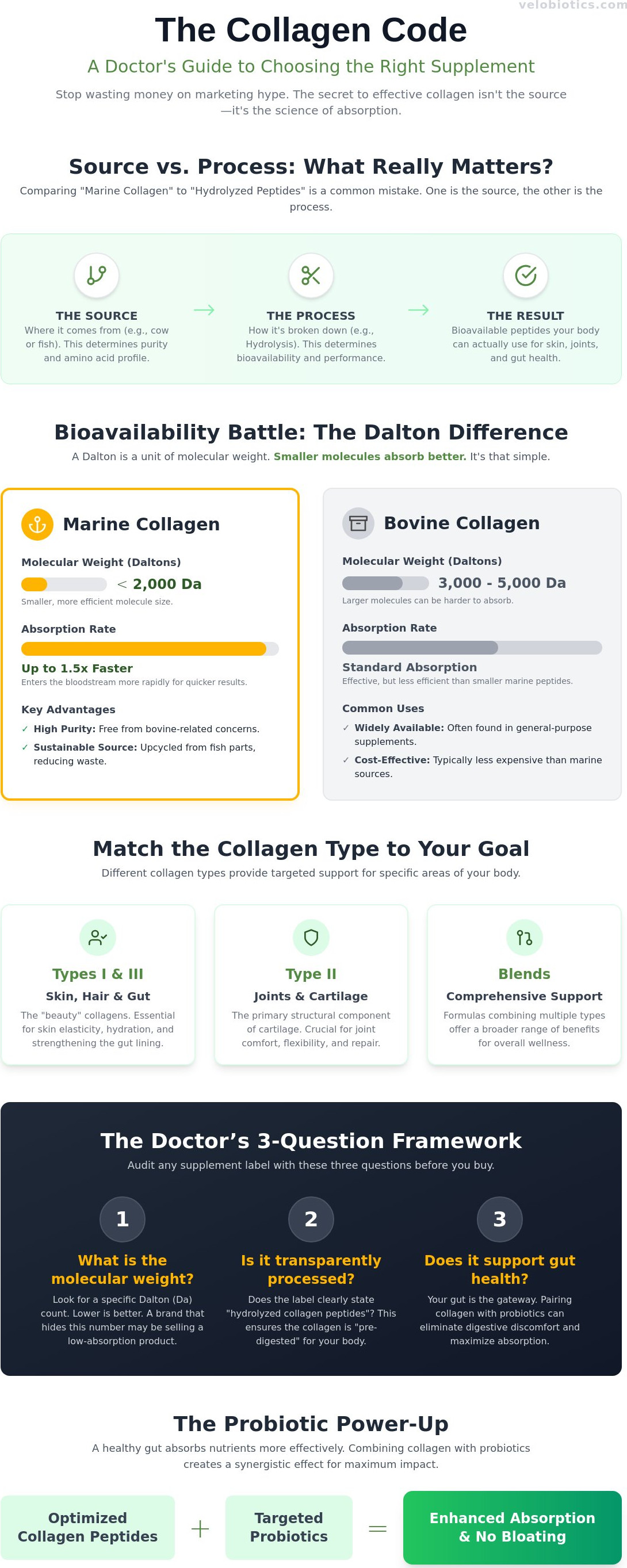
In my clinic, I often tell patients that your body isn't a bucket you just pour supplements into. When we evaluate hydrolyzed collagen peptides vs marine collagen, we have to talk about Daltons. A Dalton is a unit of molecular weight. The smaller the Dalton count, the easier it is for that protein to slip through your intestinal wall and into your bloodstream. Standard bovine peptides usually sit between 3,000 and 5,000 Daltons. Marine peptides, however, are often under 2,000 Daltons. This size difference is why marine sources can be absorbed up to 1.5 times faster than their land-based counterparts. It isn't just about the source; it's about the physics of the molecule.
As a doctor, my concern isn't how much collagen you swallow, but how much actually reaches your cells. You could consume 20 grams of a low-quality powder, but if the molecular weight is too high, most of it will simply pass through your system without being utilized. We want to maximize biological viability. The choice between hydrolyzed collagen peptides vs marine collagen ultimately depends on your target tissue and how much of the active ingredient survives your internal environment.
The Science of Molecular Weight (Daltons)
The threshold for intestinal permeability is generally around 4,000 Daltons. If a molecule is larger than that, your body has to work overtime to break it down further, or it simply fails to enter the blood. This is where marine collagen gets its "beauty" reputation. Because those peptides are so small, they reach the skin and hair follicles with incredible speed. On the other hand, bovine collagen's slightly larger peptides can be a secret weapon for your gut. These molecules linger a bit longer in the digestive tract, providing the structural material needed for collagen peptide supplementation for joint health and gut lining repair.
- Marine Peptides (<2,000 Da): Ideal for rapid skin elasticity and hair growth.
- Bovine Peptides (3,000–5,000 Da): Excellent for structural joint support and "sealing" the gut.
Stomach Acid: The Great Barrier
Your stomach acid is designed to destroy proteins. It doesn't care if you paid fifty dollars for those peptides; it's going to try and denature them immediately. This creates a massive efficacy gap in the supplement industry. You might swallow ten grams of collagen, but if only two grams survive the "acid bath" in a viable state, you're wasting money. This is why I advocate for advanced delivery systems like micro-encapsulation. By shielding the peptides, we ensure they reach the small intestine where they can actually be absorbed and put to work.
Peptide viability determines the actual dosage your body receives, not the number printed on the tub. If you're serious about supporting your digestive environment while improving your structural health, you need a delivery system that respects your internal biology.
Targeted Benefits: Skin Elasticity vs. Joint and Gut Support
When you're weighing hydrolyzed collagen peptides vs marine collagen, you're really choosing your biological target. Collagen isn't a single substance; it's a family of proteins with different roles. Type I is the "beauty" collagen, making up about 90% of your body's supply and providing structure to your skin, hair, and nails. Type II is the "cushion" found in your cartilage and joints. Type III is the "scaffolding" for your organs and, crucially, your gut lining. While marine sources are almost exclusively Type I, bovine sources usually offer a robust mix of Type I and Type III. This is why your specific health goal should dictate your source choice.
I often see patients who spend hundreds on skincare but ignore their digestive health. This is a mistake because of the Gut-Skin Axis. Your body can only synthesize new collagen if your gut is healthy enough to absorb the building blocks and your microbiome is balanced enough to facilitate the process. If your digestive tract is inflamed, even the best peptides won't reach your skin. You can't build a beautiful house on a crumbling foundation.
Marine Collagen for the 'Beauty' Enthusiast
If your primary goal is to erase fine lines and restore that youthful bounce, marine collagen is your best friend. These peptides are exceptionally high in hydroxyproline, an amino acid that acts as a direct signal to your fibroblasts. These are the "factory" cells in your dermis that produce new collagen. Scientific reviews on Marine Collagen for Skin Anti-Aging show that regular intake can significantly increase skin hydration and density. Because marine peptides are so small, they reach these skin cells faster, making them the gold standard for aesthetic results. They also provide the specific nutrients required for keratin production, which is why users often report stronger nails and thicker hair within weeks.
Bovine Peptides for Joint and Gut Integrity
For those dealing with joint discomfort or digestive issues like bloating, bovine-sourced peptides are the superior choice. The presence of Type III collagen is vital here because it forms the structural matrix of the intestinal wall. When we talk about "sealing" the gut, we're talking about using Type III collagen to repair the microscopic gaps in your lining. Bovine sources are also rich in glycine, an amino acid essential for joint lubrication and systemic recovery. I recommend a comprehensive Probiotics for Digestive Health strategy alongside bovine peptides. This synergy ensures your gut can actually utilize the glycine to rebuild cartilage and strengthen the gut barrier.
- Marine: Best for skin elasticity, wrinkle reduction, and hair growth.
- Bovine: Best for joint lubrication, gut lining repair, and muscle recovery.
- The Hybrid Approach: Many of my patients find the best results by alternating sources or using a blend that covers Types I, II, and III.
In the global market, bovine collagen still holds a 54.3% share as of 2026 because of this versatility. While marine collagen is growing faster at a 7.1% rate due to its aesthetic appeal, don't overlook bovine if your joints are clicking or your gut feels sluggish. Choosing between hydrolyzed collagen peptides vs marine collagen isn't about which is "better" overall, it's about which one solves your specific biological problem.
The Doctor’s Selection Framework: 3 Questions to Ask Before Buying
Choosing between hydrolyzed collagen peptides vs marine collagen shouldn't feel like a guessing game. As a doctor, I use a specific triage system to help patients select the right formula. With the global collagen supplements market estimated at 2.62 billion dollars in 2026, there's a lot of noise. You need a signal. Instead of getting lost in marketing fluff, ask these three clinical questions to ensure you're getting a product that actually works.
- Question 1: What is your primary health goal? If you want to erase fine lines, go marine. If you need to support joint cartilage or repair a "leaky" gut, bovine is your structural powerhouse.
- Question 2: Does the product list its molecular weight? As we discussed, Daltons matter. If a brand won't disclose its processing method or particle size, they might be hiding poor bioavailability. The proposed Dietary Supplement Listing Act of 2026 aims to force more transparency, but you should demand it now.
- Question 3: Are there "Enablers" included? Collagen doesn't work in a vacuum. Your body requires cofactors like Vitamin C to actually "knit" those peptides into new tissue.
For the best results, look for "Grass-Fed" on bovine labels or "Wild-Caught" for marine sources. These aren't just buzzwords. They're indicators that the source was free from the industrial contaminants and hormones that can trigger the very inflammation you're trying to fix.
Checking for Purity and Additives
I frequently warn my patients about the "collagen creamer" trap. Many of these trendy powders are loaded with maltodextrin, artificial sweeteners, and thickeners that feed bad gut bacteria. These additives can cause the exact bloating and digestive distress you're trying to avoid. Unflavored, pure peptides are the gold standard for medical-grade results. Always check for third-party testing certifications like NSF or Informed Choice. These seals verify that what is on the label is actually in the tub, which is critical for your safety and success.
The Synergy Factor: Why Collagen Alone Isn't Enough
Think of collagen peptides as the bricks and Vitamin C as the mortar. Without the mortar, the bricks just sit there. Beyond Vitamin C, the emerging science of 2026 highlights the role of probiotics in enhancing peptide absorption. A healthy microbiome produces the enzymes necessary to further break down peptides for systemic use. This is why a multi-strain probiotic approach is superior for beauty and wellness. It creates a fertile environment for the collagen to actually take root.
If you want to bypass the guesswork and ensure your supplements are biologically viable, you can view our clinically focused probiotic solutions that prioritize ingredient delivery and gut health.
The Velobiotics Solution: Probiotic-Enhanced Collagen Viability
I have spent my career as a physician obsessing over how to make active ingredients actually survive the human digestive tract. When we look at the marketplace for hydrolyzed collagen peptides vs marine collagen, we see a massive gap in delivery technology. It is not enough to just buy a high-quality source; you need a delivery system that respects your internal chemistry. That is why I developed the 16 Strains Probiotics Collagen Peptides. It is a hybrid approach that stops treating beauty and gut health as separate silos, instead focusing on the biological synergy between protein and bacteria.
Our proprietary micro-encapsulation technology acts as the molecular shield I discussed in earlier sections. It protects both the fragile probiotics and the hydrolyzed peptides from the corrosive environment of the stomach. This ensures that the dosage on the label actually reaches the small intestine in a viable state. By combining Type I and Type II collagen, we address both the dermal density of your skin and the structural integrity of your joints. This is my promise as a doctor: to bridge the gap between laboratory science and your daily routine with a supplement that actually does what it claims.
Why 16 Strains of Probiotics?
A diverse microbiome is the engine of absorption. We don't just want one or two strains; we need a broad spectrum of 16 specific strains to maximize the breakdown and uptake of amino acids. These strains were selected to target skin inflammation and reinforce gut wall integrity simultaneously. When your microbiome is optimized, the debate of hydrolyzed collagen peptides vs marine collagen becomes less about which source is "stronger" and more about how effectively your body can utilize the building blocks provided. For those who need intensive gut support, pairing your collagen with Velo16 Probiotic Digestive Capsules can provide the extra foundation needed for systemic wellness.
Actionable Next Steps for 2026
Consistency is the primary driver of physiological change. I recommend a strict 30-day protocol because that aligns with the typical cycle for cellular turnover in the skin. You won't see a total transformation overnight, but by day 30, the cumulative effect of bioavailable peptides becomes undeniable. To implement this, you can easily mix Almasi Probiotics Collagen Powder 200 g into your morning routine. Unlike standard powders that clump, our formulation is designed for solubility. You can Shop Velobiotics Collagen Solutions today to find the high-viability formula that fits your lifestyle and health goals for 2026.
Future-Proof Your Health with Bioavailable Science
We've navigated the complex landscape of hydrolyzed collagen peptides vs marine collagen to reveal that the source is only half the story. Your success depends on choosing Type I for aesthetic goals or Type III for structural gut and joint repair, while always prioritizing a low molecular weight for intestinal permeability. Remember that even the highest quality peptides are useless if they don't survive the journey through your stomach's harsh environment.
Achieving visibly better skin elasticity and reduced joint discomfort requires a delivery system that prioritizes biological viability over marketing claims. By utilizing our 16-strain probiotic delivery system and proprietary micro-encapsulation technology, we ensure our clinically backed Type I and II collagen reaches the cells that need it most. You don't have to settle for supplements that just end up as expensive waste.
Discover the Science of Bioavailable Collagen at Velobiotics
It's time to stop guessing and start supporting your body with the precision it deserves. Your path to a healthier gut and glowing skin is now backed by empirical evidence. You have the tools to make an informed choice that delivers real, tangible results for your daily wellness routine.
Frequently Asked Questions
Is marine collagen really better for skin than bovine collagen?
Marine collagen is generally superior for aesthetic goals because it consists almost entirely of Type I collagen, which is the primary building block of human skin. Because the fish-derived peptides are often under 2,000 Daltons, they reach the dermis faster than land-based alternatives. While bovine is a fantastic all-rounder for the whole body, marine's specific amino acid profile makes it the clinical choice for reducing fine lines and increasing hydration.
Can I take both hydrolyzed peptides and marine collagen together?
You can absolutely combine them to cover a broader range of biological needs. Taking hydrolyzed collagen peptides vs marine collagen together allows you to benefit from the skin-targeting Type I in fish and the joint-supporting Type III in bovine sources. This multi-source approach mimics the variety of proteins found in a diverse whole-food diet, providing a more comprehensive structural scaffolding for your entire body.
How long does it take to see results from collagen peptides?
You should expect to see initial skin hydration changes within 4 to 6 weeks of daily use. However, joint and bone density improvements typically require a longer commitment of 12 weeks or more. This timeline reflects the natural rate of cellular turnover and collagen synthesis in the human body. Consistency is your best friend here; skipping days resets the biological clock on your progress.
Do collagen supplements cause bloating or digestive upset?
Bloating usually happens when large, non-hydrolyzed protein molecules sit in the gut and ferment. If you choose high-quality hydrolyzed collagen peptides vs marine collagen that use micro-encapsulation, the risk of digestive upset is significantly lower. Pairing your collagen with a multi-strain probiotic also helps your gut break down the peptides efficiently, turning a potential irritant into a gut-healing tool that actually reduces inflammation.
Is marine collagen safe for people with shellfish allergies?
You should exercise extreme caution if you have a shellfish or fish allergy. While marine collagen is typically sourced from the skin and scales of fish rather than shellfish, cross-contamination in manufacturing facilities is a real risk. If you have a known allergy, bovine-sourced peptides are a much safer clinical alternative that provides similar structural benefits without the risk of a dangerous allergic response.
What is the best time of day to take my collagen supplement?
There isn't a perfect hour, but taking it on an empty stomach in the morning can lead to faster absorption. Alternatively, some of my patients prefer taking it at night to support the body's natural repair processes during deep sleep. The most practical advice is to pick a time that ensures you won't forget, as the cumulative daily dose is what drives long-term tissue repair.
Does heat (like hot coffee) destroy the benefits of hydrolyzed collagen?
You don't need to worry about your morning latte ruining your supplement. Hydrolyzed peptides have already been processed using heat and enzymes, making them stable up to about 300 degrees Celsius. This is much hotter than your standard cup of coffee or tea. Feel free to stir your powder into hot soups or beverages without fear of denaturing the active protein chains.
Can men benefit from marine collagen, or is it just for women?
Collagen is a gender-neutral protein essential for every human body regardless of sex. Men often find marine collagen particularly useful for maintaining hair density and supporting skin health after shaving. Additionally, the amino acids in these peptides assist in muscle recovery and tendon strength after exercise. It isn't just a beauty product; it's a foundational structural supplement that supports longevity and performance for everyone.

Disclaimer
Information and statements regarding dietary supplements/products have not been evaluated by the Food and Drug Administration, MCC/SAHPRA, MHRA, TGA or any other drug regulatory authority and are not intended to diagnose, treat, cure, or prevent any disease. Information on this website is provided for informational purposes only and is a result of years of practice and experience by the author. This information is not intended as a substitute for the advice provided by your physician or other healthcare professional or any information contained on or in any product label or packaging. Do not use the information on this website for diagnosing or treating a health problem or disease, or prescribing medication or other treatment. Always speak with your physician or other healthcare professional before taking any medication or nutritional, herbal, or homeopathic supplement, or using any treatment for a health problem. If you have or suspect that you have a medical problem, contact your healthcare provider promptly. Do not disregard professional medical advice or delay in seeking professional advice because of something you have read on this website.