

Preventing BV After Your Period: A Doctor's Guide
Why does your body seem to lose its biological balance the moment your period finally ends? If you're constantly searching for how to prevent bv after period cycles, you've likely noticed a shift in your scent that feels impossible to ignore. It isn't a hygiene failure. It's a predictable reaction to the fact that menstrual blood has a pH of approximately 7.4, which acts as a significant alkaline disruptor to your naturally acidic environment. This shift allows unwanted bacteria to thrive while your protective flora struggles to survive.
I recognize the anxiety of feeling like you can be smelled through your clothing or the frustration of using drugstore products that only irritate your delicate microbiome further. You deserve a solution rooted in clinical evidence rather than vague wellness promises. In this guide, I'll explain the scientific mechanism behind these shifts and provide a clear, actionable protocol to reset your pH and repopulate your beneficial flora. We're going to move past the confusion of normal cycle changes and give you a doctor-approved strategy to reclaim your confidence and intimate health.
Key Takeaways
- Understand why the alkaline nature of menstrual blood, which has a pH of 7.4, weakens your vaginal defenses.
- Learn to distinguish between normal post-flow metallic scents and the fishy odors that signal a clinical imbalance.
- Discover how to prevent bv after period by adopting a "Reset and Repopulate" protocol to restore your protective mucosal layer.
- Identify why traditional feminine washes and douching actually accelerate microbiome damage rather than fixing it.
- Find out when to use boric acid for an immediate pH reset versus using probiotics for long-term bacterial defense.
The Science of the Post-Period Shift: Why Your Scent Changes
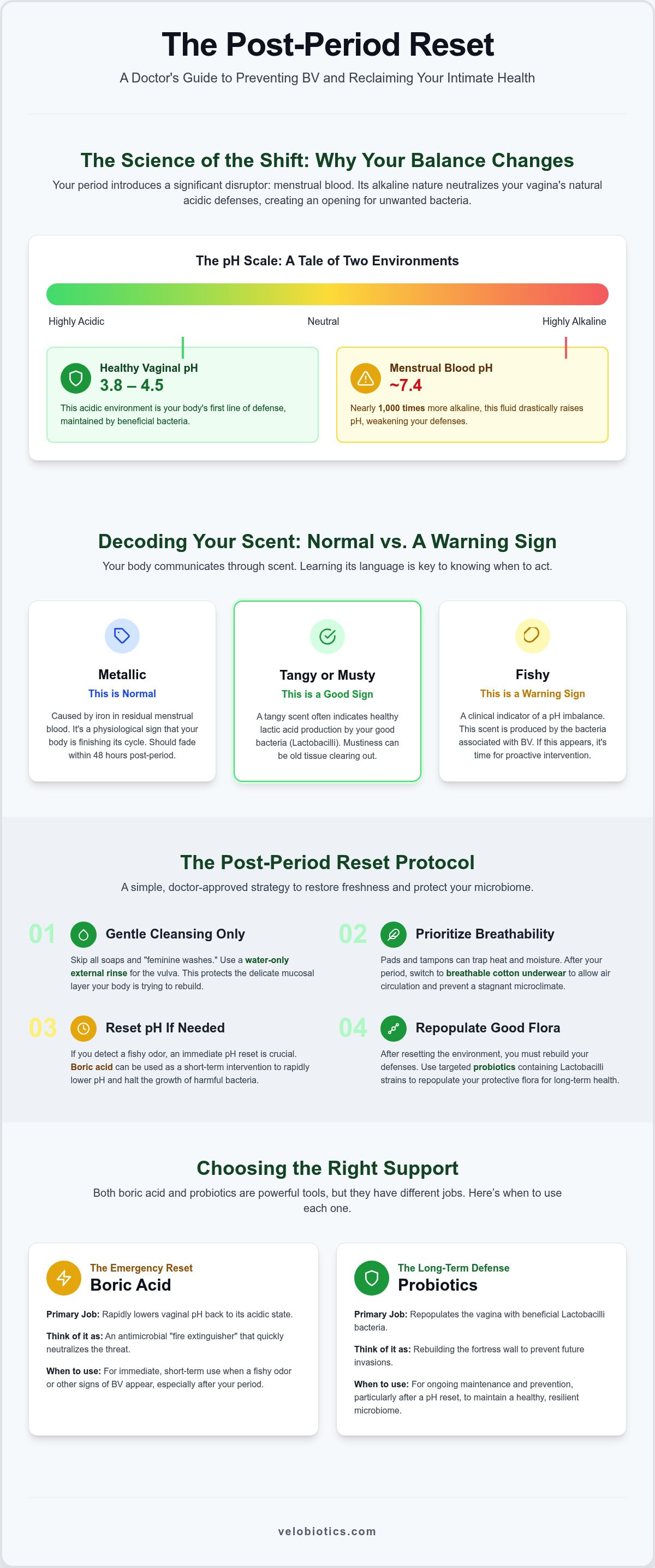
The vaginal ecosystem is a marvel of biological engineering, specifically designed to be inhospitable to pathogens. Under normal circumstances, your body maintains a highly acidic environment with a pH between 3.8 and 4.5. This acidity is your first line of defense. However, every month, a significant biological disruptor arrives: your period. Menstrual blood has a pH of approximately 7.4. To put that in perspective, blood is nearly 1,000 times more alkaline than your natural vaginal state. When this fluid enters the canal, it acts as a chemical buffer, neutralizing the acidity and raising the overall pH. This shift creates a "VIP invitation" for the anaerobic bacteria associated with Bacterial vaginosis. If you've been searching for how to prevent bv after period symptoms start, you must first respect this fundamental shift in chemistry.
The Lactobacilli Factor
Your internal peace is kept by a specific group of "good" bacteria called Lactobacilli. These microbes consume glycogen from your vaginal lining and convert it into lactic acid, which keeps the pH low. When menstrual blood floods the environment, it literally "drowns out" these beneficial microbes. The alkaline blood neutralizes the lactic acid they've worked so hard to produce, causing their population to plummet. The sudden pH spike caused by residual menstrual fluid is the primary trigger for post-period odor. Without enough Lactobacilli to police the area, opportunistic bacteria begin to multiply rapidly.
Hormones and Moisture
Chemistry isn't the only factor at play; your hormones and external environment also contribute to the risk. During your period, estrogen levels drop to their lowest point. This drop is significant because estrogen helps maintain the thickness of the vaginal lining and the levels of glycogen available for your good bacteria. Less estrogen means less "fuel" for your protective flora. Learning how to prevent bv after period reoccurrence involves more than just washing; it requires managing the moisture and hormonal dips that occur simultaneously.
Additionally, the use of pads and tampons can trap heat and moisture against the body. This creates a stagnant, warm, and alkaline microclimate where bacteria thrive. Breathability is a biological requirement, not just a fashion choice. Switching to breathable cotton or utilizing a targeted reset like Femina Probiotic COOKIE FRESH Suppositories can help address these environmental stressors before they lead to a full-blown infection.
Metallic vs. Fishy: Decoding Your Post-Period Odor
Decoding your body's olfactory signals is an essential skill for anyone learning how to prevent bv after period cycles. Not every scent is a cause for alarm. Most post-period odors follow a very specific biological logic, and understanding the difference between a temporary shift and a clinical problem can save you a lot of unnecessary stress. Your vagina is an incredibly communicative organ; you just need to know the vocabulary.
A metallic scent is the most common observation during and immediately after your flow. This is entirely physiological, driven by the iron content in the hemoglobin of your menstrual blood. It simply means your body is still clearing the last of the uterine lining. In contrast, a fishy odor is a clinical indicator of a pH imbalance. This scent arises from volatile amines produced by anaerobic bacteria that multiply when your acidity levels drop. If you notice a tangy or slightly musty scent, it's actually a good sign. This usually reflects a healthy, Lactobacillus-dominant environment where lactic acid production is working as it should.
The tipping point between "cycle-normal" and "infection-ready" occurs when the scent persists or worsens more than 48 hours after your flow ends. If that metallic tang shifts into a sharp, pervasive fishy odor, your microbiome hasn't successfully self-corrected. This is the moment where proactive intervention becomes necessary to stop a full infection from taking hold.
The Old Blood Theory
Residual tissue and blood trapped in the vaginal folds can sometimes create a temporary musty smell. This isn't BV. It's the natural breakdown of organic material that hasn't quite exited yet. This usually clears up within 48 hours of your period ending naturally. For a simple reset, I recommend a water-only external rinse protocol for the vulva. Skip the soaps entirely. Even the mildest cleansers can strip the protective mucosal layer your body is trying to rebuild during this vulnerable window.
The BV Warning Signs
Clinical BV typically involves more than just a scent. You might notice a thin, grayish-white discharge that coats the vaginal walls. A classic diagnostic tool we use in the lab is the "Whiff Test." If the odor intensifies significantly after contact with alkaline triggers, like semen or certain soaps, it's a sign that the bad bacteria have taken over. Focus on preventing BV from settling in by prioritizing microbiome restoration. To understand the latest clinical approaches, check out our guide on Probiotics for BV: A Doctor’s Guide to Restoring Your Vaginal Microbiome in 2026. If you need to clear out residual odors and reset your pH immediately, consider a targeted option like Femina COOKIE FRESH Boric Acid ONLY Suppositories.
The Douching Trap: Why Feminine Washes Fail Your Microbiome
The instinct to "scrub away" the remnants of your period is powerful, but it's a biological trap. Many patients ask me how to prevent bv after period cycles by using specialized washes, and my answer is always the same: stop scrubbing. Your vagina is a sophisticated, self-cleaning organ. It doesn't require internal intervention to stay healthy. When you use douching products or internal washes, you're essentially performing an ecological scorched-earth policy on your microbiome. You aren't just cleaning; you're clearing out the very defenses you need.
The problem lies in the Rebound Effect. By attempting to eliminate a temporary odor, you strip away the protective mucosal layer and the very Lactobacilli that keep pathogens at bay. This leaves a vacuum that bad bacteria are more than happy to fill. Consequently, the odor returns within hours, often stronger and more persistent than before. As noted in the Bacterial Vaginosis - CDC Fact Sheet, douching is a primary risk factor for developing an infection precisely because it upsets this delicate balance. It's a cycle of "cleaning" that leads directly to more clinical symptoms.
Surfactants vs. Bio-Chemistry
Soaps and washes rely on surfactants, which are chemicals designed to break down oils and dirt. On your hands, they're great. In your vagina, they're a disaster. These chemicals break down the essential fatty acids that protect your vaginal skin and maintain its integrity. It's vital to distinguish between external vulvar cleaning, which only requires tepid water, and internal vaginal cleansing, which should never happen. If you can smell a scent through your clothing, the issue is an internal pH spike. The solution is pH correction, not a surface-level soap that further destabilizes your chemistry.
The Myth of Fresh Scents
If a product smells like a "summer breeze" or a "floral garden," it's a red flag for your vaginal health. Drugstore feminine products are often loaded with chemical irritants and perfumes that trigger inflammation and further disrupt your pH. These fragrances don't fix the problem; they just mask it while simultaneously making the environment more alkaline. Instead of reaching for perfumes, focus on clinical-grade pH balancers. Options like Femina COOKIE FRESH Boric Acid ONLY Suppositories work with your biology to reset the environment without the damage caused by harsh surfactants.
The Post-Period Reset Protocol: 4 Steps to Freshness
If you want to master how to prevent bv after period symptoms from becoming a recurring monthly nightmare, you need a protocol that respects your biology. Proactive care is always more effective than reactive treatment. My "Reset and Repopulate" methodology is designed to address the environment first and the inhabitants second. By following these four steps, you can guide your microbiome back to its natural, acidic state within 72 hours of your flow ending.
- Step 1: Hydrate and Oxygenate. Switch to 100% cotton underwear immediately post-flow. Anaerobic bacteria, the ones responsible for fishy odors, thrive in low-oxygen environments. Cotton allows for air circulation, which naturally inhibits their growth.
- Step 2: External Hygiene Only. Use tepid water to rinse the vulva. Avoid all internal soaps, even those marketed as "pH balanced." Your body is already working to restore its mucosal layer; don't interfere with that process.
- Step 3: pH Correction. Use clinical-grade Boric Acid to drop the pH back to acidic levels. This provides the "reset" your system needs.
- Step 4: Microbiome Repopulation. Introduce targeted probiotics to the environment to ensure the "good" bacteria outcompete the bad.
Why Boric Acid is the Reset Button
Boric Acid has a 100-year history in gynecological health for a reason: it works. Unlike antibiotics that can be indiscriminate, Boric Acid specifically targets the biofilm, a protective slimy layer, that bad bacteria hide in. It’s important to understand that Boric Acid does not kill everything; it simply makes the soil too acidic for bad seeds to grow. By lowering the pH, you create a hostile environment for pathogens while clearing the way for your natural flora to return. This is the most effective way to handle the alkaline spike we discussed earlier.
The Power of Probiotic Viability
Many people suggest eating yogurt or taking generic oral supplements, but these methods have incredibly low biological viability for vaginal health. Most oral probiotics never reach the vaginal canal because they're destroyed by harsh stomach acid. For immediate relief and long-term protection, you need direct-to-source probiotic suppositories. To learn more about why delivery systems matter, read about Probiotics That Survive Stomach Acid: The Science of Effective Delivery in 2026. For a comprehensive solution that handles both the reset and repopulation phases, I recommend using Femina Probiotic COOKIE FRESH Suppositories.
Choosing the Right Support: Boric Acid vs. Probiotics
Navigating the shelf of feminine health products can be overwhelming, but the choice between boric acid and probiotics doesn't have to be a guessing game. When you're focused on how to prevent bv after period cycles, you need to understand the distinct roles these two powerhouses play. Boric acid is your tactical cleanup crew. It's designed to enter the environment, immediately neutralize the alkaline shift caused by menstrual blood, and dissolve the bacterial biofilms that cause that telltale odor. Probiotics, on the other hand, are your long-term defense force. They don't just clear the air; they occupy the space, producing lactic acid to ensure bad bacteria can't find a foothold.
The gold standard for post-period maintenance is a dual-action approach. If you only use boric acid, you've reset the pH but left the "soil" empty. If you only use probiotics without a pH reset, those beneficial microbes may struggle to survive in an environment that is still too alkaline. By combining them, you reset the chemistry and immediately repopulate the territory. This prevents the rebound effect where odor returns the moment you stop "cleaning."
The Velobiotics Difference: Micro-encapsulation
In the world of microbiome health, stability and viability are the two most important words. Most over-the-counter probiotics are fragile; they often die on the shelf or shortly after application due to moisture and temperature changes. We utilize a proprietary micro-encapsulation technology that acts as a protective shield, keeping the probiotics alive until they are needed. This technology ensures a 10x higher probiotic survival rate compared to standard market offerings. For a seamless reset, I recommend the Femina Probiotic COOKIE FRESH Suppositories with Boric Acid, which delivers both a clinical pH balancer and protected probiotics in a single, dual-action tool.
Long-term Maintenance Strategies
True health is built on consistency. For daily systemic support, incorporating Femina Probiotic Capsules with Cranberry Extract into your routine helps maintain a baseline of beneficial flora from the inside out. Then, implement a post-period suppository routine: use one suppository for one to three nights immediately after your flow ends. This single night of reset can prevent a whole month of worry and keep your confidence intact. My final doctor's note is simple: listen to your body; it speaks in scents. If you notice a shift, don't wait for an infection to settle. Take proactive steps to restore your natural balance and learn how to prevent bv after period recurrence for good.
Take Control of Your Monthly Microbiome Reset
Understanding the biology of your cycle is the first step toward lasting comfort. We've explored how the alkaline nature of menstrual blood, with its pH of 7.4, creates a temporary vulnerability that pathogens love to exploit. By moving away from disruptive soaps and embracing a "Reset and Repopulate" methodology, you finally have a clear roadmap for how to prevent bv after period cycles. The goal isn't just to mask a scent; it's to rebuild the acidic environment where your protective flora can flourish once again.
You don't have to navigate these monthly shifts with guesswork. Our solutions are doctor-formulated for maximum biological viability, ensuring that active ingredients are successfully delivered to where they're needed most. If you're ready to stop the cycle of frustration, it's time for a protocol that offers dual-action Boric Acid and probiotics. Reset your microbiome with Femina Cookie Fresh Suppositories and experience the power of clinically-backed pH restoration. You've got the tools and the knowledge to stay balanced and confident all month long.
Common Questions About Post-Period Health
Why does my vagina smell like fish only after my period?
A fishy odor after your period is a clinical sign that your vaginal pH has become too alkaline, allowing anaerobic bacteria to overgrow. Menstrual blood has a pH of approximately 7.4, which neutralizes your natural acidity and triggers this shift. If you're looking for how to prevent bv after period odors, focusing on immediate pH correction once your flow stops is the most effective strategy to stop these bacteria from multiplying.
Is it normal to have a metallic smell at the end of my cycle?
Yes, a metallic scent is completely normal and expected at the end of your cycle. This smell is caused by the iron content in the hemoglobin found in menstrual blood. It usually dissipates within 24 to 48 hours as your body finishes clearing the uterine lining. Unlike a fishy odor, this scent doesn't indicate an infection or a need for clinical intervention.
Can I use boric acid suppositories while I am still bleeding?
You can use boric acid suppositories while bleeding, but they are most effective when used during the "spotting" phase or immediately after your flow ends. Using them during heavy bleeding may result in the product being washed away before it can properly balance your pH. For the best results, wait until the final day of your period to begin your reset protocol.
How long does it take for the post-period smell to go away naturally?
A healthy vaginal microbiome typically self-corrects within two to three days after your period ends. During this window, your Lactobacilli work overtime to produce lactic acid and lower the pH back to its acidic baseline. If the odor persists beyond 72 hours, it's a sign that your natural defenses haven't successfully regained control and you may need proactive support.
Do probiotics really help with vaginal odor?
Probiotics are highly effective at managing vaginal odor because they repopulate the environment with "good" bacteria that produce protective lactic acid. These microbes act as a biological defense force against the odor-causing bacteria that thrive after your period. To see real results, ensure you use targeted strains that are specifically known for maintaining vaginal health rather than generic gut supplements.
What should I do if the odor is accompanied by itching or burning?
If your odor is paired with itching, burning, or significant irritation, you should consult a healthcare provider for a proper diagnosis. While BV is common, these symptoms can also indicate a yeast infection or other underlying issues. It's important to rule out other conditions before starting an at-home reset protocol to ensure you're using the correct treatment for your specific needs.
Can my diet affect how I smell after my period?
Your diet can indirectly influence your post-period scent by affecting the overall balance of bacteria in your body through the gut-vaginal axis. High-sugar diets can encourage the growth of unwanted organisms, while fermented foods support a healthy microbiome. While diet isn't the only factor in how to prevent bv after period cycles, maintaining a balanced gut provides a stronger foundation for your intimate health.
Is it safe to use scented panty liners to mask the smell?
You should avoid scented panty liners because the fragrances and chemicals can severely irritate your vaginal lining and further disrupt your pH. Masking the smell with perfumes doesn't address the underlying bacterial imbalance; instead, it often causes inflammation that makes the environment more alkaline. Stick to unscented, 100% cotton liners to allow for proper oxygenation and prevent moisture buildup.

Disclaimer
Information and statements regarding dietary supplements/products have not been evaluated by the Food and Drug Administration, MCC/SAHPRA, MHRA, TGA or any other drug regulatory authority and are not intended to diagnose, treat, cure, or prevent any disease. Information on this website is provided for informational purposes only and is a result of years of practice and experience by the author. This information is not intended as a substitute for the advice provided by your physician or other healthcare professional or any information contained on or in any product label or packaging. Do not use the information on this website for diagnosing or treating a health problem or disease, or prescribing medication or other treatment. Always speak with your physician or other healthcare professional before taking any medication or nutritional, herbal, or homeopathic supplement, or using any treatment for a health problem. If you have or suspect that you have a medical problem, contact your healthcare provider promptly. Do not disregard professional medical advice or delay in seeking professional advice because of something you have read on this website.