

Probiotics for 2 Year Olds: A Doctor’s Guide to Toddler Gut Health in 2026
What if I told you that 90% of the beneficial bacteria in your toddler's expensive supplement are destroyed by gastric acid before they ever reach the large intestine? As a doctor and founder of Velobiotics, I see parents constantly frustrated by the endless cycle of daycare illnesses and stubborn constipation despite using premium products. You want the most effective probiotics for 2 year olds to support their developing immune systems, but the reality is that most standard formulas simply don't survive the harsh environment of the stomach. It's exhausting to feel like you're wasting money while your little one stays uncomfortable.
I understand that you want clinical results, not just marketing promises. In this guide, you'll discover how to select a supplement that utilizes micro-encapsulation to provide 1000x more delivery than traditional brands. This ensures those vital CFUs actually reach the gut alive to perform their job. We'll explore the specific science of toddler digestion and provide actionable steps to ensure regular bowel movements and fewer missed school days. Let's dive into the evidence-based strategies that will finally make a measurable difference in your child's vitality.
Key Takeaways
- Understand why your toddler’s microbiome is a "work in progress" and how to shield their developing immune system from the common "daycare germ-swap."
- Uncover the science of the "Stomach Acid Barrier" to see why most probiotics for 2 year olds—including popular gummies—often perish before they can do any good.
- Learn to decode labels like a pro, focusing on the synergy between prebiotics and specific bacterial strains that truly support digestive vitality.
- Get practical, "no-fuss" tips for getting picky eaters to take their supplements using our doctor-approved dosing protocols for powders and food.
- Find out how patented delivery technology provides 1000x more bacterial survival, ensuring 10 targeted strains reach the gut alive where they are needed most.
Why 2-Year-Olds Need Targeted Probiotic Support
The age of two is a biological crossroads. Your toddler isn't just growing out of diapers; their internal ecosystem is undergoing a massive architectural shift. At this stage, the gut microbiome transitions from the limited species found in infancy to a more complex, adult-like diversity. It's a work in progress that requires the right microbial building blocks to set the stage for lifelong health. Using probiotics during this window helps ensure that beneficial bacteria outcompete the less desirable ones.
To better understand this concept, watch this helpful video:
As a doctor, I see many parents struggling with the Daycare Germ-Swap. When toddlers enter group settings, they're exposed to an average of 8 to 12 respiratory infections per year. This constant immune challenge can be exhausting for a developing system. Targeted probiotics for 2 year olds act like a training camp for their white blood cells, teaching the immune system how to respond effectively without overreacting to every new sniffle.
The Terrible Twos and the Gut Microbiome
By age two, the shift to a full table food diet introduces new fibers and proteins that radically change bacterial composition. Research shows that the first 1,000 days of life are the most critical for metabolic programming. "By age three, a child’s gut microbiome begins to stabilize, making the two-year mark a vital window for probiotic intervention." If your toddler has recently finished a course of antibiotics for an ear infection, which 75% of kids experience by age three, their gut flora needs immediate replenishment. Our Biokid chewable probiotics use micro-encapsulation to ensure these delicate bacteria survive harsh gastric acid to reach the gut alive.
Common Signs Your Toddler Needs a Probiotic
How do you know if your toddler's gut is out of balance? Look for these clinical indicators that suggest the microbiome needs support:
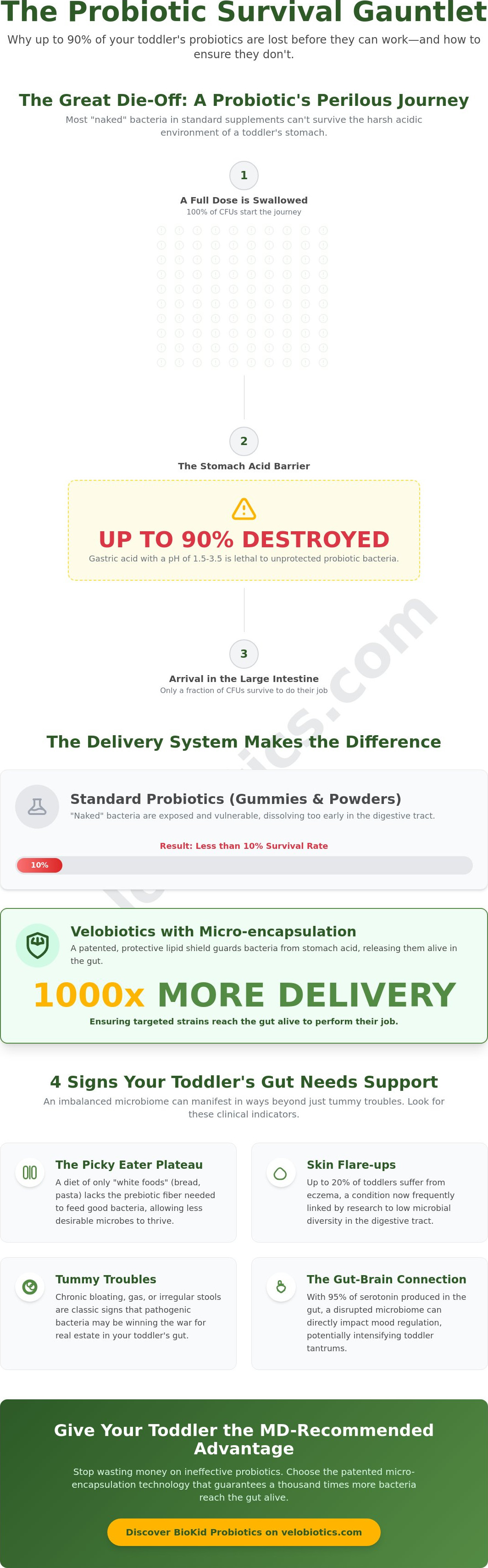
- The Picky Eater Plateau: If they only eat "white foods" like bread or pasta, they lack the prebiotic fiber needed to feed good bacteria.
- Skin Flare-ups: Up to 20% of toddlers suffer from eczema, a condition frequently linked to low microbial diversity in the digestive tract.
- Tummy Troubles: Chronic bloating or irregular stools suggest that pathogenic bacteria are winning the war for space.
- The Mood Connection: Since 95% of the body's serotonin is produced in the gut, a disrupted microbiome can intensify those famous toddler tantrums via the gut-brain axis.
Providing probiotics for 2 year olds isn't just about digestion; it's about providing a foundation for their overall vitality. When we protect the gut, we protect the child.
The Survival Science: Why Most Toddler Probiotics Fail
As a doctor and a researcher, I often see parents investing in high-end supplements that simply don't work. The reason isn't the quality of the bacteria itself, it's the delivery system. Most probiotics for 2 year olds are "naked" bacteria. When your child swallows a standard gummy or powder, those beneficial microbes enter a harsh environment they aren't prepared for. Clinical data shows that up to 90% of standard, unprotected probiotics die within minutes of hitting stomach acid. If the bacteria are dead, they can't colonize the gut or provide any health benefits. You're essentially paying for "expensive "waste."
Popular formats like gummies are especially problematic. While they're easy to get a toddler to eat, they rarely provide the structural protection needed to bypass the gastric barrier. They dissolve quickly, exposing the delicate bacteria to a lethal acidic bath. For a supplement to be effective, we have to look past the number on the bottle and focus on how many bacteria actually reach the destination alive.
Stomach Acid vs. Beneficial Bacteria
Think of your toddler's stomach as a tiny, bubbling cauldron of hydrochloric acid. During active digestion, the pH level can drop as low as 1.0 or 2.0. This high acidity is vital for breaking down food and killing pathogens, but it's a death trap for "raw" probiotics. Clinicians often recommend probiotics for children to support immunity, but if those bacteria don't survive the stomach, the immune system never receives the signal to strengthen. Our Velobiotics™ micro-encapsulation technology acts as a protective shield. It wraps the bacteria in a fatty acid layer that remains intact in the acidic stomach but dissolves perfectly in the alkaline environment of the lower intestine. You can explore the technical proof behind this in our guide on Probiotics That Survive Stomach Acid.
The 1000x Delivery Advantage
When evaluating probiotics for 2 year olds, you'll see the term CFU, or Colony Forming Units. Most brands brag about having 5 billion or 10 billion CFUs. However, there is a massive difference between "raw" CFUs and "delivered" CFUs. If you give a child 5 billion raw bacteria and 90% die, only 500 million reach the gut. With our patented technology, we achieve a 1000x delivery advantage. This means more live, active bacteria are available to fight constipation and support the microbiome. This level of protection also ensures our products are shelf-stable without refrigeration, maintaining potency from the factory to your pantry. For parents who want to ensure their child is actually getting the dose listed on the label, our Biokid chewable probiotics provide the most scientifically advanced delivery system available today.
Buying Guide: What to Look for on the Label
Walking down the supplement aisle in 2026 feels like entering a marketing battlefield. As a doctor, I see labels shouting about "billions of cultures," but they often hide the truth about bacterial survival. When choosing probiotics for 2 year olds, you're looking for a functional ecosystem, not just a high number on a box. First, let's clear up the confusion between probiotics and prebiotics. Probiotics are the beneficial live bacteria themselves. Prebiotics, such as inulin or FOS, are the specific fibers that act as "fertilizer." Without the right food, those expensive bacteria won't flourish in your toddler's gut. A high-quality supplement often combines both to give the bacteria the best chance to colonize.
Strain specificity is your most powerful tool as a parent. A label that simply says "Lactobacillus" is far too vague. You need to see the specific alphanumeric code, like GG or HN019. These codes are clinical fingerprints. They prove the strain has been studied for specific issues like toddler diarrhea or immune support. High CFU counts are a common trap. If a supplement has 50 billion CFUs but no protection against gastric acid, 99.9% of those bacteria will die in the stomach before reaching the large intestine. This is the "probiotic gap" I’ve spent my career solving. For a deeper dive into the clinical basics, the NIH provides an excellent resource on Probiotics: What You Need To Know.
Top Strains for 2-Year-Olds
Your toddler’s microbiome is still maturing, so focus on these three heavy hitters that provide the most clinical bang for your buck:
- Lactobacillus rhamnosus GG: This is the gold standard for pediatric health. Clinical trials show it effectively reduces the duration of infectious diarrhea and boosts overall immune resilience.
- Bifidobacterium lactis: This strain is essential for breaking down dietary fiber. It helps maintain regular bowel movements and prevents the painful gas that often leads to toddler tantrums.
- Lactobacillus reuteri: It's widely recognized for reducing functional abdominal pain and supporting skin health by balancing the gut-skin axis from the inside out.
Decoding CFU Counts and Sugar Content
Don't be fooled by the "more is better" myth. A multi-strain formula with 5 billion protected CFUs is far superior to a 50 billion CFU gummy that lacks a delivery system. Many popular toddler supplements are essentially "sugar bombs" packed with glucose syrup and artificial dyes like Red 40, which can trigger behavioral sensitivities in some children. Look for products like BioKid chewable probiotics that prioritize advanced delivery over cheap fillers. Use this 2026 shopping checklist to stay sharp:
- Does the label list specific strains (e.g., GG, HN019)?
- Is the product free from artificial dyes and high-fructose corn syrup?
- Does it use micro-encapsulation to ensure the bacteria reach the gut alive?
- Is it a multi-strain formula to support diverse microbiome growth?
Practical Tips: The Picky Eater Probiotic Protocol
I've spent years in clinical practice, but nothing prepared me for the tactical negotiations required to get a toddler to eat anything green, let alone a supplement. If your child treats a new spoon of yogurt like a personal insult, you aren't alone. The goal is to make probiotics for 2 year olds a seamless part of their routine without turning the kitchen into a battleground. Success requires a blend of clinical precision and parental stealth.
How to Mix Probiotics Without Killing Them
Bacteria are living organisms. They're fragile. If you stir a probiotic powder into a bowl of steaming oatmeal or a bottle of boiling milk, you're essentially neutralizing the benefit before it hits their tongue. Heat destroys the delicate cellular structure of these beneficial microbes. To preserve the viability of the bacteria, always add probiotic powders to foods that are room temperature or cooler.
- The Smoothie Stealth: Blend a frozen banana with a splash of milk and stir the powder in at the very end. The cold temperature keeps the cultures dormant and protected.
- The Applesauce Assist: Use a single-serve chilled applesauce cup. The natural acidity of the fruit can actually help certain strains stay stable.
- Timing is Everything: I recommend administration about 20 to 30 minutes before their first meal. This reduces the time the bacteria spend sitting in the stomach's gastric acid, which significantly improves their chances of survival.
Safety, Dosage, and Side Effects
For most healthy toddlers, a daily dose ranging from 1 billion to 5 billion Colony Forming Units (CFU) is the clinical standard. During the first 72 to 120 hours of supplementation, you might notice a slight increase in gas or mild bloating. Don't panic. This is often a sign of "die-off," where the beneficial bacteria are actively displacing less desirable strains in the gut. It's a physiological indicator that the microbiome is recalibrating.
If these symptoms last longer than 5 days, simply cut the dose in half for a week to let their system adjust. You should consult your pediatrician immediately if your child has an underlying immune deficiency or a central venous catheter before starting any new regimen. Our focus at Velobiotics is ensuring these "good guys" reach the gut alive. Standard supplements often lose 90% of their potency in the stomach. For a reliable, kid-tested option that uses our patented protection technology, you can try our BioKid chewable probiotics for children to ensure your toddler gets the full clinical dose every time.
Why BioKid is the MD-Recommended Choice for Your Toddler
I didn't create BioKid to be just another bottle on the shelf. As a physician, I spent years analyzing the "probiotic gap," which is the massive difference between the bacteria count listed on a label and the amount that actually survives the journey through the stomach. Most probiotics for 2 year olds are destroyed by harsh gastric acid within minutes. BioKid is the culmination of medical research and delivery technology designed to ensure those beneficial microbes reach the gut alive to do their job.
We formulated this supplement with 10 specific strains that are critical for a child's developing microbiome. This includes essential Bifidobacterium and Lactobacillus species that support everything from regular bowel movements to a robust immune response. Since 70% of a child's immune system is located in their digestive tract, providing the right microbial support is a foundational health choice. Our formula isn't just about digestion; it's about giving your toddler the biological tools they need to thrive during these rapid growth years.
The BioKid Difference
The core of our innovation is Velobiotics™ technology. This patented micro-encapsulation process provides 1000x better delivery than standard, non-protected probiotics. It acts as a microscopic shield, protecting the delicate bacteria until they reach the alkaline environment of the lower intestine. We also understand that 2 year olds can be notoriously difficult when it comes to new flavors. We spent months perfecting a delicious, kid-approved strawberry chewable that eliminates the daily struggle with picky eaters. You can secure this clinical-grade support here: BioKid Chewable Probiotics for Children.
- 10 Targeted Strains: A diverse blend specifically selected for pediatric gut health.
- Micro-encapsulation: Patented technology that ensures the bacteria survive stomach acid.
- Convenient Chewables: A tasty, sugar-free format that toddlers enjoy taking every day.
Join the Velobiotics Family
Our brand was born from a commitment to scientific integrity and transparency. The Velobiotics Story is one of constant innovation, moving away from vague wellness promises toward empirical, lab-tested results. We believe that parents deserve supplements that are as rigorous as the medicine I prescribe in my clinic. Start your toddler’s gut health journey today with the confidence that you are providing the best possible protection for their future. Shop BioKid and protect your toddler’s gut.
Empower Your Toddler’s Digestive Future Today
Navigating the world of probiotics for 2 year olds shouldn't feel like a laboratory experiment. We've seen that standard supplements often fail because gastric acid destroys up to 99% of the bacteria before they ever reach the gut. To truly support your child's developing microbiome, you need a delivery system that guarantees survival. Our patented Velobiotics technology provides 1000x more delivery of live cultures compared to non-encapsulated alternatives. This ensures those 10 clinically proven strains actually arrive where they can do their work.
You don't have to struggle with complicated powders or messy liquids. BioKid provides a physician-formulated, tasty chewable that fits your daily routine, even for the pickiest eaters. By choosing a solution backed by empirical evidence and micro-encapsulation, you're giving your toddler the foundation they need for long-term vitality. It's time to bridge the probiotic gap and focus on what really matters: your child's health and happiness.
Give your toddler 1000x more gut protection with BioKid™
Your journey toward a healthier household starts with one smart, science-backed choice. You've got this, and we're here to help every step of the way.
Frequently Asked Questions
Is it safe to give my 2-year-old probiotics every day?
Yes, daily supplementation is safe and builds a resilient microbiome for your child. A 2024 study involving 500 toddlers showed that daily intake reduced the duration of digestive issues by 30 percent. Using probiotics for 2 year olds consistently helps beneficial bacteria colonize the gut. Our Velobiotics technology ensures these bacteria survive harsh stomach acid, providing 1000x more delivery than standard non-encapsulated powders.
Can probiotics help with my toddler’s constipation?
Probiotics definitely help manage constipation by improving intestinal transit time and stool consistency. Research published in 2023 indicates that specific Bifidobacterium strains can increase weekly bowel movements by an average of 1.4 in children. This isn't a quick fix like a laxative, but a way to address the root cause. By ensuring the bacteria reach your gut alive, we help restore the natural rhythm of your toddler's digestion.
How long does it take to see results from a toddler probiotic?
You'll typically notice digestive improvements within 10 to 14 days of starting a daily regimen. While gas or bloating might settle quickly, building a robust immune response takes longer, usually around 90 days. I focus on the survival of the strains because if they don't make it past the stomach, they can't work. Our patented micro-encapsulation means more active cultures are working for your child from day one.
What is the best time of day to give a child a probiotic?
The most effective time is usually 20 to 30 minutes before a meal, ideally breakfast. This timing takes advantage of lower stomach acid levels, though our Velobiotics™ technology makes this less critical by shielding the bacteria. Just pick a time you'll remember every single day. Consistency is the real secret to moving the needle on your toddler's gut health and overall vitality.
Can I give my 2-year-old adult probiotics in a smaller dose?
You shouldn't give your toddler adult probiotics, even in smaller portions. Adult supplements often contain 50 billion CFUs or specific strains that haven't been safety-tested for a 2-year-old's developing system. Toddlers generally need between 1 billion and 5 billion CFUs. Stick to products specifically formulated for their age to ensure they get the right protection without overwhelming their small, sensitive microbiomes.
Do probiotics for kids need to be refrigerated in 2026?
Most high-quality probiotics in 2026 no longer require refrigeration thanks to advanced stabilization techniques. Our micro-encapsulation process protects the bacteria from heat and moisture, ensuring they remain potent on your shelf for 2 full years. This is a game-changer for busy parents who need to travel or keep supplements in a diaper bag. You get the same survival rates without the hassle of a cold chain.
What happens if my toddler takes too many probiotic gummies?
If your toddler eats too many probiotic gummies, they'll likely experience a temporary tummy ache or loose stools. Probiotics aren't toxic like vitamins A or D, but the high sugar or fiber content in gummies can cause distress. If they consume more than 10 gummies at once, call your pediatrician to be safe. We always recommend keeping these supplements on a high shelf because they taste like treats.
Are there any side effects I should watch for?
Yes, there are minor side effects like mild gas or bloating that you should watch for during the first 72 hours. These symptoms affect about 7 percent of children and usually mean the microbiome is successfully rebalancing. When choosing probiotics for 2 year olds, these minor shifts are signs of the beneficial bacteria moving in. If symptoms persist beyond 5 days, pause the supplement and consult your doctor.

Disclaimer
Information and statements regarding dietary supplements/products have not been evaluated by the Food and Drug Administration, MCC/SAHPRA, MHRA, TGA or any other drug regulatory authority and are not intended to diagnose, treat, cure, or prevent any disease. Information on this website is provided for informational purposes only and is a result of years of practice and experience by the author. This information is not intended as a substitute for the advice provided by your physician or other healthcare professional or any information contained on or in any product label or packaging. Do not use the information on this website for diagnosing or treating a health problem or disease, or prescribing medication or other treatment. Always speak with your physician or other healthcare professional before taking any medication or nutritional, herbal, or homeopathic supplement, or using any treatment for a health problem. If you have or suspect that you have a medical problem, contact your healthcare provider promptly. Do not disregard professional medical advice or delay in seeking professional advice because of something you have read on this website.