

Probiotics for Bloating & Weight Loss: 2026 Doctor's Guide
What if the billions of probiotics you are swallowing every morning never actually make it past your stomach's "acid bath"? It is a frustrating reality that most standard supplements fail before they even reach your gut, leaving you stuck with persistent abdominal pressure and "food babies" that won't budge. If you've been searching for probiotics for bloating and weight loss only to see zero change on the scale or in your waistline, you aren't alone. Clinical data from 2025 suggests that while specific strains can lead to a weight reduction of about 1.1 kg, these results depend entirely on whether the bacteria remain biologically viable during their journey.
I know how exhausting it is to count every calorie while your midsection feels like an over-inflated balloon. In this 2026 guide, I'll help you bridge the gap between complex laboratory breakthroughs and your daily routine. We'll explore the clinical link between your microbiome and stubborn weight, focusing on why a 16-strain approach is the gold standard for metabolic health. You will learn how to identify probiotics that actually survive to deliver results and walk away with a clear, actionable protocol to achieve a flatter stomach and a much more efficient metabolism.
Key Takeaways
- Understand how gut dysbiosis triggers a "Microbiome-Metabolic Loop" that links persistent abdominal pressure directly to fat storage.
- Identify the specific clinical strains, such as Lactobacillus gasseri, that are scientifically proven to target visceral fat and reduce waist circumference.
- Discover why micro-encapsulated probiotics for bloating and weight loss are essential to ensure beneficial bacteria actually survive the stomach's "acid bath."
- Master a 30-day protocol for timing and consistency to successfully shift your internal ecosystem for improved metabolic health.
- Learn how to pair your probiotic "seeds" with the right prebiotic "fertilizer" to maintain a sustainable, long-term fat-burning environment.
The Gut-Weight Connection: Why Bloating and Weight Gain Go Hand-in-Hand
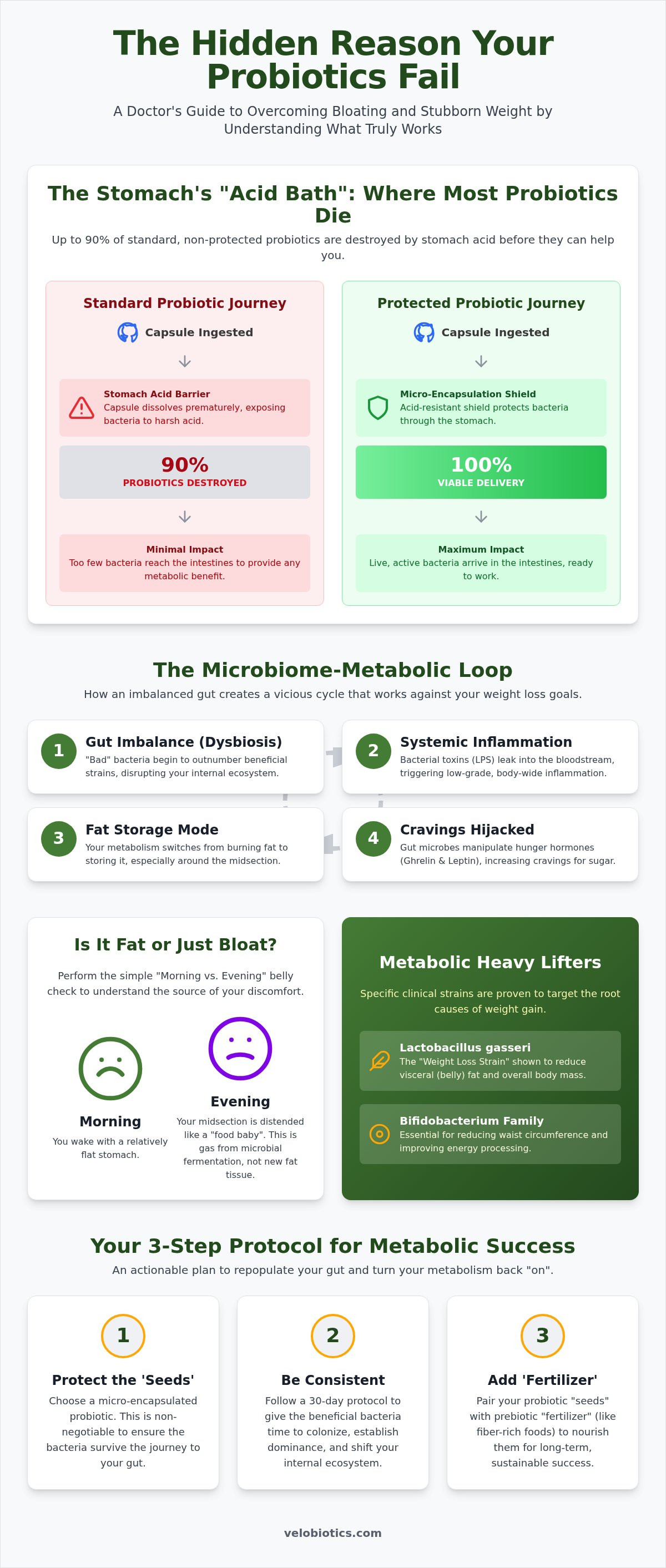
Your gut is far more than a simple processing plant for food; it is the command center for your entire metabolic system. When the delicate balance of your microbiome shifts toward dysbiosis, you enter what I call the Microbiome-Metabolic Loop. In this cycle, gut imbalance triggers low-grade inflammation that forces your body to prioritize fat storage over fat burning. This isn't just about feeling "full." It is a biological state where your internal chemistry is actively working against your weight loss goals.
This imbalance often stems from "bad" bacteria winning the war for dominance in your intestinal tract. These microbes release lipopolysaccharides (LPS), which are toxic molecules that can leak into your bloodstream. Once LPS enters your system, it triggers systemic inflammation, a primary reason many people struggle to see results even when using probiotics for bloating and weight loss. While Probiotics are widely recognized for their role in digestion, their impact on systemic inflammation is where the real magic happens for weight management.
Think of your healthy gut bacteria as a metabolic thermostat. When your microbiome is diverse and thriving, your body efficiently regulates energy expenditure and insulin sensitivity. However, when that thermostat is broken by dysbiosis, your body becomes incredibly efficient at storing calories as fat, particularly around the midsection. Restoring this balance is the first step in turning your metabolism back "on."
Is it Fat or Just Bloat? Identifying the Difference
I often tell my patients to perform a simple "morning versus evening" belly check. If you wake up with a relatively flat stomach but look several months pregnant by late afternoon, you aren't dealing with new fat tissue; you are experiencing gas-producing bacteria. These microbes ferment food too quickly, creating a "food baby" that mimics the appearance of weight gain. This persistent pressure is physically uncomfortable, but it also takes a psychological toll. It is hard to stay motivated for a workout when you feel heavy and sluggish before you even lace up your shoes.
How Gut Bacteria Control Your Cravings
Your gut bacteria are actually "talking" to your brain through hunger hormones like Ghrelin, the hunger signal, and Leptin, the fullness signal. A high-sugar diet breeds specific strains that thrive on glucose. These microbes can actually manipulate your cravings to ensure they get fed, making you reach for snacks you don't even want. When you select the right probiotics for bloating and weight loss, you are essentially hiring a new management team for your metabolism. Using a targeted formula like GutSlim Probiotics Fat Burner can help recalibrate these signals, flipping the switch from "store" to "burn." By repopulating the gut with beneficial strains, you can finally silence those late-night sugar urges and regain control over your appetite.
The Science of Survival: Which Probiotic Strains Actually Target Bloating and Metabolism?
When you are scanning a label for probiotics for bloating and weight loss, the long Latin names can feel like a different language. However, specific strains are the workers that actually do the heavy lifting for your metabolism. Take Lactobacillus gasseri, for example. In the clinical world, we often refer to this as the "weight loss strain" because multiple studies have shown its ability to help reduce visceral fat and overall body mass. Similarly, members of the Bifidobacterium family are essential for anyone trying to reduce waist circumference and improve the way the body processes energy.
But here is the clinical reality that most supplement companies won't tell you: the majority of those bacteria are dead before they ever reach your gut. Your stomach is a literal "acid barrier" designed to destroy bacteria. Research suggests that up to 90% of standard, non-protected probiotics are wiped out by gastric acid within minutes. If the bacteria aren't alive when they reach your intestines, they cannot colonize or provide any metabolic benefit. Micro-encapsulation acts as a sophisticated, acid-resistant shield that ensures biological viability by protecting the bacteria until they reach their destination. This technology allows for a 1000x higher survival rate than traditional capsules, which is why it's vital to look at what the science says about probiotics regarding delivery and potency.
Metabolic Masters: Strains for Fat Oxidation
Beyond L. gasseri, we look to Lactobacillus plantarum for its impressive role in lipid metabolism. This strain helps your body manage how it breaks down and stores fats. Some of these elite microbes even help your body naturally increase the production of GLP-1, a hormone that tells your brain you are full and satisfied. If your goal is to specifically target these pathways, I often suggest a "metabolic partner" like the GutSlim Probiotics Fat Burner, which is formulated to support these exact biological functions.
The Bloat-Busters: Strains for Digestive Comfort
For that uncomfortable "food baby" feeling, Lactobacillus rhamnosus is a standout for its ability to reduce gas and abdominal distension. However, a single strain is rarely enough to fix a complex gut imbalance. You need a diverse army of at least 16 different strains to support the entire length of the digestive tract. This diversity ensures that the "bad" gas-producing bacteria don't have room to grow. For comprehensive daily support, Velo16 Probiotic Digestive Capsules provide the broad-spectrum diversity required for a healthy, flat stomach. If you want to ensure your supplements are actually surviving to do their job, you can examine our proprietary delivery technology to see the difference for yourself.
Probiotics vs. Prebiotics: Building a Sustainable Fat-Burning Ecosystem
Think of your gut like a garden. If you want a lush, vibrant landscape, you can't just scatter seeds and hope for the best. You need high-quality fertilizer to ensure those seeds actually take root and thrive. In the world of microbiome health, your probiotics for bloating and weight loss are the seeds, while prebiotics are the fertilizer. If you take a probiotic supplement without providing the necessary prebiotic fiber, you are essentially throwing your money away. Without fuel, those beneficial bacteria will simply pass through your system without ever colonizing your gut.
When healthy bacteria consume prebiotic fibers, they produce metabolic byproducts called Short-Chain Fatty Acids (SCFAs). The most critical of these is butyrate. Butyrate acts as the primary energy source for the cells lining your colon, strengthening the gut barrier and preventing the systemic inflammation we discussed earlier. A robust gut wall ensures that your metabolism remains efficient and that "bad" bacteria don't have the opportunity to trigger the rapid fermentation that leads to painful abdominal pressure. By feeding your microbiome correctly, you create a self-sustaining ecosystem that naturally resists bloating.
The Power of Synbiotics for Weight Loss
To get the most out of your protocol, you should focus on synbiotics. This is a clinical term for a synergistic combination of live bacteria and the specific fuel they need to survive. Synbiotics are significantly more effective at colonizing the gut than probiotics alone because they arrive with a "packed lunch," allowing them to start working immediately. While the research on probiotics' effect on weight loss shows modest reductions of about 1.1 kg on average, these results are much more sustainable when the bacteria are properly nourished. For a convenient way to support this process, I recommend incorporating a nutrient-dense source like GutSlim Probiotics Supergreens, which provides the essential prebiotic foundation your microbiome requires.
Foods That Fight Bloat (and Those That Feed It)
What you put on your plate determines which bacteria win the war in your gut. To keep your stomach flat, focus on an "Anti-Bloat" plate filled with polyphenols and gentle fibers. However, there is a catch. Some "healthy" fibers, known as FODMAPs (fermentable oligosaccharides, disaccharides, monosaccharides, and polyols), can actually trigger intense bloating in sensitive individuals. If you find that broccoli or beans leave you feeling like a balloon, you might be over-fermenting these complex carbs.
I always advise my patients to use the "Slow Introduction" method. Don't try to double your fiber intake overnight. Start with small servings of low-FODMAP prebiotics like blueberries, kiwi, or cooked carrots. Gradually increasing your intake over two weeks allows your microbiome to adapt without the digestive drama. This steady approach, combined with high-viability probiotics for bloating and weight loss, is the most reliable path to long-term metabolic health.
The Doctor’s Protocol: How to Take Probiotics for Maximum Results
Taking your probiotics for bloating and weight loss at the right time is just as important as the strains themselves. If you don't follow a structured protocol, even the most advanced formulas can struggle to colonize your gut effectively. I recommend a 30-day window of consistent daily use to allow your microbiome to shift from a state of dysbiosis to metabolic balance. During this time, your focus should be on creating the ideal internal environment for these new "residents" to thrive.
Consistency is the secret to moving the needle on your metabolic rate. It takes time for beneficial bacteria to displace the established, gas-producing microbes that cause abdominal pressure. Beyond timing, you must prioritize hydration and electrolytes. Water is the primary vehicle for digestive motility; without it, your system becomes stagnant, making it harder for probiotics to do their job. Think of electrolytes like magnesium and potassium as the electrical signals that keep your digestive muscles moving smoothly.
The Morning Routine for a Flatter Stomach
Your daily ritual should begin the moment you wake up. I advise my patients to start their day with 500ml of room-temperature water and their probiotic capsule. This hydrates your system and dilutes any lingering stomach acid, providing a safer passage for the bacteria. You should avoid drinking coffee for at least 30 minutes after your dose. The high acidity and heat of coffee can degrade live cultures before they reach the small intestine. The gastrocolic reflex is a biological signal that triggers contractions in your colon immediately after you consume water or food, effectively clearing the path for new digestion.
Troubleshooting the 'Probiotic Adjustment Period'
Don't be alarmed if you feel slightly more bloated during the first few days of a new regimen. This is often caused by a "die-off" effect, where beneficial bacteria begin to eliminate the harmful, gas-producing strains. This temporary shift is actually a positive sign that your microbiome is undergoing a necessary recalibration. You can differentiate this healthy adjustment from a poor-quality supplement by the duration of the symptoms; a standard adjustment period shouldn't last more than a week. If you want to ensure your chosen formula is actually designed to survive these internal challenges, you can explore our GutSlim Probiotics Tummy Toner for targeted relief. To get the most out of your journey, invest in a delivery system that guarantees biological viability.
The Velobiotics Advantage: Why GutSlim is Your 2026 Metabolic Solution
As a doctor, I've seen many patients waste their time on "high-potency" supplements that simply fail to deliver. The reason is almost always the same: the bacteria are destroyed by stomach acid before they can even begin to work. Our proprietary micro-encapsulation technology solves this fundamental biological problem by shielding each individual bacterium. This process ensures that we deliver 1000x more viable bacteria to your gut compared to standard, unprotected capsules. When you choose probiotics for bloating and weight loss, you aren't just buying a supplement; you're investing in a sophisticated delivery system designed to bypass your body's harshest internal environments.
We believe in a "Clean Label" philosophy. This means our GutSlim range is doctor-formulated without unnecessary fillers, artificial binders, or GMOs. By focusing on high-viability strains and clinical purity, we provide your metabolism with a partner that actually survives to colonize. Integrating these 16 strains into your long-term wellness strategy allows you to maintain the "metabolic thermostat" we discussed earlier, ensuring your body stays in a fat-burning state rather than a storage-heavy one.
The specific formulation of GutSlim Probiotics Tummy Toner is engineered to address the root causes of abdominal distension. By repopulating the gut with beneficial colonies that outcompete gas-producing microbes, you can finally find relief from the "food baby" cycle that stalls so many fitness journeys.
Beyond the Gut: Systemic Benefits of Velobiotics
The impact of a healthy microbiome extends far beyond your waistline. When your gut is balanced, your nutrient absorption improves, leading to a noticeable boost in daily energy levels. You might also notice a difference in your mirror; the "Gut-Skin" axis is a well-documented connection where a flatter, healthier stomach often leads to clearer, more radiant skin. For a comprehensive look at how these biological systems interact, you can explore our guide on probiotics for digestive health to see how systemic viability changes everything.
Choosing Your GutSlim Journey
Every metabolism is unique, which is why we've developed targeted solutions for different goals. If your primary struggle is persistent abdominal pressure, the Tummy Toner is your ideal starting point. For those hitting a weight loss plateau, the GutSlim Probiotics Fat Burner utilizes thermogenic support to help shift stubborn visceral fat. If you need a convenient way to manage calories while feeding your microbiome, the GutSlim Probiotics Diet Shake provides a balanced, synbiotic meal replacement.
Many of my patients find success with a "Starter Bundle" approach, combining these tools for a total metabolic reset. This multi-angled strategy ensures you are attacking bloat and fat storage from every biological perspective. You can explore the GutSlim range today and take the first step toward a flatter stomach and a more efficient metabolism using probiotics for bloating and weight loss that actually survive to do the job.
Your Path to a Balanced Metabolism and a Flatter Stomach
Achieving your health goals isn't about following the latest wellness trend; it's about understanding the biological mechanisms of your own body. We have explored how the "Microbiome-Metabolic Loop" can trap you in a cycle of inflammation and fat storage. You now know that the effectiveness of probiotics for bloating and weight loss depends entirely on biological viability. Without a delivery system that survives the stomach's "acid bath," your efforts are often wasted. By prioritizing 16-strain diversity and proper prebiotic "fertilizer," you can finally recalibrate your metabolic thermostat.
Maintaining a healthy microbiome is a goal that can extend to every member of the household, including pets. For feline owners, Purrlys provides specialized insights into cat probiotics and hygiene to ensure a fresh and healthy living space.
As a doctor-founded organization, we are committed to solving the efficacy gaps that plague the supplement industry. Our proprietary micro-encapsulation technology ensures an over 1000x better survival rate than standard probiotics, delivering active ingredients exactly where they are needed. Consistency is your greatest ally in this journey. If you're ready to stop guessing and start seeing measurable results in your digestive comfort and metabolic rate, it's time to take the next step. Start Your 30-Day Gut Transformation with Velobiotics GutSlim. You have the science and the protocol; now it's time to let your microbiome work for you.
Frequently Asked Questions
Can probiotics really help with belly fat?
Probiotics help reduce belly fat by shifting how your body absorbs calories and recalibrating hunger hormones like leptin. Clinical data from 2025 indicates that specific strains, particularly Lactobacillus gasseri, can lead to measurable reductions in visceral fat over a 12-week period. They don't replace exercise, but they act as a metabolic partner by turning down the fat-storage signals triggered by chronic gut inflammation.
How long does it take for probiotics to reduce bloating?
Most patients start feeling a reduction in abdominal pressure within the first 7 to 14 days of consistent use. However, it takes about 30 days for a full microbiome shift to stabilize. During this window, your "good" bacteria are actively displacing the gas-producing microbes that cause that uncomfortable "food baby" look. If you don't see changes by week four, you might need a more diverse 16-strain formula.
Will probiotics make me gain weight initially?
Probiotics won't cause actual fat gain, but you might notice a temporary increase in water retention or gas during the first week. This is often part of the adjustment phase as your internal ecosystem recalibrates. It isn't new weight; it's simply your body reacting to the introduction of billions of new beneficial residents. This usually subsides quickly as your digestion becomes more efficient and your gut wall strengthens.
What is the best time of day to take a weight loss probiotic?
The most effective time to take probiotics for bloating and weight loss is first thing in the morning, roughly 30 minutes before breakfast. Taking them on an empty stomach with a large glass of water helps them move quickly through the stomach's acid barrier. This timing ensures the live cultures reach your intestines before your digestive system becomes highly acidic from processing a full meal.
Can I take probiotics while on a GLP-1 or weight loss medication?
You can certainly use probiotics alongside GLP-1 agonists or other weight loss medications. In fact, many people find that probiotics help manage the digestive side effects, like slow motility or nausea, often associated with these drugs. Since these medications change how your gut functions, a high-quality probiotic ensures your microbiome remains diverse and resilient throughout your treatment. Always consult your doctor before starting any new supplement.
Do I need to keep my probiotics in the fridge for them to work?
Many modern probiotics don't require refrigeration if they use advanced delivery technology. Our micro-encapsulation process seals the bacteria, protecting them from heat and moisture at room temperature. This makes them much more practical for daily life and travel. Always check your specific product's label, but a shelf-stable claim usually indicates the bacteria are protected by a technological seal rather than just cold storage.
Can probiotics cause more gas and bloating?
It is common to experience a temporary increase in gas or bloating during the first few days of a new regimen. We call this the "die-off" effect, which happens when beneficial bacteria begin to eliminate harmful, gas-producing strains. This is actually a sign that your probiotics for bloating and weight loss are starting to work. If the discomfort lasts longer than a week, you may want to lower your dose and increase it gradually.
How do I know if my probiotic is actually surviving my stomach acid?
You can't feel the survival process happening, so you have to look for quantifiable comparative claims on the packaging. Standard capsules often lose up to 90% of their bacteria to stomach acid. To ensure viability, choose products that specifically mention micro-encapsulation or proprietary acid-resistant seals. These technologies offer an over 1000x better survival rate, ensuring the bacteria you pay for actually reach your metabolic control center.

Disclaimer
Information and statements regarding dietary supplements/products have not been evaluated by the Food and Drug Administration, MCC/SAHPRA, MHRA, TGA or any other drug regulatory authority and are not intended to diagnose, treat, cure, or prevent any disease. Information on this website is provided for informational purposes only and is a result of years of practice and experience by the author. This information is not intended as a substitute for the advice provided by your physician or other healthcare professional or any information contained on or in any product label or packaging. Do not use the information on this website for diagnosing or treating a health problem or disease, or prescribing medication or other treatment. Always speak with your physician or other healthcare professional before taking any medication or nutritional, herbal, or homeopathic supplement, or using any treatment for a health problem. If you have or suspect that you have a medical problem, contact your healthcare provider promptly. Do not disregard professional medical advice or delay in seeking professional advice because of something you have read on this website.