

Probiotics for BV Treatment: A Doctor’s Guide to Breaking the Recurrence Cycle
Did you know that 60% of women who treat bacterial vaginosis with antibiotics alone see that familiar, fishy odor return within just a few months? It's incredibly frustrating to feel like you're stuck in a revolving door of prescriptions, especially when you're searching for effective probiotics for bv treatment to finally end the cycle. As a doctor, I've seen countless patients exhausted by this "antibiotic loop," wondering why their bodies can't just stay in balance. The reality is that standard treatments often clear the infection but fail to restore your vaginal microbiome. However, clinical data shows that adding specific probiotic strains can actually lower that recurrence rate by 50%.
I'm here to help you break that cycle by diving into the clinical science behind vaginal health. We're going to look at which strains, like Lactobacillus rhamnosus GR-1 and Lactobacillus reuteri RC-14, actually have the power to colonize and protect your internal environment. We'll explore the critical importance of biological viability, why oral probiotics must survive the gut-vagina axis to work, and the specific protocol for using probiotics alongside boric acid to stop recurrences in their tracks. It's time to move past temporary fixes and start focusing on long-term balance.
Break the cycle of recurring discomfort by understanding why treating bacterial vaginosis as a simple infection often fails, leaving your vaginal environment empty and vulnerable to the dreaded "Antibiotic Loop." We will explore the microbial science of dysbiosis and how to restore your internal balance for good. This guide moves beyond temporary fixes to provide a roadmap for lasting vaginal health.
Identify the specific "Big Three" Lactobacillus strains that act as your body's internal security team and learn why they are the clinical gold standard for anyone seeking probiotics for bv treatment. These specific strains don't just sit there; they actively produce the lactic acid and hydrogen peroxide needed to defend your territory against invading pathogens. Choosing the right strain is the difference between a product that works and one that is just marketing.
Compare the high-speed "Direct Route" of vaginal suppositories against the steady "Migration Route" of oral capsules to determine which delivery method suits your specific needs. We will also dive into the "Clean Slate" protocol, showing you exactly how to use boric acid as a biological reset button. This two-step process involves clearing out stubborn biofilms before repopulating your microbiome with healthy bacterial tenants.
Finally, uncover the truth about the "Viability Gap" and why a high CFU count on a label means nothing if the bacteria don't survive the journey. See how proprietary micro-encapsulation technology acts as a protective shield, ensuring your probiotics actually arrive alive and ready to provide the long-term relief you deserve. It's time to focus on what actually reaches your system, not just what's printed on the bottle.
The BV Loop: Why Standard Treatments Often Fail
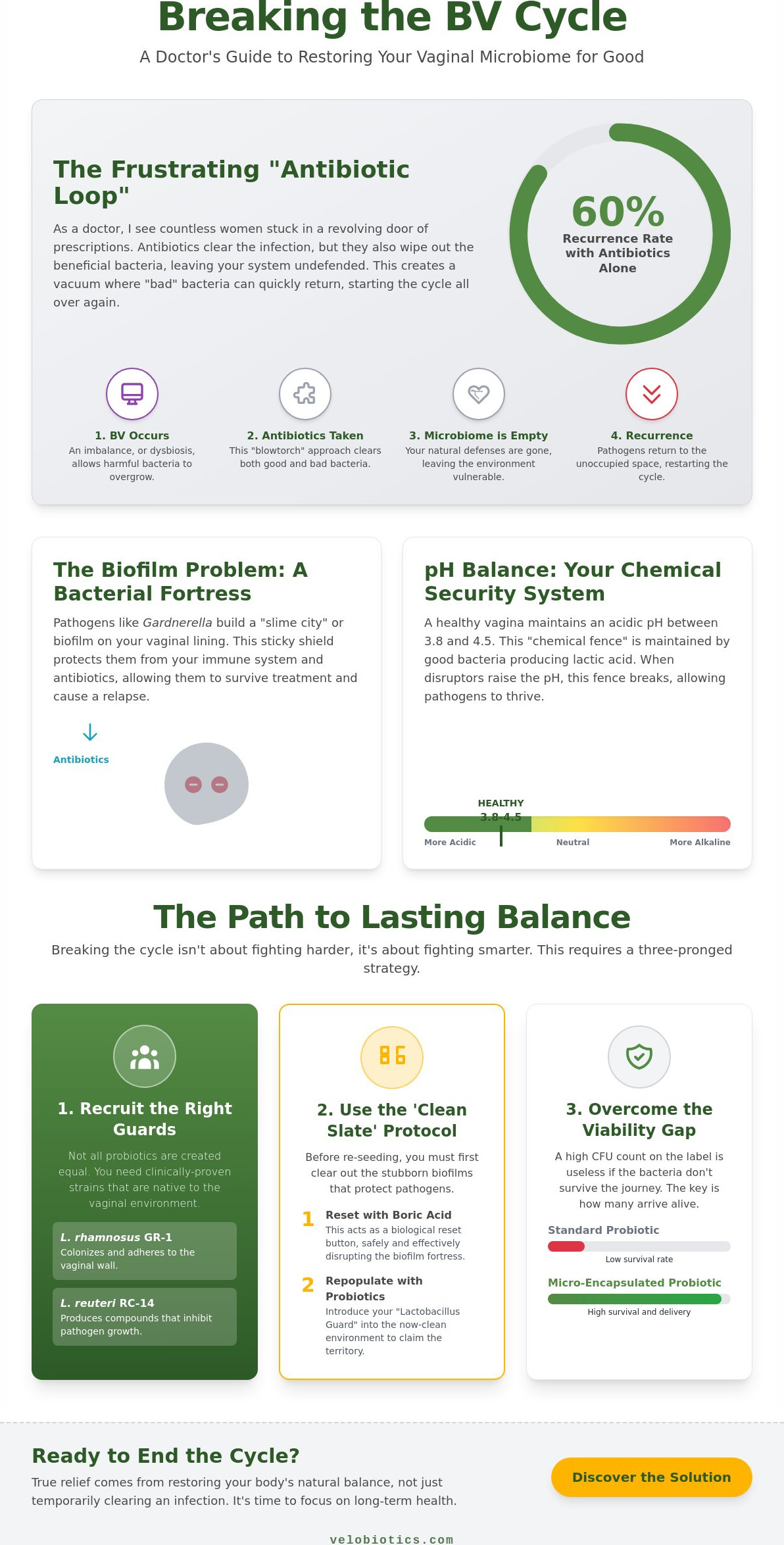
Most patients think of Bacterial Vaginosis (BV) as a simple infection, like a cold or a minor scrape. As a doctor, I prefer the term "dysbiosis." This means your internal ecosystem has fallen out of balance. Think of your vagina as a lush garden. When you take antibiotics, you aren't just pulling weeds; you're essentially using a blowtorch on the entire plot. While the "bad" bacteria die, the "good" bacteria vanish too, leaving the soil empty and vulnerable. This creates what I call the Antibiotic Loop, where the bad guys simply move back into the empty house the moment you finish your prescription.
Breaking this cycle requires more than just killing pathogens; it requires a deliberate strategy of re-seeding the environment. This is where using specific probiotics for bv treatment becomes a game changer. Instead of just clearing the land, we're actively replanting the "good" trees to ensure the weeds don't have room to sprout again. If you don't occupy the territory with beneficial bacteria, the pathogens will inevitably return to claim the space.
To better understand this concept, watch this helpful video:
The Biofilm Problem: Why BV Returns
The reason your standard seven day course of metronidazole often fails is due to a biological fortress called a biofilm. Species like Gardnerella vaginalis build a "slime city" on your vaginal lining. This sticky matrix acts as a physical shield, protecting the bacteria from both your immune system and the antibiotics you're taking. Even if most of the bacteria die, the small percentage hiding in the biofilm survive to rebuild the colony. Research indicates that introducing high quality probiotics helps interfere with these bacterial fortresses by competing for space and nutrients, making it significantly harder for pathogens to maintain their grip.
pH Balance: The Security System of Your Vagina
Your first line of defense is actually chemical. A healthy vaginal pH stays between 3.8 and 4.5, which is quite acidic. This acidity is maintained by Lactobacilli that produce lactic acid. When external factors like semen, menstrual blood, or harsh soaps enter the picture, they raise the pH and make the environment less acidic. pH balance is the chemical fence that keeps Gardnerella out. If that fence breaks, the bad bacteria thrive. Products like Femina Probiotic COOKIE FRESH with Boric Acid are designed to reset this "fence" while simultaneously delivering the probiotics for bv treatment needed to maintain long term security.
The Lactobacillus Guard: Which Probiotic Strains Actually Treat BV?
If you've ever stood in a pharmacy aisle staring at a sea of supplement bottles, you know how overwhelming the choices can be. Many products claim to support "feminine health," but from a clinical perspective, not all bacteria are created equal. When selecting probiotics for bv treatment, we must look beyond generic marketing and focus on the specific "Big Three" strains that naturally dominate a healthy vaginal ecosystem: Lactobacillus rhamnosus, L. reuteri, and L. crispatus. These aren't just random additives. They are the primary architects of your internal defense system, building on the "re-seeding" strategy we discussed earlier.
These specific strains work by producing two critical substances: lactic acid and hydrogen peroxide. Lactic acid keeps your pH low, while hydrogen peroxide acts as a natural disinfectant that kills off harmful pathogens. Research from Harvard Health underscores the importance of these specific Lactobacillus species in preventing BV recurrences by maintaining a hostile environment for invaders. If your supplement doesn't contain these targeted strains, you're likely wasting your time and money.
I often hear patients ask if they can just eat more yogurt to fix the problem. This is the "Yogurt Myth." While yogurt is great for your gut, the strains used to ferment dairy, such as L. bulgaricus or S. thermophilus, are not the same ones that colonize the vaginal tract. They simply don't have the biological "keys" to unlock and inhabit that specific territory. Beyond the strain mismatch, the quantity of live bacteria that actually survives the journey through your stomach acid from a cup of yogurt is negligible. When we talk about probiotics for bv treatment, we are looking for clinical-grade viability and urogenital-specific strains.
Lactobacillus rhamnosus GR-1: The BV Fighter
One of the most well-documented soldiers in this fight is Lactobacillus rhamnosus GR-1. This strain is unique because of its incredible ability to adhere to the vaginal walls. Think of it like biological velcro. Once it sticks, it begins a process called competitive inhibition. It physically blocks Gardnerella and other bad bacteria from attaching to your cells. Clinical trials have shown that when GR-1 is used alongside standard care, it significantly reduces the rate of recurrence compared to using antibiotics alone. For those looking for a reliable daily option, our Femina™ Probiotic Capsules utilize these high-adhesion strains to provide consistent protection.
Why Diversity Matters in Your Probiotic
While specific strains are vital, we also want to avoid a "monoculture." A healthy microbiome is a diverse one. Different strains thrive at slightly different pH levels and provide coverage at different times of the day. By using a multi-strain approach, you ensure that even if one strain is temporarily stressed by external factors, others are there to hold the line. This concept of microbial diversity extends to your entire body. To support your overall health and ensure your gut isn't acting as a reservoir for bad bacteria, consider a broad-spectrum supplement like Velo16 Probiotic Digestive Capsules, which helps maintain balance across multiple internal systems.
Oral vs. Vaginal Probiotics: Which Delivery Method Wins?
One of the most frequent questions I hear in my clinical practice is whether a patient should swallow a capsule or use a vaginal suppository. It's a great question because the answer isn't always "one or the other." Both methods play unique roles in probiotics for bv treatment, but the delivery mechanism determines how fast you'll see results and how much of the active ingredient actually reaches the target. Think of it like choosing between a local delivery service and a cross-country shipment. One is immediate and targeted, while the other is systemic and built for the long haul.
The "Direct Route" involves suppositories that bypass your entire digestive system. This is often the preferred method for anyone currently experiencing the frustration of a flare-up. Conversely, the "Oral Route" relies on the migration theory. This is the biological process where beneficial bacteria travel through the gut, exit the rectum, and migrate across the perineum to colonize the vaginal tract. While this sounds like a long journey, it's a natural pathway that has been well-documented in clinical research. However, the success of this journey depends entirely on the survival of the bacteria.
The Hurdles of Oral Probiotics
The biggest challenge with oral supplements is the harsh environment of the human stomach. Your gastric juices are a vat of hydrochloric acid designed to break down food and kill invading pathogens. Unfortunately, this acid doesn't distinguish between "good" and "bad" bacteria. Without a protective shield, up to 90% of standard probiotics are obliterated before they even reach your lower intestines. This is why many women feel like their supplements aren't working; the bacteria simply didn't arrive alive. For a deeper look at the technology required to solve this, you can read about probiotics that survive stomach acid. Even with high-viability capsules like our Femina™ Probiotic Capsules, the migration process takes time. You might not see a significant shift in your vaginal microbiome for two to four weeks.
The Case for Vaginal Suppositories
If you're looking for speed, suppositories are the clear winner. Because you're applying the treatment directly to the source of the dysbiosis, the relief is often felt within hours or days rather than weeks. Suppositories provide a concentrated dose exactly where the imbalance exists. This direct application is particularly effective at targeting the stubborn biofilms we discussed earlier. By placing the Lactobacillus exactly where the Gardnerella is trying to build its "slime city," you're giving the good guys a massive home-field advantage.
There are practical trade-offs to consider, of course. Suppositories can be a bit messy, so I usually advise my patients to use them at bedtime. Oral capsules, on the other hand, are the gold standard for clean, convenient daily maintenance once the initial flare-up is under control. For those in the middle of a recurrence cycle, a product like Femina Probiotic COOKIE FRESH with Boric Acid offers the dual benefit of resetting pH and delivering live cultures exactly where they are needed most.
The 'Clean Slate' Protocol: Combining Boric Acid and Probiotics
Imagine trying to paint a room that has old, peeling wallpaper. If you simply slap a fresh coat of paint over the mess, it won't be long before everything starts to crumble again. Most traditional approaches to bacterial vaginosis act like that poorly applied paint; they cover the problem without addressing the underlying surface. To truly break the recurrence cycle, we need a "Clean Slate" protocol. This three step process involves stripping away the biological debris, re-seeding the environment with beneficial life, and then maintaining that balance with systemic support. It's the most effective way to use probiotics for bv treatment because it ensures the "good guys" actually have a place to land and thrive.
Timing is everything in this protocol. You shouldn't just dump probiotics into a high-pH environment. If your vaginal pH is currently sitting at a 5.5 or 6.0, the Lactobacilli will struggle to colonize. They need that acidic sweet spot of 3.8 to 4.5 to really take root. By using boric acid first, you're not just killing off bad bacteria; you're prepping the soil for a successful harvest of healthy flora. Once the pH is reset and the territory is clear, you introduce your probiotics to occupy the space before the pathogens can return.
Boric Acid: The Biofilm Buster
We've already discussed the "slime city" fortresses that Gardnerella builds. Boric acid acts as a mild antiseptic that specifically targets and dissolves this biofilm layer. It's the biological equivalent of a deep scrub. By breaking down these fortresses, boric acid exposes the hidden bacteria that antibiotics often miss. This makes it the perfect "prep work" for colonization. For a streamlined approach, I recommend the Femina Probiotic COOKIE FRESH with Boric Acid, which combines the biofilm-clearing power of boric acid with a direct delivery of urogenital probiotics.
Maintenance: Keeping BV Away for Good
Once you've cleared the slate and re-seeded the area, the goal shifts to long term maintenance. This is where your daily habits and systemic support come into play. Your new bacterial tenants need a supportive environment to stay healthy. I always tell my patients to follow these simple rules:
- Stick to breathable, cotton underwear to prevent moisture buildup.
- Stop douching immediately; your vagina is a self-cleaning oven that only needs external washing with plain water.
- Use pH strips at home to monitor your acidity levels once a week.
- Consider a "booster" dose of vaginal probiotics after events that naturally raise your pH, such as unprotected sex or the end of your menstrual cycle.
To ensure your defense system remains robust from the inside out, finishing the protocol with a high-viability oral supplement is essential. This creates a steady reservoir of Lactobacilli in the gut that can migrate as needed to maintain your vaginal health. Don't leave your recovery to chance. Start your long-term maintenance today with our clinically-backed Femina™ capsules to keep the recurrence cycle closed for good.
Beyond the Label: Why 'Viability' is the Key to BV Relief
One of the biggest misconceptions in the supplement industry is that a higher number of Colony Forming Units (CFUs) automatically leads to better results. As a doctor, I see patients all the time who've tried high-dose probiotics for bv treatment with zero success. The reason is simple: dead bacteria don't treat BV. This is what I call the Viability Gap. A bottle might claim to contain 50 billion CFUs at the time of manufacture, but by the time that pill sits on a warm shelf, travels to your home, and faces your stomach acid, you might only be receiving a tiny fraction of live, active bacteria. That is a failure of delivery, not a failure of the science.
To solve this fundamental biological problem, we utilize a proprietary micro-encapsulation technology. Think of it as a microscopic, high-tech shield that wraps around every single bacterial cell. This technology ensures that our probiotics remain dormant and protected until they reach the specific environment where they need to activate. Because of this protective seal, our formulations deliver 1000x more live bacteria to the target area compared to standard, unprotected brands. When you choose a doctor-founded approach, the focus shifts from marketing buzzwords to quantifiable clinical outcomes.
The Science of Micro-Encapsulation
Our micro-encapsulation process is specifically designed to withstand the three primary killers of probiotics: moisture, heat, and gastric acid. Most products on the market claim to be shelf-stable, but there is a significant difference between a bacteria being "present" and being "biologically active" once it enters your system. A "shelf-stable" label doesn't guarantee that the bacteria will survive the intense acidity of your digestive tract. You can learn more about how we developed this protective technology in The Velobiotics Story. By ensuring viability, we ensure that the probiotics for bv treatment you invest in actually have the power to colonize and protect your microbiome.
Practical Advice for the Skeptical Buyer
If you're a skeptical buyer, your first step should be looking past the front of the bottle. Flip the label over and look for specific strain names. If a product just says "Lactobacillus," it's often a sign of a generic, low-quality formulation. You want to see specific identifiers like L. rhamnosus GR-1 or L. reuteri RC-14. These are the strains with the clinical credentials to handle vaginal dysbiosis and prevent future flare-ups.
Cheaper isn't better for live cultures. High-quality probiotic production requires expensive stabilization and testing to ensure the bacteria reach you in a functional state. Choosing a low-cost alternative often means you're paying for inactive ingredients that won't help your symptoms. Taking control of your intimate health is an investment in your long-term well-being and confidence. You don't have to stay stuck in the frustration of the recurrence cycle. By choosing high-viability, scientifically-protected strains, you are giving your body the tools it needs to maintain a permanent state of balance.
Reclaim Your Vaginal Health for the Long Term
You don't have to accept recurring discharge and odor as a permanent part of your life. By moving beyond the "antibiotic loop" and focusing on the clinical science of microbial balance, you've learned that success depends on more than just killing bad bacteria. It requires the right strains, like L. rhamnosus and L. reuteri, and a delivery system that ensures they actually arrive alive. Our doctor-founded biotechnology solves the industry's viability gap, using proprietary micro-encapsulation to provide 1000x better probiotic delivery compared to standard, unprotected brands.
This technology, combined with our dual-action Boric Acid and Probiotic formula, gives you a professional-grade strategy for effective probiotics for bv treatment. It's time to stop pulling weeds and start planting a garden that can defend itself. You have the knowledge and the tools to break the cycle and regain your confidence once and for all. Stop the cycle and restore your balance with Femina Cookie Fresh Probiotic Suppositories. You deserve to feel comfortable and balanced every single day.
Frequently Asked Questions
Can probiotics really cure BV on their own without antibiotics?
Probiotics are primarily designed for prevention and maintenance rather than as a standalone cure for an acute, symptomatic infection. While they are essential for restoring the microbiome, clinical guidelines still recommend antibiotics as the primary treatment for active cases. Using probiotics for bv treatment is most effective as an adjunct therapy to prevent the 60% recurrence rate often seen when using antibiotics alone.
How long does it take for probiotics to start working for BV symptoms?
The timeline for relief depends largely on the delivery method you choose. Vaginal suppositories often provide a noticeable improvement in odor and discharge within 24 to 72 hours because they deliver a concentrated dose directly to the site of the imbalance. Oral capsules take longer, typically requiring two to four weeks of daily use to allow the bacteria to migrate and successfully colonize the vaginal tract.
Is it better to take oral probiotics or use vaginal suppositories for BV?
Both methods have unique clinical benefits, so the better choice depends on your current health goals. Suppositories are superior for immediate relief during a flare-up because they bypass the digestive system and target the biofilm directly. Oral probiotics are the gold standard for long term maintenance. Many patients find the best results by starting with suppositories to reset the environment and then switching to daily oral capsules.
Can I use probiotics while I am currently taking antibiotics for BV?
Yes, you should use probiotics while taking antibiotics to help mitigate the "blowtorch" effect on your microbiome. Antibiotics kill both good and bad bacteria, so introducing high viability strains during treatment helps occupy the territory as it is being cleared. Just ensure you take your oral probiotic at least two hours apart from your antibiotic dose to maximize the survival of the live cultures.
What are the specific probiotic strains I should look for to treat BV?
You should look for urogenital specific strains, specifically Lactobacillus rhamnosus GR-1 and Lactobacillus reuteri RC-14. These are the most clinically studied strains for vaginal health and are proven to adhere to the vaginal walls. These specific bacteria produce the lactic acid and hydrogen peroxide needed to keep pathogens like Gardnerella from building their protective biofilms.
Are there any side effects to using probiotics for vaginal health?
Side effects are rare and usually mild, as you are simply replenishing bacteria that should naturally be present in your body. Some women might experience a slight increase in vaginal discharge as the microbiome resets or minor bloating when starting a new oral regimen. If you experience significant irritation or a burning sensation, it is a good idea to check for sensitivities to other inactive ingredients in the suppository base.
How often should I use probiotic suppositories to prevent BV from coming back?
For maintenance, a common protocol is using one suppository once or twice a week, or immediately following events that disrupt your pH levels. This includes the days following your menstrual cycle or after unprotected intercourse. Consistent use helps maintain the "chemical fence" of acidity, ensuring that any stray bad bacteria don't have the opportunity to settle and build a new colony.
Can I use probiotics for BV treatment during my period?
You can certainly continue using oral probiotics for bv treatment during your period, but it's often best to pause vaginal suppositories until your flow has stopped. Menstrual blood has a higher pH than the healthy vaginal environment, which can make it harder for the probiotics to colonize effectively. It's much more efficient to start your suppository regimen on the final day of your period to reset your balance.

Disclaimer
Information and statements regarding dietary supplements/products have not been evaluated by the Food and Drug Administration, MCC/SAHPRA, MHRA, TGA or any other drug regulatory authority and are not intended to diagnose, treat, cure, or prevent any disease. Information on this website is provided for informational purposes only and is a result of years of practice and experience by the author. This information is not intended as a substitute for the advice provided by your physician or other healthcare professional or any information contained on or in any product label or packaging. Do not use the information on this website for diagnosing or treating a health problem or disease, or prescribing medication or other treatment. Always speak with your physician or other healthcare professional before taking any medication or nutritional, herbal, or homeopathic supplement, or using any treatment for a health problem. If you have or suspect that you have a medical problem, contact your healthcare provider promptly. Do not disregard professional medical advice or delay in seeking professional advice because of something you have read on this website.