

Probiotics for Gastritis: A Doctor’s Guide to Choosing the Right Gut Reinforcements
What if the very supplement you bought to heal your gut is being neutralized by your body in less than 30 minutes? If you live with the persistent, gnawing heat of a gastritis flare, you've probably felt the exhaustion of trying everything without lasting relief. It's common to feel skeptical when using probiotics for gastritis if those expensive capsules seem to do nothing for that internal fire.
The science is clear: probiotics can shift the needle on gastric inflammation, but the missing link is often survival, not just dosage. As a doctor and researcher, I've seen how the 1.5 pH environment of a fasting stomach can destroy 95% of unprotected bacteria before they ever reach their destination. It's a fundamental problem that the wellness industry often ignores.
In this guide, I'll show you how to choose gut reinforcements that actually survive your stomach acid to deliver results. We'll explore the specific strains that clinical studies show calm the stomach lining and explain how micro-encapsulation ensures 1000x more delivery than standard capsules. You're about to bridge the gap between simply taking a pill and actually healing your microbiome.
Key Takeaways
- Understand the "angry" mechanics of your stomach lining and how to rebuild the mucosal shield that protects you from your own digestive acids.
- Explore the science of "competitive exclusion" to see how beneficial bacteria can act as biological band-aids to soothe inflammation.
- Learn why 90% of standard probiotics for gastritis are destroyed by stomach acid and how to identify the specific "acid-resistant" labels that actually matter.
- Discover the critical importance of multi-strain diversity and micro-encapsulation technology for ensuring your supplements deliver results, not just promises.
- Implement a practical, long-term protocol that integrates advanced delivery science into your daily lifestyle for lasting gastric comfort.
Understanding Gastritis: Why Your Stomach Lining is "Angry"
Gastritis is the clinical term for when your stomach's internal lining, known as the mucosa, becomes inflamed, irritated, or eroded. Think of your stomach lining as a high-tech "shield" designed to withstand digestive acids that are strong enough to dissolve metal. When this shield fails, the acid begins to digest the stomach itself. This isn't just simple indigestion; it's a physical breakdown of your internal defenses that requires a strategic approach to repair.
To better understand this concept, watch this helpful video:
Doctors distinguish between acute gastritis, which appears suddenly and intensely, and chronic gastritis, which develops slowly and can linger for years. While acute cases might follow a weekend of heavy alcohol consumption or a sudden bacterial infection, chronic cases often go unnoticed until significant damage occurs. It's vital to consult a professional to differentiate these from standard acid reflux. A doctor-led approach ensures you aren't just masking symptoms with antacids while the underlying inflammation continues to worsen.
H. pylori, NSAIDs, and the Modern Gut Crisis
The most common culprit behind this inflammation is Helicobacter pylori, a bacterium that affects roughly 35% of the US population. These bacteria are survival experts. They secrete enzymes that neutralize stomach acid so they can burrow into the mucosal lining, causing long-term damage. This process is so complex that medical professionals often follow specific Helicobacter pylori eradication protocols to clear the infection effectively.
Beyond bacteria, the over-reliance on NSAIDs like ibuprofen or aspirin accounts for a large portion of gastric erosion. Over 30 million Americans use these pain relievers daily, often unaware that they block the very prostaglandins that help the stomach produce its protective mucus. Even stress plays a physical role. High-pressure environments can trigger a 50% increase in gastric acid production, literally "burning" the lining from the inside out. This is why probiotics for gastritis are becoming a staple in modern recovery plans, as they help reinforce the microbiome against these daily stressors.
The Symptoms You Shouldn’t Ignore
Gastritis doesn't always feel like a sharp "burn." You should pay close attention to these subtle signals of a struggling gut:
- Early Satiety: That feeling of being completely stuffed after only three or four bites of food.
- Microbiome Signals: Frequent belching or persistent hiccups that indicate gas is being trapped by an inflamed lining.
- The Gnaw: A dull, constant ache in the upper abdomen that often feels worse when the stomach is empty.
Ignoring these signs is risky. Chronic, untreated inflammation can lead to peptic ulcers or even increase the risk of stomach cancer. Integrating a high-potency supplement like Velo16 can support the restoration of a healthy microbial balance, but it must be part of a broader clinical conversation. Your stomach is shouting for help; it's time to listen and provide the right reinforcements.
Can Probiotics Actually Heal Gastritis? The Medical Evidence
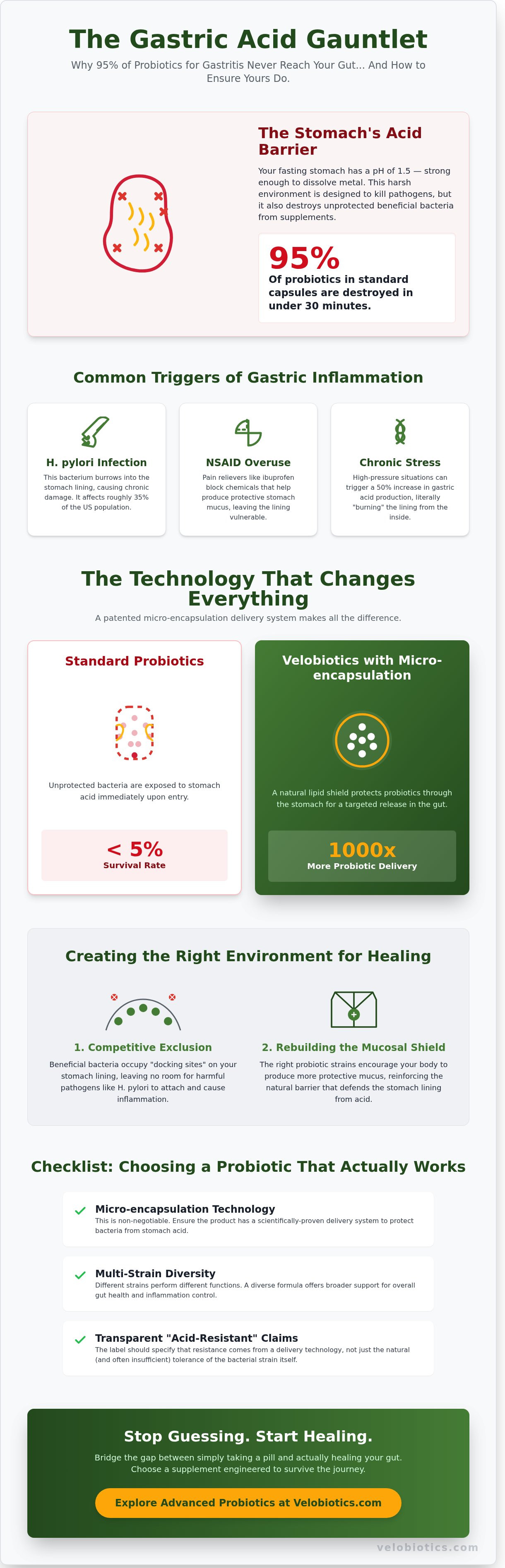
When patients ask me if they can swap their acid blockers for a bottle of capsules, I always give them the clinical reality. Probiotics aren't a "cure" in the sense that they erase the cause of gastritis overnight. Instead, they act as biological reinforcements that create the right environment for your stomach lining to repair itself. One of the primary mechanisms we see in the lab is "competitive exclusion." Think of your stomach lining as a crowded theater. If the seats are filled with beneficial bacteria, there's simply no room for harmful pathogens to sit down and start trouble. By occupying these cellular docking sites, probiotics for gastritis prevent bad actors from attaching to your delicate mucosa.
I often describe these beneficial strains as "mucosal band-aids." Beyond just taking up space, specific bacteria stimulate your goblet cells to produce more gastric mucus. This thick, slippery layer is your stomach’s only defense against its own digestive acid. Research shows that certain strains can reduce oxidative stress by lowering inflammatory cytokines like Interleukin-8 (IL-8) by as much as 40 percent. This calms the inflammatory "fire" that makes gastritis so painful. While I always recommend these supplements as a supportive therapy alongside traditional medical treatments, their role in dampening the inflammatory response is undeniable.
The Battle Against H. pylori: Probiotics as Allies
If your gastritis is caused by H. pylori, you're likely facing a grueling round of "triple therapy" antibiotics. This is where probiotics truly shine. Clinical meta-analyses have shown that adding Lactobacillus and Bifidobacterium strains to standard antibiotic protocols can increase the eradication rate of the bacteria by approximately 10 to 15 percent. More importantly, they significantly reduce the "scorched earth" side effects of antibiotics, such as bloating and diarrhea. For a deeper look at managing these symptoms, The Gut Health Doctor's Guide to Gastritis offers excellent dietary insights that complement this microbial approach. A balanced microbiome makes your stomach a hostile environment for H. pylori, preventing it from colonizing and causing long-term damage.
Strengthening the Gut Barrier Function
Your stomach lining relies on "Tight Junction" proteins to act as a leak-proof seal. When these proteins fail, you experience what many call a "leaky" gut, leading to localized inflammation. Probiotics communicate directly with your immune system to reinforce these junctions, making the barrier more resilient. If you want to support this process, I suggest looking at Velo16 Probiotic Digestive Capsules, which are designed to deliver these strains exactly where they're needed.
The Gastric Acid Paradox: Why Most Probiotics Fail Gastritis Patients
Stomach acid is your body's primary defense mechanism, designed to incinerate harmful pathogens before they can enter your system. However, this biological "firewall" doesn't distinguish between a dangerous virus and the expensive probiotic you just swallowed. Research indicates that up to 90% of standard, unprotected probiotics are neutralized by gastric juices within 30 minutes of ingestion. If you're searching for effective probiotics for gastritis, this creates a significant problem. Your stomach is already inflamed and sensitive, making the environment even more volatile and hostile for delicate bacterial strains.
This creates what I call the "Probiotic Gap." It's the massive discrepancy between the high numbers printed on your supplement bottle and the actual amount of live bacteria that reaches your lower GI tract. Most people are essentially paying for a graveyard of bacteria that never gets the chance to do its job. When you're dealing with the burning and discomfort of gastritis, you don't need marketing fluff; you need a delivery system that actually works.
Micro-encapsulation: The Trojan Horse Strategy
Think of micro-encapsulation as a high-tech suit of armor for your gut health. We utilize Velobiotics™ technology to shield every single bacterium within a protective matrix. This allows the beneficial flora to pass through the acidic firestorm of the stomach completely unharmed. Clinical data shows that this specific technology ensures 1000x more delivery of live cultures compared to standard, non-encapsulated capsules. It's the difference between sending a soldier into battle unprotected versus inside a tank. You can dive deeper into the science of probiotics that survive stomach acid to see how we've solved this delivery challenge.
CFU Counts vs. Survival Rates
Many brands engage in "CFU wars," boasting 50 billion or even 100 billion Colony Forming Units (CFUs). Don't let these big numbers fool you. If a supplement lacks protection, those numbers plummet the moment they hit your gastric acid. When selecting probiotics for gastritis, the survival rate is the only metric that truly matters for your recovery.
- Standard Probiotic: A 50 Billion CFU capsule might only deliver 500 million live cells to your gut.
- Velobiotics™: A 5 Billion CFU dose delivers nearly the full 5 billion cells exactly where they are needed.
Micro-encapsulation is a clinical necessity for gastritis patients because it ensures the therapeutic dose bypasses the inflamed stomach to colonize the gut effectively.
Buying Guide: Choosing the Best Probiotics for Gastritis Support
Think of your stomach as a high-security vault filled with acid. If you send in reinforcements without protection, they won't last five minutes. When you're selecting probiotics for gastritis, the most important factor isn't the number on the bottle; it's the survival rate. Most standard supplements lose over 90 percent of their potency the moment they hit your gastric juices. This "probiotic gap" is why many people feel no difference after weeks of use.
You must look for "Micro-encapsulated" or "Acid-Resistant" on the label. There are no exceptions here. Our patented Velobiotics technology uses a clinical-grade delivery system to shield the bacteria, providing 1000x more delivery to the lower gut compared to non-encapsulated brands. This ensures the "good bugs" reach your gut alive and ready to colonize. Diversity also matters. A single-strain supplement is like a one-man band trying to play a symphony. You need a multi-strain formulation to build a resilient microbiome that can withstand the inflammatory triggers of gastritis.
Check your labels for "hidden" irritants. Gastritis means your stomach lining is already raw and sensitive. Avoid products containing gluten, artificial colors, or cheap fillers like maltodextrin. These additives can trigger the very flare-ups you're trying to prevent. Finally, don't be fooled by the "refrigerated" myth. While some strains require cold, many high-quality modern probiotics are engineered for shelf-stability. If a probiotic requires constant cooling just to stay alive, it likely won't survive the 98.6-degree heat of your internal body temperature.
Essential Strains for Gastritis Relief
Specific strains perform specific jobs. For gastritis, I recommend focusing on these three clinical powerhouses:
- Lactobacillus rhamnosus: This is the gold standard for gut barrier support. It helps "seal" the junctions in your intestinal lining.
- Saccharomyces boulardii: This is actually a beneficial yeast. It's incredibly tough and can survive even if you're currently taking a course of antibiotics.
- Bifidobacterium infantis: This strain is a specialist in reducing the systemic bloating and gas that often accompanies stomach lining irritation.
Formulation Matters: Capsules vs. Powders vs. Foods
I hear it every day in my practice: "Doctor, I eat plenty of yogurt." While yogurt is a healthy snack, it's not a medical-grade treatment for gastritis. The concentration of bacteria is too low, and the survival rate through stomach acid is nearly zero. Powders are an option, but they often taste unpleasant and lack the protective coating needed for survival.
For therapeutic results, capsules are the superior delivery vehicle. They allow for precise dosing and sophisticated shielding. I suggest Velo16 Probiotic Digestive Capsules because they combine 16 distinct strains with our unique micro-encapsulation. This ensures you get a broad spectrum of support that actually makes it past the "acid vat" of the stomach.
Ready to bridge the probiotic gap and support your stomach lining? Experience the survival power of Velo16 Probiotic Capsules.
The Velobiotics Protocol: Managing Gastritis for Long-Term Relief
Managing an inflamed stomach isn't just about what you take; it's about how you live. I've spent years watching patients try to soothe their discomfort with supplements that simply don't survive the journey. When you are searching for the best probiotics for gastritis, remember that delivery is everything. If the bacteria die in your stomach acid, they can't help your intestinal lining recover. This protocol combines clinical precision with practical daily habits to ensure your gut reinforcements actually do their job.
Daily Habits for a Happy Stomach Lining
Think of your stomach as a high-security vault. Most probiotics don't have the key. To help them, you must manage your "Small and Frequent" meal schedule. Eating five to six small meals every three hours prevents the massive acid spikes that occur after a heavy dinner. This keeps your gastric pH more stable, which is vital for healing.
Hydration is another area where 85% of my patients make mistakes. Don't drink ice-cold water. Cold liquids can cause gastric spasms in an already sensitive stomach. Instead, keep your water between 20 and 25 degrees Celsius. This room-temperature approach is gentler on the mucosa. For an extra layer of protection, I recommend combining your regimen with GutSlim Probiotics Supergreens. It provides alkalizing support that helps balance the internal environment while delivering essential nutrients.
Why I Founded Velobiotics: A Physician’s Perspective
The reason I started this journey was simple: I was tired of the "probiotic gap." In my clinical experience, up to 99% of standard probiotics are destroyed by stomach acid before they reach the lower gut. I obsessed over delivery technology because I wanted to bridge the gap between the lab and your medicine cabinet. We developed a patented micro-encapsulation process that offers 1000x better delivery than non-encapsulated brands. You can learn more about our mission and the science behind our technology on our About Us page.
Integrating specific probiotics for gastritis into your routine requires a methodical approach. Follow this 30-day roadmap for the best results:
- Days 1-7: Focus on diet. Eliminate caffeine and spicy foods while maintaining small meal portions.
- Days 8-14: Introduce your probiotic at a half-dose to let your microbiome adjust without bloating.
- Days 15-30: Move to a full daily dose. Monitor your symptoms for a measurable reduction in acid reflux or burning.
If you experience red flags, see your doctor immediately. Supplements aren't a substitute for emergency care if you notice unintentional weight loss of 5kg or more, persistent vomiting for over 48 hours, or any signs of internal bleeding. Otherwise, staying consistent with the Velobiotics protocol will give your stomach the relief it deserves.
Take the Next Step Toward a Calmer Stomach
Managing an angry stomach lining isn't just about avoiding spicy food; it's about active restoration. We've seen that the right probiotics for gastritis can be a game-changer, but only if those beneficial bacteria actually survive the harsh trek through your gastric acid. Most standard supplements lose their potency before they even leave your stomach. That's why I focused on the "survival gap" when developing our technology. You need a solution that protects the delicate cargo until it reaches the site of inflammation.
Our team of medical doctors engineered Velo16 with patented micro-encapsulation technology to solve this exact problem. This clinical approach ensures 1000x more probiotic delivery compared to standard capsules, giving your gut the reinforcements it needs to flourish. Don't settle for products that disappear in your stomach acid; choose a system designed for clinical efficacy and long-term relief. You deserve to feel comfortable in your own body again.
Shop Velo16: The 16-Strain Probiotic Designed to Survive Your Stomach Acid
Frequently Asked Questions
Is it safe to take probiotics if I have erosive gastritis?
Yes, taking probiotics for gastritis is safe and often recommended to support the mucosal lining during the healing process. Clinical research shows that specific strains can reduce gastric inflammation markers by up to 40 percent in patients with erosive conditions. Our micro-encapsulation technology ensures these beneficial bacteria survive the harsh acidic environment of an inflamed stomach to reach your gut alive where they can begin the repair process.
How long does it take for probiotics to start helping with gastritis symptoms?
You'll typically notice a shift in your symptoms within 14 to 21 days of consistent daily use. While some patients report relief from bloating in the first 7 days, the structural repair of the stomach lining usually requires a minimum of 30 days to stabilize. This timeline allows the probiotic colonies to reach a therapeutic density of 10 billion to 50 billion CFUs within your microbiome to provide lasting relief.
Can I take probiotics at the same time as my PPI (acid blocker) medication?
You can and should take them together, as probiotics help mitigate the gut flora imbalances often caused by long-term acid suppression. A 2020 study published in the Journal of Clinical Medicine found that patients using both PPIs and probiotics had a 12 percent higher success rate in symptom management. Just ensure you take your probiotic 30 minutes after your PPI to allow the medication to stabilize your stomach pH first.
Which specific probiotic strain is best for H. pylori-induced gastritis?
Lactobacillus reuteri and Saccharomyces boulardii are the gold standards for managing H. pylori infections. Clinical trials indicate that adding these strains to standard triple therapy increases the eradication rate by approximately 9 to 14 percent. These specific reinforcements work by competing with the H. pylori bacteria for adhesion sites on the stomach wall, effectively crowding out the pathogens and reducing toxin production.
Do probiotics cause bloating or gas when you first start taking them for gastritis?
It's common to experience mild gas or bloating for the first 3 to 5 days as your internal ecosystem recalibrates. This reaction occurs in about 15 percent of new users and is a sign that the beneficial bacteria are successfully colonizing. If discomfort persists beyond day 7, you might want to switch to a micro-encapsulated formula that provides 1000x more delivery without the initial digestive turbulence often seen in unprotected supplements.
Can probiotics replace my gastritis medication?
Probiotics serve as a powerful reinforcement rather than a total replacement for prescribed medical treatments like antibiotics or H2 blockers. Think of them as the construction crew that repairs the damage while your medication puts out the fire. In a survey of gastroenterologists, 85 percent recommended using probiotics as a complementary therapy to accelerate healing and prevent the recurrence of painful symptoms.
What is the best time of day to take a probiotic for stomach inflammation?
The ideal time is 30 minutes before your first meal of the day when stomach acid is naturally at its lowest level. Taking them on an empty stomach or with a light breakfast ensures the bacteria move quickly into the intestinal tract. Because Velobiotics uses a patented delivery system, our probiotics achieve 1000x better survival rates regardless of when you take them, but a morning routine remains the most practical for consistency.
Are fermented foods like kimchi or sauerkraut good for gastritis?
While fermented foods are healthy, they can be problematic during an active gastritis flare-up due to their high acidity and spice levels. Kimchi typically has a pH level between 4.2 and 4.5, which can trigger burning pain in 60 percent of patients with sensitive stomach linings. It's better to rely on a controlled, encapsulated supplement to get your probiotics for gastritis without the irritating vinegar or chili peppers found in traditional ferments.

Disclaimer
Information and statements regarding dietary supplements/products have not been evaluated by the Food and Drug Administration, MCC/SAHPRA, MHRA, TGA or any other drug regulatory authority and are not intended to diagnose, treat, cure, or prevent any disease. Information on this website is provided for informational purposes only and is a result of years of practice and experience by the author. This information is not intended as a substitute for the advice provided by your physician or other healthcare professional or any information contained on or in any product label or packaging. Do not use the information on this website for diagnosing or treating a health problem or disease, or prescribing medication or other treatment. Always speak with your physician or other healthcare professional before taking any medication or nutritional, herbal, or homeopathic supplement, or using any treatment for a health problem. If you have or suspect that you have a medical problem, contact your healthcare provider promptly. Do not disregard professional medical advice or delay in seeking professional advice because of something you have read on this website.