

Probiotics for Male Athletic Performance: A Doctor’s Guide to the Gut-Muscle Axis
What if the most critical component of your training stack isn't what you lift or even what you eat, but how well your gut communicates with your muscle fibers? As a physician, I've seen countless men push their bodies to the limit, only to be sidelined by slow recovery or digestive distress during high-intensity sessions. You likely agree that it's frustrating to nail your macros and training volume, yet still feel sluggish or bloated when it's time to perform. The missing link is often the microbiome; understanding how to use probiotics for male athletic performance can be the difference between a plateau and your next personal best.
In this guide, I'll show you how the gut-muscle axis influences your stamina and muscle growth, moving beyond vague wellness claims to focus on clinical-grade results. You'll discover how to select strains that actually survive the harsh acidic environment of the stomach to deliver measurable benefits. We'll explore the science of reducing systemic inflammation, improving nutrient uptake for gains, and ensuring your energy levels remain sustained through the most demanding sessions. It's time to stop guessing about your supplements and start using biological viability to your advantage.
Key Takeaways
- Learn how the gut-muscle axis acts as a high-speed communication line between your microbiome and your muscles, effectively serving as a second metabolic engine during training.
- Identify how specific bacterial strains can lower systemic inflammation and improve the efficiency of protein absorption to shorten your recovery window.
- Understand why high CFU counts are often just vanity metrics and how micro-encapsulation technology ensures your probiotics actually reach the colon alive.
- Discover how to tailor your use of probiotics for male athletic performance based on your specific discipline, from endurance-focused VO2 max gains to strength-based leucine utilization.
- Get practical tips on the best time of day to take your probiotics and how to use prebiotics to fuel your internal ecosystem for sustained energy.
Understanding the Gut-Muscle Axis: How Your Microbiome Drives Performance
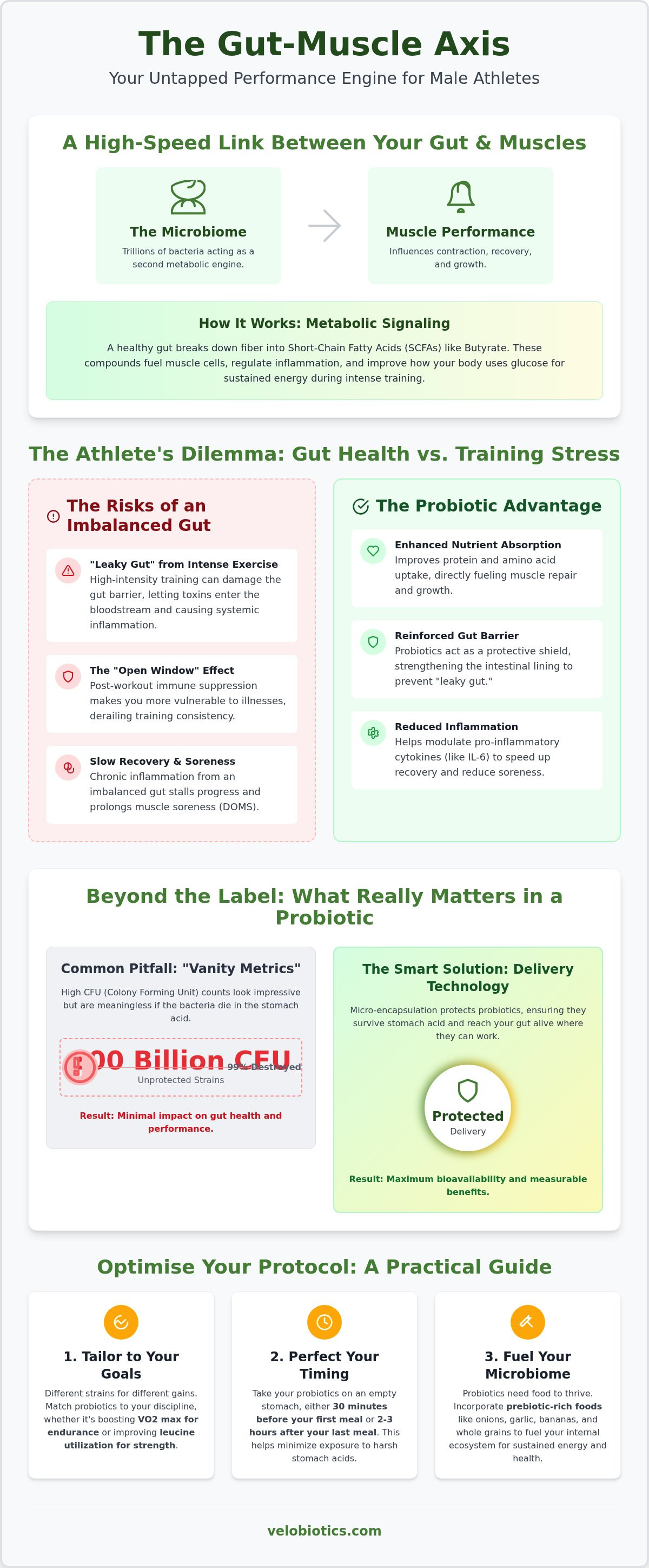
The gut-muscle axis isn't just a fancy medical term; it's the biological highway connecting your digestive health to your physical output. When we discuss probiotics for male athletic performance, we're looking at how the trillions of bacteria in your colon influence the way your muscles contract, recover, and grow. Essentially, your microbiome acts as a second metabolic engine. It breaks down fibers and produces short-chain fatty acids (SCFAs) like butyrate and propionate. These compounds provide a direct energy source for your muscle cells and help regulate systemic inflammation, ensuring your body stays in an anabolic state for longer periods.
Think of your gut as the ultimate gatekeeper for your gains. Probiotics are live microorganisms that ensure this gate remains functional, allowing vital nutrients in while keeping harmful pathogens out of your bloodstream. The Gut-Muscle Axis is the critical link between nutrient intake and power output. Without a balanced microbiome, you could be eating the perfect diet and still feel like you're running on half a tank because your body cannot effectively process the fuel you're providing.
To better understand how these tiny microbes influence your physical results, watch this helpful video:
The Science of Metabolic Signaling
Your gut bacteria do more than just digest food; they signal your body to utilize glucose more efficiently. This metabolic signaling is vital for maintaining high glycogen levels in your muscle tissue. When your microbiome is optimized, your body becomes better at shuttling sugar into the muscles rather than storing it as fat. This process ensures that when you're hitting the final set of a heavy squat session, your muscles have the fuel they need to finish strong. Furthermore, a healthy gut environment improves mitochondrial function, which is the literal powerhouse of every muscle fiber you're trying to build.
Exercise-Induced Stress and the Microbiome
Intense training is a double-edged sword. While it builds strength, high-intensity cardio or heavy lifting can temporarily disrupt your gut barrier function. This often leads to "leaky gut," a condition where the intestinal lining becomes permeable. When this happens, endotoxins can enter the bloodstream and trigger systemic inflammation that slows down your recovery. There's also the "Open Window" theory. This concept suggests that for several hours post-workout, your immune system is suppressed, making athletes more prone to minor illnesses that can derail a training block.
Using high-quality probiotics acts as a protective shield for your intestinal lining. By reinforcing the gut barrier, you minimize the systemic stress caused by training. This is why I often recommend a broad-spectrum approach, such as using 16 strains of probiotics to maintain diversity and resilience. A diverse microbiome doesn't just prevent digestive distress during a marathon or a heavy lift; it keeps your immune system robust so you don't miss a single day of progress due to avoidable fatigue or illness.
The Bio-Physiological Benefits: Recovery, Inflammation, and Hormonal Health
When you finish a heavy lifting session, your body enters a state of controlled physiological chaos. This is acute inflammation, a necessary signal that tells your muscles it's time to grow. The danger lies in chronic inflammation, which can linger and stall your progress. Clinical data, including a detailed review on probiotics and sports performance, indicates that specific bacterial strains help modulate the release of pro-inflammatory cytokines like Interleukin-6 (IL-6). By dampening this "fire" post-workout, you aren't just reducing soreness; you're accelerating the entire repair cycle.
The gut also serves as the primary site for nutrient assimilation. If your microbiome is out of balance, your protein synthesis takes a hit regardless of how much leucine you consume. Utilizing probiotics for male athletic performance ensures that the amino acids from your diet are actually absorbed and transported to the muscle tissues that need them most. It's about maximizing the efficiency of every gram of protein you eat, ensuring your hard work in the gym isn't wasted due to poor bioavailability.
Crushing Post-Workout Inflammation
Distinguishing between beneficial acute inflammation and detrimental chronic inflammation is key for any serious athlete. Acute inflammation triggers the healing process, but when it becomes systemic, it leads to burnout and injury. Strains such as Lactobacillus rhamnosus have been shown to help manage this transition by reinforcing the gut barrier. I suggest taking your probiotic alongside your post-workout meal. This timing leverages the increased blood flow to your digestive tract, boosting the uptake of critical nutrients and helping you recover faster for your next session.
Hormonal Balance and the Gut
Your endocrine health is inextricably linked to your microbiome. For example, Vitamin D is a vital precursor to testosterone, yet its absorption is highly dependent on gut health. When your gut is thriving, your body is better equipped to manage cortisol, the stress hormone that can literally eat away at your muscle during periods of overtraining. Additionally, a healthy gut helps detoxify excess estrogen, which is crucial for maintaining an optimal testosterone-to-estrogen ratio. To support these complex systems, I recommend looking into the His-Biotics Probiotics Original Multivitamin, which provides a foundation for both bacterial diversity and hormonal support. You can learn more about how we developed these targeted solutions by reading the Velobiotics story.
Matching Strains to Goals: Endurance, Strength, and High-Intensity Training
Not all probiotics serve the same purpose. Just as you wouldn't use a marathon training plan to prepare for a powerlifting meet, you shouldn't expect a single-strain yogurt to meet the demands of an elite athlete. The efficacy of probiotics for male athletic performance depends heavily on strain specificity. A multi-strain approach is essential because different bacteria colonize distinct areas of the gut and perform unique metabolic tasks. While one strain might focus on protecting the intestinal barrier, another might be responsible for synthesizing the B vitamins needed for energy production. When selecting probiotics for male athletic performance, specificity is your best ally.
The Endurance Stack: Stamina and GI Stability
For marathoners and cyclists, the greatest hurdle often isn't the legs; it's the gut. High-intensity aerobic activity diverts blood flow away from the digestive system, which can lead to the dreaded "runner’s trots." Consistent use of Lactobacillus and Bifidobacterium combinations helps maintain the integrity of the gut lining under these stressful conditions. Research published in a review of probiotics for post-exercise recovery suggests that these strains can also indirectly support VO2 max by reducing systemic oxidative stress. Endurance is as much about gut endurance as it is about lung capacity. By stabilizing your internal environment, you ensure that GI distress doesn't force a DNF on race day.
The Strength Stack: Hypertrophy and Repair
If your goal is hypertrophy, your microbiome needs to be an efficient protein-processing plant. Many lifters on high-calorie bulk diets suffer from "protein bloat," where the body struggles to break down massive amounts of whey or casein. This is where Bacillus coagulans becomes a game-changer. This specific strain has been documented to reduce muscle soreness (DOMS) and improve the absorption of leucine, the primary trigger for muscle protein synthesis. To manage the digestive load of a surplus diet, I often point athletes toward Velo16 Probiotic Digestive Capsules. These provide the enzymatic support necessary to ensure that your daily protein intake turns into muscle rather than digestive discomfort.
Intermittent sports like MMA or football require a blend of both worlds. These athletes need the cognitive focus to make split-second decisions and the rapid recovery to handle multiple training sessions per day. A diverse microbial profile supports the production of neurotransmitters like GABA and serotonin, which are crucial for maintaining composure under the bright lights of competition. By selecting a broad-spectrum formulation, you cover all the physiological bases, from cognitive resilience to physical repair.
Beyond the Label: Selecting a Probiotic That Actually Reaches Your Gut
The most sophisticated training program in the world won't save you if your supplement stack fails at the first biological hurdle: your stomach. As a physician, I've observed a significant efficacy gap in the supplement industry. Many products marketed as probiotics for male athletic performance boast massive colony-forming unit (CFU) counts, yet they lack the technology to survive the journey through gastric acid. If the bacteria are dead before they reach your colon, they cannot influence the gut-muscle axis or support your recovery. You aren't just looking for high numbers; you're looking for biological viability.
The "Doctor's Secret" to a truly effective probiotic is micro-encapsulation technology. While standard capsules dissolve almost immediately in the stomach, micro-encapsulation acts like a protective shield, ensuring up to 1000x better survival rates for the active strains. This technology allows the bacteria to bypass the harsh acidic environment and release only when they reach the alkaline environment of the intestines. For the modern athlete, this means your supplement remains potent and effective even if it's sitting in your gym bag rather than a refrigerator. Shelf stability is a requirement, not a luxury, for a busy lifestyle.
The Myth of High CFU Counts
Don't be fooled by labels promising 100 billion CFUs. In clinical terms, 100 billion "dead" bacteria are infinitely less effective than 1 billion "live" encapsulated ones. Traditional enteric coatings offer some protection, but they often fail to account for the unique internal environment of an active man. Our research into Velo16 Probiotic Digestive Capsules focused on solving this exact delivery problem. By using proprietary micro-encapsulation, we ensure that the 16 strains we include actually arrive at their destination ready to work. It's the difference between a supplement that looks good on paper and one that actually drives results in the gym.
Reading the Supplement Facts Like a Pro
When you examine a label, look for specific strain codes like HN019 or LPC-37 rather than just a generic genus name like Lactobacillus. These codes identify the exact "breed" of bacteria that has been studied in clinical trials. Be wary of "Proprietary Blends" that don't disclose the dosage of each individual strain. These blends often hide low amounts of expensive, high-performing strains behind a wall of cheaper fillers. In a market where the FDA regulates probiotics as dietary supplements without requiring pre-market approval, choosing a physician-led brand is your best safeguard against ineffective products.
Your 2026 checklist for a performance-grade probiotic is simple: it must be multi-strain to cover diverse metabolic needs, micro-encapsulated for guaranteed survival, and physician-formulated to ensure the ratios match human physiology. Stop gambling with your gut health and choose a delivery system that respects the science of survival. You can secure your foundation for peak performance by selecting clinically-backed probiotic delivery systems that are engineered for the serious athlete.
Optimising Your Protocol: Practical Advice for the Modern Athlete
Optimising your protocol isn't just about swallowing a capsule; it's about creating an internal environment where those bacteria can thrive. One of the most common questions I get in my clinic is about timing. Should you take your probiotics on an empty stomach or with your pre-workout? While traditional, unprotected supplements are often destroyed by the stomach acid spike that occurs during digestion, our micro-encapsulation technology changes the rules. However, I still recommend taking your probiotics for male athletic performance in the morning. This allows the strains to establish themselves before the physiological stress of your daily training begins.
Think of your probiotics as the "seeds" and prebiotics as the "fertilizer." Without adequate fiber, even the most resilient strains will struggle to colonize. Integrating complex carbohydrates like oats, bananas, and asparagus into your diet provides the necessary fuel for your microbiome. When you pair this with consistent hydration, you're essentially building a fortress for your gut-muscle axis. This synergy ensures that the beneficial bacteria can produce the short-chain fatty acids required for muscle energy and recovery.
A Daily Routine for Peak Performance
- Step 1: Start your day with a morning dose of His-Biotics. This provides a foundation of 16 clinical strains and a full multivitamin profile to support your immune system and gut health throughout the day.
- Step 2: Maintain high hydration levels and prioritize prebiotic fiber intake. This keeps the "good guys" in your gut active and ready to process your macros.
- Step 3: Pair your post-workout protein with recovery-focused nutrition. By using probiotics for male athletic performance, you've already primed your system for better amino acid uptake, making your post-gym meal much more effective.
The Physician’s Final Verdict
During the first 30 days of this protocol, pay close attention to three specific metrics: digestive regularity, energy stability throughout the afternoon, and your speed of recovery between sessions. Most athletes report a noticeable reduction in "protein bloat" within the first week, followed by more sustained stamina during high-intensity intervals by week three. These aren't just subjective feelings; they are the result of a more efficient metabolic engine working in your favor.
The gut is the unsung hero of the athletic world. While it's tempting to reach for short-term stimulants or high-caffeine pre-workouts, true performance is built on the foundation of long-term microbiome health. By focusing on biological viability, you're ensuring that your body can actually use the nutrients you're feeding it. I invite you to explore our full range of Velobiotics Men’s Health Solutions to find the right fit for your specific training goals. Your muscles do the work, but your gut provides the power.
Mastering Your Internal Environment for Peak Output
Your journey toward elite performance doesn't end at the gym door; it begins with the biological foundation you build within. We've explored how the gut-muscle axis acts as your second metabolic engine, driving recovery and hormonal balance through precise microbial signaling. You now understand that high CFU counts are meaningless without biological viability. By prioritizing delivery systems that ensure survival, you bridge the gap between consuming nutrients and actually utilizing them for growth and stamina. Integrating the right probiotics for male athletic performance into your daily stack is a strategic move that pays dividends in every training session.
I developed His-Biotics to solve the efficacy gap that plagues the supplement industry. It's physician-formulated specifically for male physiology, combining over 10 clinical strains with a complete multivitamin profile. Our proprietary micro-encapsulation technology ensures these active ingredients have a 1000x better survival rate than standard capsules, so they actually reach your gut alive. Don't let your hard work be undermined by poor nutrient absorption or systemic inflammation.
Upgrade your recovery with His-Biotics – The clinical-grade probiotic for men. It's time to stop guessing and start training with the full power of your microbiome behind you. Stay focused, stay consistent, and let your biology work for you.
Frequently Asked Questions
Do probiotics actually help with muscle growth?
Yes, probiotics support muscle growth indirectly by optimizing the gut-muscle axis and improving nutrient bioavailability. When you take specific clinical strains, your body becomes much more efficient at breaking down dietary protein into usable amino acids like leucine. This increased absorption means more of your protein intake goes toward muscle repair rather than being wasted. It's a foundational step for anyone using probiotics for male athletic performance to maximize their hypertrophy goals. For those also looking to support their body's overall development potential, you can visit Tallori to learn more about their specialized growth supplements.
How long does it take for an athlete to see results from probiotics?
You'll likely notice digestive improvements, such as reduced bloating and better regularity, within the first 7 to 14 days. However, the more significant performance benefits, like enhanced recovery and sustained energy levels, typically take 3 to 4 weeks of consistent use. This timeline allows the beneficial bacteria to successfully colonize your gut and begin modulating systemic inflammation. For long-term physiological changes, daily consistency is far more important than a high one-time dose.
Can probiotics reduce the risk of illness during heavy training cycles?
Is it better for men to take a specific "male" probiotic?
It's highly beneficial for men to choose a formulation tailored to their unique physiological and hormonal needs. Men's probiotics, like His-Biotics, often combine specific bacterial strains with multivitamins that support testosterone production and cardiovascular health. Selecting a product designed for male physiology ensures you're addressing the specific metabolic demands of a man's training regimen. Generic wellness supplements often lack the targeted strain diversity required to support the gut-muscle axis effectively.
Can I get enough probiotics from food like yogurt for athletic performance?
While yogurt and fermented foods are healthy additions to your diet, they rarely provide the strain concentration needed for elite athletic performance. Most commercial yogurts contain only one or two strains, and many of these bacteria are killed by stomach acid before they ever reach the colon. Clinical-grade supplements use micro-encapsulation to ensure survival and delivery. If you're serious about your training results, you need the targeted, high-potency delivery that food alone cannot provide.
What happens if I stop taking probiotics? Will my performance drop?
If you stop supplementation, your microbiome will gradually return to its baseline state within about 1 to 2 weeks. You won't experience a sudden "crash" in your performance, but you might notice a return of digestive sluggishness or slightly slower recovery times. Probiotics are transient visitors in the gut, not permanent residents. To maintain the consistent benefits for the gut-muscle axis, you should treat them as a permanent part of your daily supplement stack.
Are there any side effects for athletes, like bloating or gas?
Some athletes experience mild gas or bloating during the first 3 to 5 days as the gut environment shifts. This is a normal sign that the new, beneficial bacteria are competing with existing flora. To minimize this, start with a consistent daily dose and stay well-hydrated. If you use a micro-encapsulated product, these symptoms are often significantly reduced because the bacteria are released lower in the digestive tract, bypassing the initial fermentation in the upper gut.
Can I take probiotics with my protein shake or pre-workout?
You can certainly take probiotics with a protein shake, as the protein can actually help buffer the bacteria through the stomach. However, be cautious with pre-workouts that contain very high levels of caffeine or artificial stimulants. These can increase gut motility and potentially flush the bacteria out before they have a chance to colonize. For the best results in probiotics for male athletic performance, I recommend taking your dose with a meal or your post-workout recovery shake.

Disclaimer
Information and statements regarding dietary supplements/products have not been evaluated by the Food and Drug Administration, MCC/SAHPRA, MHRA, TGA or any other drug regulatory authority and are not intended to diagnose, treat, cure, or prevent any disease. Information on this website is provided for informational purposes only and is a result of years of practice and experience by the author. This information is not intended as a substitute for the advice provided by your physician or other healthcare professional or any information contained on or in any product label or packaging. Do not use the information on this website for diagnosing or treating a health problem or disease, or prescribing medication or other treatment. Always speak with your physician or other healthcare professional before taking any medication or nutritional, herbal, or homeopathic supplement, or using any treatment for a health problem. If you have or suspect that you have a medical problem, contact your healthcare provider promptly. Do not disregard professional medical advice or delay in seeking professional advice because of something you have read on this website.