

Probiotics for Sugar Cravings: A Doctor's Guide
What if that 3 p.m. cookie craving isn't a sign of weak willpower, but a loud command from a tiny army of bacteria living in your gut? It's a frustrating cycle that many of my patients face; you try to resist the sweets, only to end up feeling out of control and bloated by evening. If you've ever felt guilty over a failed diet, it's time to stop blaming your mind and start looking at your microbiome. The reality is that your gut bacteria can actually manipulate your appetite to ensure their own survival. By using probiotics to manage sugar cravings, you're not just masking a symptom; you're addressing the biological root of the problem.
In this guide, I'll show you the scientific connection between your internal ecosystem and sugar addiction. You'll learn which specific probiotic strains are most effective at stabilizing your metabolic health and silencing the constant urge for a sugar fix. We'll also dive into why most standard supplements fail and how advanced delivery technology ensures these microbes survive the journey through your stomach acid. It's time to regain control of your health with a plan that's grounded in clinical evidence rather than empty promises.
Key Takeaways
- Understand how "microbial hijacking" works and why your gut bacteria, not your willpower, might be the ones demanding that afternoon candy bar.
- Discover the role of the "fullness hormone" GLP-1 and how specific microbes trigger its release to help you feel satisfied more quickly.
- Learn the scientific advantage of using probiotics to manage sugar cravings by selecting diverse, 16-strain blends that support metabolic health.
- Follow a practical, doctor-designed protocol to starve sugar-loving bacteria while feeding the beneficial strains that protect your gut environment.
- Find out why most standard supplements fail the "viability test" and how micro-encapsulation technology ensures your probiotics arrive at their destination alive.
Why Your Brain Isn’t the Boss of Your Sugar Cravings
If you've spent years beating yourself up over a midnight chocolate raid, I have some professional news for you: it isn't just your lack of discipline. Let’s talk about the "Willpower Myth." Most weight management advice treats your brain like a CEO in total control. In reality, your gut is more like a rowdy board of directors. When certain bacteria dominate the room, they don't just ask for sugar; they demand it. This is microbial "hijacking." These organisms have evolved clever ways to manipulate your behavior to ensure their own survival. Since sugar provides rapid energy for specific yeast and bacteria, they've developed a vested interest in your diet. By using probiotics to manage sugar cravings, you're essentially installing a more cooperative board of directors.
Sugar also triggers a massive release of dopamine in the brain, creating a powerful reward loop that feels impossible to break. However, the initial signal that prompts you to reach for the cupcake often originates in your digestive tract. Your microbes are the ones starting the conversation. Using probiotics to manage sugar cravings isn't just a wellness trend; it's a targeted clinical strategy to reclaim your metabolic health from the inside out.
The "Hungry Microbe" Theory
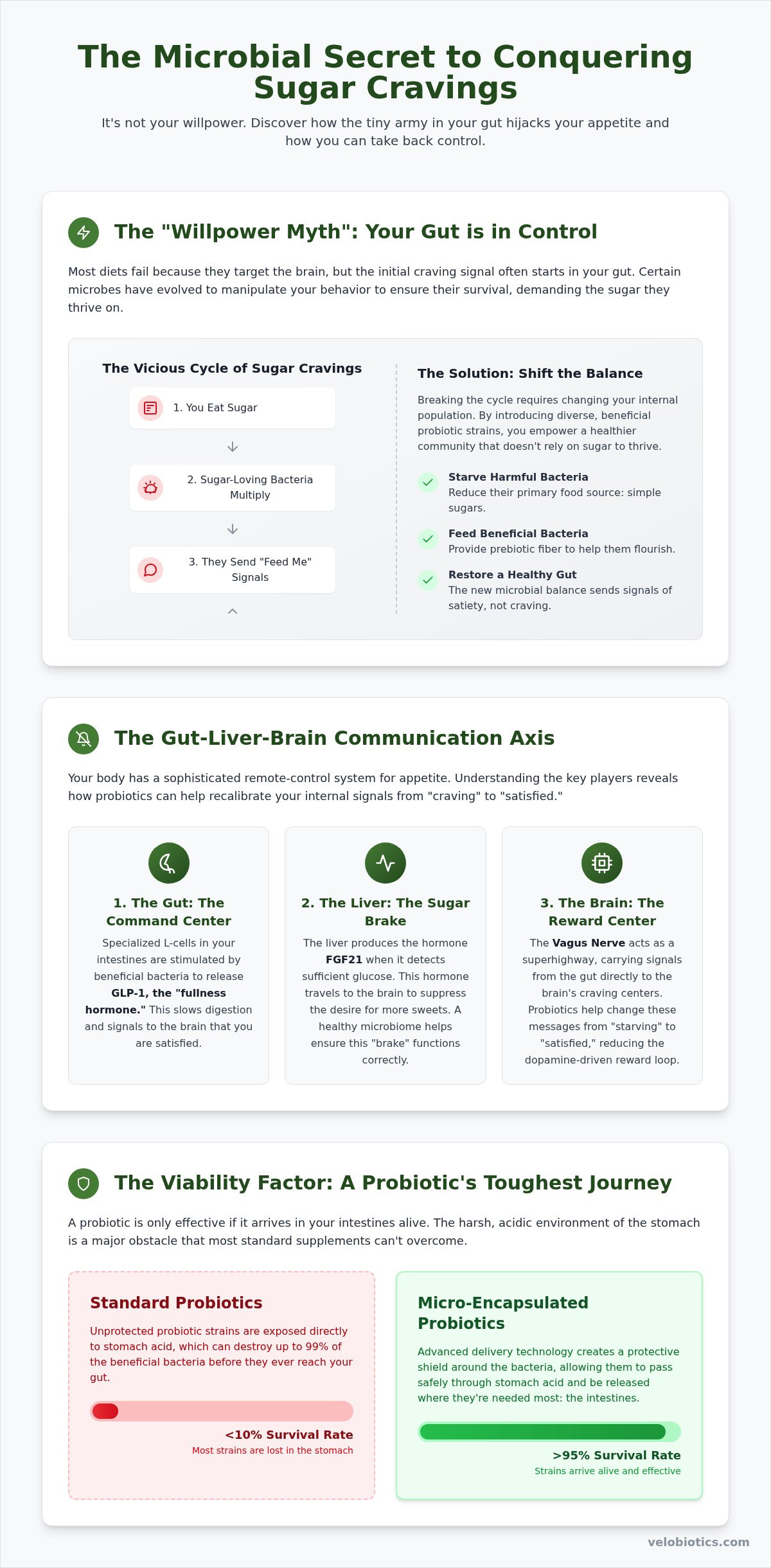
Not all bacteria are created equal. In a balanced system, your gut microbiome helps you digest fiber and produce essential vitamins. But when dysbiosis occurs, "sugar-seeking" strains like certain Proteobacteria can take over. These microbes thrive on simple carbohydrates. They create a vicious cycle: the more sugar you eat, the more they grow, and the more they grow, the louder their "feed me" signals become. Breaking this cycle requires more than just grit; it requires a shift in the microbial population to favor strains that don't depend on a glucose spike to survive.
How Your Gut Microbes Talk to Your Brain
The primary communication highway between your gut and your head is the Vagus nerve. It’s a physical link that allows your gut to send instant status reports to your brain’s craving centers. Microbes also communicate via metabolites. Metabolites are the chemical byproducts of bacterial fermentation. These chemicals can cross into your bloodstream and influence your mood, appetite, and even your taste bud sensitivity. When your gut is out of balance, these "text messages" are almost always about finding more sugar. Restoring balance with a diverse supplement like Velo16 helps change the tone of these messages from "starving" to "satisfied."
The Gut-Liver-Brain Axis: How Microbes Remote Control Your Cravings
Your gut doesn't just digest food; it's a sophisticated sensory organ. Within your gut lining, specialized sensors called FFAR4 receptors act like biological glucose detectors. When you consume sugar, these receptors trigger a cascade of signals that travel through the gut-to-brain pathway, instantly informing your reward centers that "the good stuff" has arrived. This is why artificial sweeteners often feel unsatisfying; they don't always activate this specific circuit. By using probiotics to manage sugar cravings, we aim to recalibrate these sensors so they don't stay in a state of constant high alert.
The liver also plays a critical role in this communication loop. It produces a hormone called FGF21, which acts as a "sugar brake." When the liver detects sufficient glucose levels, FGF21 travels to the brain to suppress the desire for more sweets. If your microbiome is in a state of dysbiosis, this "brake" can fail. Beneficial bacteria help maintain the integrity of this Gut-Liver-Brain axis, ensuring that the signals for satiety are loud, clear, and timely. It’s a remote control system where the microbes often hold the buttons.
GLP-1: The Natural Appetite Suppressor in Your Gut
You've likely heard of GLP-1 in the context of modern metabolic medications. However, your gut is actually a natural GLP-1 factory. Specific probiotic strains stimulate the L-cells in your intestinal lining to release this "fullness hormone" into your bloodstream. GLP-1 slows down how fast your stomach empties and sends a direct signal to your brain that you're satisfied. To get the best results, you must provide these bacteria with prebiotic fiber. Fiber is the essential fuel that allows these microbes to produce the metabolites necessary for GLP-1 activation. If you're looking for a targeted way to support this process, consider exploring a probiotic GLP-1 booster to assist your natural metabolic rhythm.
The Vitamin B5 Connection
While probiotics offer a natural way to support GLP-1 levels, researchers often utilize specialized peptides and compounds to study these metabolic pathways in detail; you can learn more about Biomod Peptides and their range of high-purity products for laboratory use.
One of the most exciting findings in microbiome research involves a bacterium called Bacteroides vulgatus. This specific microbe is a prolific producer of Pantothenic acid, or Vitamin B5. While you can find B5 in supplements, the magic happens when it’s produced in situ by your gut bacteria. This locally produced B5 helps regulate the neural pathways that control your preference for sweet tastes. It’s like having a biological dimmer switch for your cravings. When B. vulgatus levels are low, your "sugar lust" stays on high. Using probiotics to manage sugar cravings helps restore these essential "chemist" bacteria to your internal ecosystem.
Specific Probiotic Strains That Signal Fullness and Reduce Sweet Preferences
Think of your gut like a garden. In a neglected garden, "Sugar-Seeding" bacteria act like invasive weeds. These strains thrive on simple carbohydrates and actively crowd out the "Sugar-Suppressing" strains that keep your metabolism steady. When you're using probiotics to manage sugar cravings, the goal isn't just to add one "good" plant; it's to restore the entire ecosystem's diversity. While many supplements offer a single strain, clinical experience shows that 16-strain blends are far more effective at creating a resilient environment that can withstand the occasional dietary slip-up.
Two major families, Lactobacillus and Bifidobacterium, do the heavy lifting in this biological battle. Lactobacillus rhamnosus is particularly impressive for its role in appetite regulation. It helps modulate the neural signals that tell your brain you've had enough to eat. Meanwhile, Bifidobacterium strains act as the primary guardians of your gut barrier. A strong barrier prevents inflammatory compounds from leaking into your bloodstream. When inflammation is low, your insulin works more efficiently, and you don't experience the energy crashes that lead to desperate sugar runs.
Bacteroides Vulgatus: The Sugar-Squelcher
Recent clinical research has identified Bacteroides vulgatus as a key player in how we perceive and process sugar. This strain is a natural inhabitant of a healthy human gut, yet it's often missing in those struggling with metabolic issues. B. vulgatus doesn't just occupy space; it actively helps lower fasting blood glucose levels. By improving how your body handles sugar that's already in your system, it reduces the biological "panic" that triggers a craving for more. It's essentially an internal regulator for your sweet tooth.
Lactobacillus and Bifidobacterium: The Metabolic Duo
These two families are the masters of producing Short-Chain Fatty Acids (SCFAs) like acetate and butyrate. These metabolites are crucial because they improve insulin sensitivity throughout your body. When your cells can actually use the fuel you give them, your blood sugar stays stable, and you avoid the "sugar coaster" of highs and lows. This is why a broad-spectrum approach is so vital. Velo16 Probiotic Digestive Capsules deliver a comprehensive range of these metabolic workhorses, ensuring you have the right "team" to keep your cravings in check. It's about providing your body with the tools it needs to maintain its own balance.
A Practical 4-Step Protocol to Recalibrate Your Microbiome
As a physician, I've seen that understanding the science of microbial hijacking is only half the battle. To truly silence the noise of a sweet tooth, you need a clinical strategy that addresses the ecosystem as a whole. Using probiotics to manage sugar cravings is a powerful tool, but it works best when part of a structured 4-step protocol designed to shift your internal environment from sugar-dependence to metabolic flexibility.
- Step 1: Starve the "Bad" Guys. You don't need to quit sugar cold turkey, which often leads to a stress-induced rebound. Instead, gradually reduce processed sugars by 25% each week to weaken the sugar-seeking strains without triggering a massive hunger response.
- Step 2: Feed the "Good" Guys. Prebiotic fibers act as the essential fuel for your beneficial microbes. Without this "fertilizer," your new probiotics won't be able to colonize effectively.
- Step 3: Introduce the Reinforcements. This is the phase where you introduce high-diversity, multi-strain supplements. Ensure they are protected by micro-encapsulation technology so the active ingredients actually survive the harsh passage through your stomach acid.
- Step 4: Maintain the Environment. High cortisol from chronic stress and lack of sleep can increase gut permeability. Prioritize seven hours of rest to keep your microbiome resilient and your hormones balanced.
Feeding Your New Microbes
To get the most out of your supplement, you should pair it with specific prebiotic foods. Think of this as a "synbiotic" approach, where the probiotic is the seed and the prebiotic is the fertilizer. Excellent sources include chicory root, raw garlic, leeks, and slightly under-ripe bananas which are rich in resistant starch. For the best metabolic support, I recommend taking your probiotics 30 minutes before your first meal of the day. This timing allows the microbes to transit through the stomach more efficiently when acid levels are naturally lower.
Managing the "Sugar Withdrawal" Period
When you start to starve out sugar-loving bacteria, they don't go quietly. You might experience a temporary "extinction burst" where cravings actually intensify for a few days as the bad bacteria fight for survival. Using probiotics to manage sugar cravings during this transition helps by dampening the systemic inflammation that often accompanies dietary changes. If you find this phase particularly challenging, GutSlim Probiotics Tummy Toner is specifically formulated to support your metabolism and keep you on track. To start your journey toward better gut health, you can browse our full range of doctor-formulated probiotics today.
The Viability Factor: Why Your Probiotic Must Survive to Stop the Cravings
If you've followed the steps in this guide, you now understand the biological machinery behind your appetite. However, there's a critical technical hurdle that most supplement companies ignore: the stomach acid trap. Your stomach is a highly acidic environment designed to break down food and kill invading pathogens. Unfortunately, it doesn't distinguish between harmful bacteria and the beneficial strains you're taking. Clinical data suggests that as much as 90% of standard, "naked" probiotics die before they ever reach the lower intestine. When using probiotics to manage sugar cravings, survival is the only metric that truly matters.
CFU counts on a label are often used as a marketing shorthand for quality, but they can be misleading. A product with 100 billion CFUs that lacks protection is significantly less effective than a smaller, shielded dose that actually reaches its destination. To solve this viability gap, we utilize proprietary micro-encapsulation technology. This process creates a microscopic seal around each bacterial cell, protecting it from gastric acid and bile salts. It ensures that the 16 diverse strains we've discussed are delivered intact to the areas where they can influence your metabolic hormones.
Science-Backed Delivery for Real Results
The lower intestine is the primary site for GLP-1 production and microbial fermentation. For a probiotic to effectively recalibrate your sugar sensors, it must arrive there alive and ready to colonize. Shielded probiotics maintain their biological potency through the entire digestive tract, whereas unprotected versions often lose their functional superiority within minutes of ingestion. This is the difference between simply taking a supplement and actually changing your internal environment. You can learn more about the Velobiotics story and our technology to see how we solved this fundamental delivery problem.
Choosing the Right Tool for Your Goals
Not every gut health concern requires the same approach. While general wellness might be supported by a basic blend, using probiotics to manage sugar cravings requires a more targeted metabolic focus. If your primary goal is to address weight management alongside your cravings, I recommend GutSlim Probiotics Fat Burner. This formulation combines high-viability strains with active ingredients designed to support fat oxidation and appetite control. Remember, your cravings are a biological signal, not a character flaw. By addressing the root cause with the right technology, you finally have the tools to take back control of your health and your life.
Take Control of Your Cravings Today
Sugar cravings aren't a reflection of your character; they're a direct result of a microbiome that's been hijacked by sugar-seeking bacteria. By using probiotics to manage sugar cravings, you can finally silence the biological noise and restore your metabolic health. We've explored how specific strains like B. vulgatus and L. rhamnosus stabilize blood sugar and trigger the "fullness" hormones that stop you from reaching for the cookie jar.
As a doctor-founded brand, we focus on empirical evidence and proprietary technology. Our micro-encapsulation process ensures that our 16-strain blends have 1000x better survival than standard probiotics, allowing the active ingredients to actually reach your lower intestine. This scientifically formulated approach is trusted by thousands for real digestive and metabolic results. You don't have to fight your biology alone. With the right tools and a resilient gut, you can reclaim your freedom from sugar once and for all.
Shop the GutSlim Range to Start Managing Your Cravings Today
Frequently Asked Questions
How long does it take for probiotics to reduce sugar cravings?
Most patients begin to notice a shift in their appetite within two to four weeks of consistent use. It takes time for the beneficial bacteria to colonize and start producing the metabolites that influence your "fullness" hormones. While you might feel better digestion within days, the full recalibration of your gut-brain axis is a biological process that requires daily reinforcement to stay effective.
Can probiotics help with weight loss by stopping cravings?
Yes, because they address the internal "hijacking" that leads to overeating. When you start using probiotics to manage sugar cravings, you reduce the frequency of insulin spikes and energy crashes that drive you toward high-calorie snacks. By stabilizing your metabolic signals, these microbes make it much easier to maintain a caloric deficit without the constant psychological battle against your own hunger. For individuals requiring more comprehensive care, Nusbaum Medical Centers provides specialized medical and surgical weight loss solutions to help achieve long-term metabolic health.
While Bacteroides vulgatus is a powerful "sugar-squelcher," a diverse 16-strain blend is actually more effective for long-term results. You want a combination of Lactobacillus rhamnosus for appetite regulation and Bifidobacterium to protect your gut barrier. This multi-strain approach ensures you're covering all metabolic bases, from hormone release to insulin sensitivity, rather than relying on a single microbe to do all the work.
Do I need to stop eating sugar completely for probiotics to work?
You don't have to quit cold turkey, and I often advise against it. Quitting sugar too abruptly can cause a stress response that actually disrupts your microbiome. The goal is to use the probiotics as a support system while you gradually reduce processed sweets. As the "good" bacteria take hold, you'll naturally find it much easier to make healthier choices because the intense biological drive for sugar will diminish.
Can a "leaky gut" cause me to want more sweets?
Absolutely. When your gut barrier is compromised, it leads to systemic inflammation that can muffle your brain's satiety signals. This "noise" often makes your brain think it's starving, leading to a desperate search for quick energy in the form of sugar. By repairing the gut lining with targeted Bifidobacterium strains, you lower inflammation and allow your natural "I'm full" signals to reach your brain clearly again.
Is it better to get probiotics from food or supplements for cravings?
While fermented foods are great for maintenance, supplements provide the concentrated, clinical doses needed to override a strong sugar addiction. Many foods don't contain the specific strains or the sheer volume of bacteria required for metabolic changes. Additionally, using probiotics to manage sugar cravings is most effective when the bacteria are protected by micro-encapsulation technology, ensuring they survive your stomach acid to reach the lower intestine alive.
Can children use probiotics to manage their sweet tooth?
Yes, children can benefit significantly from gut balance, provided you use a formulation designed for their needs. Kids are very susceptible to the sugar-craving cycle, which can lead to behavioral highs and lows. A gentle, multi-strain probiotic like Biokid chewable tablets can help stabilize their microbiome and make it easier to manage their daily sugar intake without the typical mealtime drama.
What happens if I stop taking the probiotic?
Your microbiome is a living, shifting ecosystem that requires consistent "weeding and seeding." If you stop the supplement but haven't yet established a high-fiber, low-sugar diet, the sugar-seeking bacteria may eventually grow back and reclaim their territory. Most people find that a maintenance dose is the most practical way to keep their cravings in check and protect the metabolic progress they've worked so hard to achieve.

Disclaimer
Information and statements regarding dietary supplements/products have not been evaluated by the Food and Drug Administration, MCC/SAHPRA, MHRA, TGA or any other drug regulatory authority and are not intended to diagnose, treat, cure, or prevent any disease. Information on this website is provided for informational purposes only and is a result of years of practice and experience by the author. This information is not intended as a substitute for the advice provided by your physician or other healthcare professional or any information contained on or in any product label or packaging. Do not use the information on this website for diagnosing or treating a health problem or disease, or prescribing medication or other treatment. Always speak with your physician or other healthcare professional before taking any medication or nutritional, herbal, or homeopathic supplement, or using any treatment for a health problem. If you have or suspect that you have a medical problem, contact your healthcare provider promptly. Do not disregard professional medical advice or delay in seeking professional advice because of something you have read on this website.