

Probiotics for Women’s Immune Support: A Doctor’s 2026 Buying Guide
That 50 billion CFU count on your supplement bottle might actually mean nothing if the bacteria don't survive the acidic journey through your stomach. As a doctor, I've seen many women spend a fortune on high-dose supplements only to end up back in my office with the same frequent colds and fatigue. It's frustrating to feel like you're doing everything right while your immune system remains sluggish. You're likely looking for probiotics for women's immune support that actually deliver results rather than just passing through your system.
I agree that understanding microbiome health can feel like a maze of confusing labels and technical jargon. You deserve to know how to choose a formula that survives gastric acid and works in synergy with Vitamin D to fortify your defenses and feminine health. In this 2026 guide, I'll explain the science of micro-encapsulation, which Lactobacillus strains truly matter for your immunity, and how to ensure your investment leads to fewer sick days and better vitality.
Key Takeaways
- Understand why 70 to 80 percent of your immune cells reside in your gut and how they communicate with your vaginal microbiome to keep you healthy.
- Learn why survival is the most critical factor when choosing probiotics for women's immune support, ensuring that beneficial bacteria actually reach your gut alive.
- Discover the specific synergy between Vitamin D and beneficial strains that helps fortify your feminine health and reduces frequent sick days.
- Identify common supplement mistakes, such as ignoring storage requirements or mixing probiotics with heat, which can render your daily routine useless.
- Get a practical doctor's checklist for matching specific probiotic strains to your current life stage and learn why micro-encapsulation offers superior delivery.
Why Women’s Immune Support Needs More Than Just "Good Bacteria"
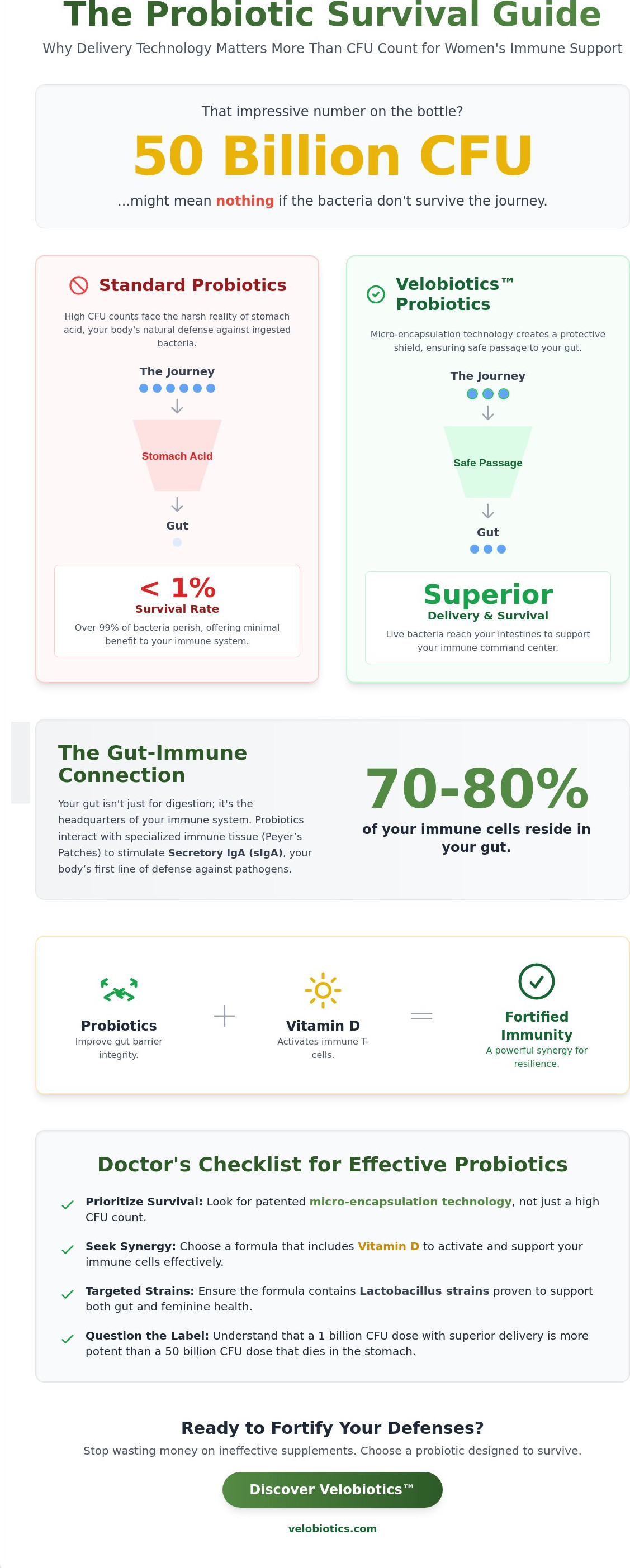
Most people imagine the immune system as a floating army of white blood cells, but its true home base is much more grounded. Approximately 70% to 80% of your immune cells reside directly within your intestinal lining. This physical proximity makes the gut microbiome the primary director of your body's defense strategies. For women, this system is uniquely complex because your gut microbiome doesn't work in isolation; it maintains a constant "conversation" with your vaginal microbiome to prevent opportunistic infections. When this communication breaks down, your systemic immunity suffers.
Selecting effective probiotics for women's immune support requires a strategy that acknowledges this dual-microbiome connection. While a comprehensive overview of probiotics shows they can influence everything from mood to skin health, their most critical role is acting as a biological shield. Generic supplements often fail because they treat the gut like a simple container rather than a sophisticated immune command center. They provide "good bacteria" that never actually reach the target site, leaving your defenses unsupported against seasonal threats or intimate health imbalances.
To better understand how to select the right supplement for your needs, watch this helpful video:
The Gut-Immune Connection Explained
Inside your small intestine, specialized clusters of lymphoid tissue known as Peyer’s patches act as a "boot camp" for your immune system. These patches monitor the pathogens passing through your digestive tract and train your immune cells to recognize friend from foe. When high-quality probiotics interact with these patches, they stimulate the production of Secretory IgA (sIgA). This antibody is your body's first line of defense, coating your mucosal linings to trap viruses and bacteria before they can enter your bloodstream. Microbiome-immune crosstalk is the foundation of female vitality.
Vitamin D: The Essential Immune Catalyst
If probiotics are the soldiers, Vitamin D3 is the training officer. It provides the necessary signals for your T-cells to activate and attack pathogens. Unfortunately, many women remain chronically deficient in Vitamin D, which leaves their immune cells in a dormant, ineffective state. There is a powerful synergy between Vitamin D and beneficial bacteria; the nutrient helps maintain the integrity of the gut barrier, while the bacteria improve the environment for nutrient absorption. Using a targeted formula like Femina™ Probiotic Capsules helps bridge this gap by supporting both the microbiome and systemic resilience. As a practical step, I recommend you check your 25-hydroxy vitamin D levels via a simple blood test before starting a high-dose regimen to ensure you're hitting the optimal range for protection.
The Buyer’s Checklist: Strains, CFUs, and the "Survival" Factor
Don't get distracted by flashy numbers on a supplement bottle. Many manufacturers brag about 50 billion or even 100 billion CFUs, but if those bacteria die in your stomach acid, you're effectively flushing money away. I call this the "Probiotic Gap." It's the massive difference between the dosage listed on the label and the actual number of bacteria that reach your gut alive to support your immune system. When shopping for probiotics for women's immune support, survival is the only metric that truly matters for your health outcomes.
Gastric acid is your body's natural barrier, designed to kill off most bacteria you ingest. Without a specialized delivery system, over 99% of standard probiotics perish before they can ever colonize your gut. This is why a single billion live bacteria with a proper shield is infinitely more valuable than a massive dose of unprotected ones that never make it past the stomach. You need a "micro-army" that is equipped to survive the journey and actually set up camp where your immune cells live.
Understanding CFU Counts vs. Delivery Technology
Think of micro-encapsulation as a "protective suit" for your beneficial bacteria. This technology ensures the delicate strains are shielded from harsh acids until they reach the alkaline environment of the lower intestine. Our patented Velobiotics™ technology provides a 1000x delivery advantage, meaning significantly more bacteria reach their destination compared to standard capsules. You can explore the clinical mechanics behind this shield in our guide on probiotics that survive stomach acid.
Key Strains for the Female Microbiome
Diversity is your greatest asset in immune defense. While a basic introduction to probiotics often focuses on general digestion, women require specific strains to maintain the balance of their unique microbiome. A multi-strain approach is superior because different bacteria handle different defensive tasks.
- Lactobacillus rhamnosus and Lactobacillus reuteri: These are the heavy hitters for vaginal health and preventing recurring infections.
- Lactobacillus acidophilus: This strain acts as the guardian of vaginal pH, creating an environment where pathogens simply cannot thrive.
- Bifidobacterium lactis: A specialist in strengthening the gut barrier, it prevents unwanted particles from leaking into your systemic circulation.
For a comprehensive daily approach, I often recommend Her-Biotics Probiotics Original Multivitamin because it combines these essential strains with targeted vitamins to handle multiple health needs at once. If you're ready to stop guessing and start protecting your vitality, invest in technology that reaches your gut alive.
Comparing the Lineup: Top Vitamin D & Probiotic Solutions for Women
Picking a supplement based on an online star rating is a gamble I don't want you to take. True immune resilience is built on synergy, especially the partnership between high-potency Vitamin D and targeted bacterial strains. In my clinical experience, women who combine these two pillars see a much more robust defensive response than those taking a generic multivitamin. When you're searching for probiotics for women's immune support, you need to look beyond the front of the bottle and examine the specific delivery technology and life-stage compatibility.
One of the biggest myths in the supplement industry is that "fresh" means "refrigerated." If your probiotic requires a cold chain to stay alive, how do you expect it to survive your 98.6-degree body and the fire of your stomach acid? A high-quality probiotic should be shelf-stable. This stability is a hallmark of micro-encapsulation, which acts as a protective shield for the bacteria. Additionally, always prioritize "clean label" features. In 2026, your supplements must be Non-GMO, gluten-free, and free from common allergens to avoid triggering the very inflammation you're trying to prevent.
Standout Products for Immune Fortification
To maximize your results, I recommend browsing our Vitamin D Collection for high-potency D3 options that act as the catalyst for your immune cells. For those dealing with recurring intimate health issues alongside low immunity, the Femina Probiotic Capsules with Cranberry offer a dual-action approach. Expectant mothers have even more specific needs; their immune systems are naturally suppressed to protect the baby, making Pregbiotics an essential tool for immune shielding during pregnancy.
Comparison Guide: Capsules vs. Powders vs. Suppositories
Oral capsules are your best bet for systemic immunity because they allow the bacteria to colonize the gut, where most of your immune cells live. However, there are times when localized support is necessary. If you're experiencing immediate discomfort or an imbalance in your vaginal microbiome, using Femina Cookie Fresh Suppositories provides direct relief while your oral supplements work on the long-term foundation. While "bargain" brands might save you ten dollars today, investing in quality means you're actually getting the live bacteria you paid for. It's the difference between buying a placebo and buying protection.
Common Pitfalls: Why Your Current Probiotic Might Be Failing You
You've done the research, bought the bottle, and started your morning routine. Yet, you still find yourself catching every bug that goes around the office. It's incredibly discouraging. If your probiotics for women's immune support aren't delivering the results you expected, it's likely not the bacteria's fault, but rather a failure in how they're being handled or delivered. Most women unknowingly sabotage their microbiome health through a few simple, avoidable errors.
The first mistake is environmental. Bacteria are living organisms. If you leave your supplement bottle in a hot car or near a sunny windowsill, the heat will kill the "good guys" before they ever touch your lips. Similarly, taking your capsule with a steaming cup of morning coffee is a recipe for failure. That 140-degree liquid acts like a thermal bath that neutralizes the delicate strains instantly. I always tell my patients to wait at least 30 minutes after their coffee or take their supplement with room-temperature water to ensure the bacteria remain viable.
- Expiration dates matter: Probiotic potency declines over time. Using a bottle that's been sitting in your cabinet for a year means you're likely swallowing inactive dust.
- The consistency gap: Your gut is a dynamic ecosystem. If you only take your supplement when you feel a cold coming on, you aren't giving the bacteria enough time to colonize and communicate with your immune cells.
- "Naked" bacteria: As we discussed in previous sections, standard capsules provide no protection against gastric acid. Without a patented delivery system like Velobiotics™, you're essentially sending soldiers into battle without armor.
The "Dead on Arrival" Problem
Research suggests that up to 90% of bacteria in standard, unprotected capsules never reach the lower intestine alive. They simply dissolve in the stomach. If you're curious about your current brand, try the "milk test" at home. Open a capsule into a small bowl of milk; if it doesn't thicken or curdle within 24 hours, the bacteria are likely dead. Clinical-grade encapsulation is the only way to bypass this biological hurdle and ensure your probiotics for women's immune support actually function as intended.
Consistency and Timing
To see a real shift in your immune response, you need to "re-seed" the gut daily for at least 2 to 4 weeks. This duration allows the new strains to establish dominance over less helpful microbes. The best time to take your immune stack is usually 30 minutes before a meal when stomach acid is at its lowest. For a deeper dive into how this process affects your overall wellness, check out my doctor's guide to what actually reaches your gut. Don't waste another dose on technology that doesn't work; switch to a delivery system that guarantees survival today.
Ready to Fortify? How to Start Your Immune Support Journey
Taking the first step toward a resilient immune system shouldn't feel like a leap of faith. By now, you understand that the "probiotic gap" is real and that survival is the only metric that matters. When you prioritize probiotics for women's immune support, you're investing in a long-term biological insurance policy. To get the most out of your new regimen, I recommend starting with a "Gut Reset." This involves pairing your supplements with fiber-rich prebiotics like garlic, onions, and asparagus. These fibers act as the fuel for your beneficial bacteria, helping them flourish once they reach your gut alive.
Don't rush the process. It takes roughly 90 days to see the full systemic shift in your microbiome. During this time, I want you to keep a simple health journal. Monitor your daily energy levels and take note of your "sick frequency." You'll likely notice that those minor seasonal sniffles become less frequent and your recovery time speeds up. This isn't magic; it's the result of your immune cells finally receiving the clear signals they need from a balanced gut. Always choose a brand that prioritizes patented delivery technology over flashy marketing hype.
Your 30-Day Immune Protocol
I suggest a phased approach to help your body adjust without bloating. During Week 1, introduce Velo16 Probiotics to begin re-seeding your system with a diverse array of 16 clinical strains. In Week 2, layer in a high-potency D3 from our Vitamin D collection to activate your T-cells. By the time you reach Week 4, you should assess your vitality. Most women report feeling "lighter" and more resilient as their gut-immune axis begins to stabilize.
The Velobiotics Guarantee
As a doctor-led brand, our formulations are rooted in clinical evidence rather than wellness trends. We solve the survival problem that other brands ignore. Our micro-encapsulation technology ensures 1000x more delivery of live cultures directly to your intestinal tract. This is our "Reach Your Gut Alive" promise to you. We believe that if you're going to invest in your health, you deserve a product that actually works at the cellular level. Ready to build your shield? Browse the Vitamin D & Immune Support Collection here.
Secure Your Microbiome Shield Today
Building a resilient immune system is a marathon; not a sprint. We've explored how the "probiotic gap" can leave your defenses vulnerable and why survival is the most critical factor for success. By choosing clinically studied strains and pairing them with high-potency Vitamin D, you're finally giving your body the tools it needs to thrive. Investing in high-quality probiotics for women's immune support is more than a wellness trend; it's a commitment to your long-term vitality.
Our doctor-led formulations utilize patented Velobiotics™ technology to provide 1000x more delivery than standard capsules. This ensures that the beneficial bacteria actually reach your gut alive to support your female microbiome health. Don't let your health goals get lost in the marketing hype of "naked" supplements that dissolve in stomach acid. Take control of your well-being with a science-backed protocol that delivers real results.
Shop the Doctor-Approved Vitamin D & Immune Support Collection to begin your journey toward lasting protection. You have the knowledge and the right technology at your fingertips; so let's make those frequent sick days a thing of the past. Your future self will thank you for the extra layer of protection you choose today.
Frequently Asked Questions
Can I take probiotics and Vitamin D at the same time?
Yes, you should absolutely take them together. Probiotics and Vitamin D work in a powerful synergy to modulate your immune response. While the bacteria train your immune cells in the gut, Vitamin D acts as the signal that activates those cells for action. I recommend taking them with your largest meal of the day to maximize the absorption of the fat-soluble Vitamin D. It's a simple way to boost your daily resilience.
How do I know if my probiotic is actually working for my immune system?
You'll notice subtle shifts in your vitality and recovery time. Since 70% of your immune system is in your gut, the first sign is usually more consistent digestion and less bloating. Over a 90-day period, you should observe fewer minor illnesses and a faster return to baseline health after stress. If you're using high-quality probiotics for women's immune support, your skin might also appear clearer as systemic inflammation decreases.
What is the best probiotic strain specifically for women?
Lactobacillus rhamnosus is widely considered the gold standard for female health. This specific strain has a remarkable ability to colonize both the gut and the vaginal tract, creating a protective acidic environment that keeps pathogens at bay. When paired with Lactobacillus reuteri, it forms a "dual-shield" that supports systemic immunity while specifically targeting areas of concern for women. Diversity in your "micro-army" is always better than relying on a single strain.
Do I need to refrigerate Velobiotics probiotics?
No, refrigeration is not necessary due to our advanced micro-encapsulation technology. Most standard probiotics require cold storage because the bacteria are "naked" and fragile. Our patented delivery system acts like a protective suit, keeping the strains dormant and stable at room temperature. This technology ensures the bacteria survive not just the shelf, but also the intense 98.6-degree heat of your body and the journey through your digestive tract.
Can probiotics help prevent the common cold or flu?
Probiotics don't "cure" viruses, but they significantly fortify your natural biological barriers. By stimulating the production of Secretory IgA, these beneficial bacteria help trap pathogens in your mucosal linings before they enter the bloodstream. This creates a more robust "first line of defense" during cold and flu season. Think of it as strengthening your internal security system so it can respond more efficiently to external threats.
Is it safe to take immune-support probiotics while pregnant?
Yes, it's typically safe and often recommended to support both maternal and fetal health. Pregnancy causes natural shifts in the immune system that can make women more susceptible to certain imbalances. Specialized formulas like Pregbiotics help maintain a healthy microbial balance during this critical time. However, I always advise my patients to discuss any new supplement with their healthcare provider to ensure it fits their specific prenatal plan.
What happens if I stop taking probiotics for a week?
Your microbiome will slowly begin to return to its original baseline. Probiotics are transient visitors; they don't permanently change your gut's genetic makeup. Instead, they exert their immune-boosting effects as they pass through. If you stop for a week, the "re-seeding" process pauses, and the beneficial conversation between the bacteria and your immune cells will eventually fade. Consistency is the secret to maintaining probiotics for women's immune support.
How much Vitamin D should a woman take daily for immune support?
While the standard recommendation is often 600 to 800 IU, many doctors suggest 2,000 to 5,000 IU for optimal immune function. This higher range helps maintain blood levels between 40 and 60 ng/mL, which is the "sweet spot" for immune cell activation. Since Vitamin D is fat-soluble and can build up in the body, it's vital to have your levels tested by a professional before starting a high-dose regimen.

Disclaimer
Information and statements regarding dietary supplements/products have not been evaluated by the Food and Drug Administration, MCC/SAHPRA, MHRA, TGA or any other drug regulatory authority and are not intended to diagnose, treat, cure, or prevent any disease. Information on this website is provided for informational purposes only and is a result of years of practice and experience by the author. This information is not intended as a substitute for the advice provided by your physician or other healthcare professional or any information contained on or in any product label or packaging. Do not use the information on this website for diagnosing or treating a health problem or disease, or prescribing medication or other treatment. Always speak with your physician or other healthcare professional before taking any medication or nutritional, herbal, or homeopathic supplement, or using any treatment for a health problem. If you have or suspect that you have a medical problem, contact your healthcare provider promptly. Do not disregard professional medical advice or delay in seeking professional advice because of something you have read on this website.