

The Connection Between Leaky Gut and Skin Issues Like Eczema: A Doctor’s Guide
What if the secret to clearing your persistent skin flare-ups isn't sitting on your bathroom shelf, but rather deep within your digestive tract? You have probably spent years cycling through various steroid creams and expensive lotions, only to find the redness and itching return the moment you stop. It is exhausting to manage symptoms when you really want a permanent solution. Recent clinical insights have solidified our understanding of the connection between leaky gut and skin issues like eczema, proving that your skin is often a biological mirror of your internal health.
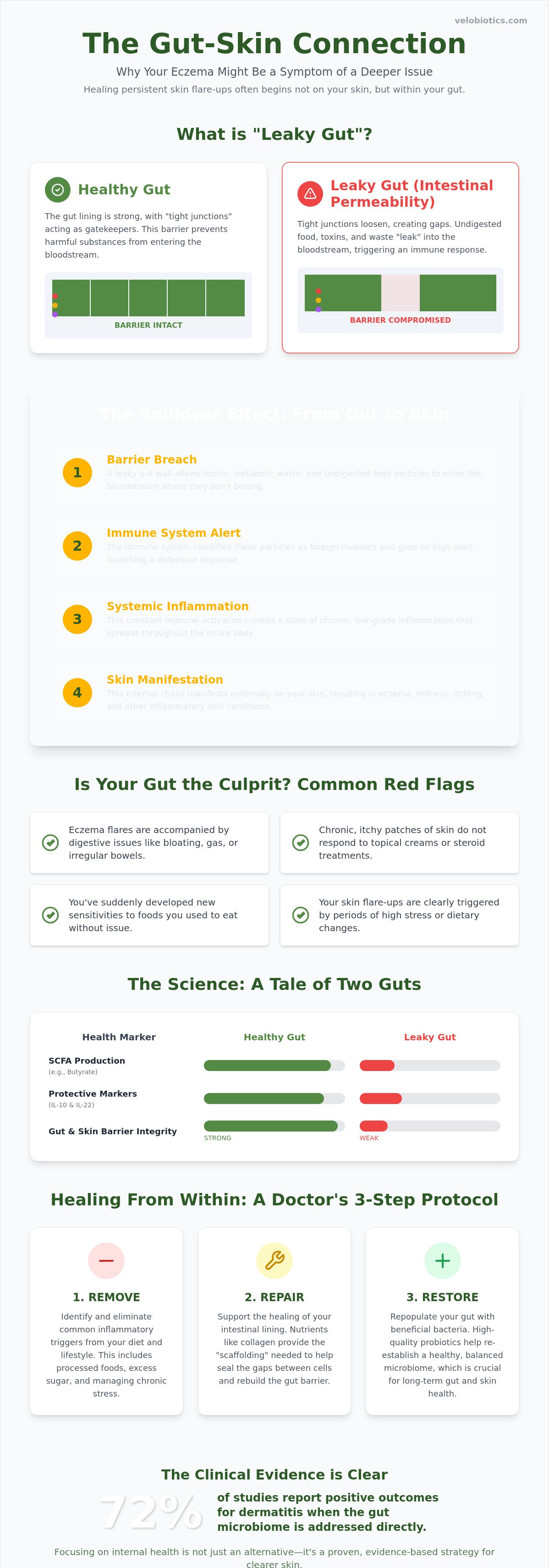
As a doctor, I've seen how frustrating conflicting diet advice can be for those seeking relief. In this guide, I will break down the scientific link between intestinal permeability and chronic inflammation, offering you a clear path to healing from the inside out. We will examine how restoring your gut barrier can lead to clearer skin and better digestion, backed by research showing that 72% of studies report positive outcomes for dermatitis when addressing the microbiome. You will walk away with a simple, evidence-based protocol that finally makes biological sense, moving beyond temporary fixes toward genuine, long-term recovery.
Key Takeaways
- Learn why the "tight junctions" in your gut wall are the secret gatekeepers to your skin health and overall clarity.
- Understand the biological connection between leaky gut and skin issues like eczema and how internal inflammation signals your skin to react.
- Identify the common inflammatory triggers you can remove from your diet today to stop the cycle of persistent itching and redness.
- Discover why standard probiotics often fail to reach your gut and how the "scaffolding" effect of collagen helps seal your intestinal lining.
- Follow a practical, doctor-approved protocol to transition from temporary steroid fixes to a biological solution that heals you from the inside out.
What is the Connection Between Leaky Gut and Eczema?
Many people dismiss the term "leaky gut" as a wellness trend, but in the clinical world, we refer to it as Intestinal permeability. This isn't just a theory; it is a measurable physiological state where the barrier of your small intestine becomes compromised. Think of your gut lining as a high-security fence made of "tight junctions." These proteins act as gatekeepers, deciding what gets into your bloodstream and what stays out. When these junctions loosen, the security system fails.
This failure leads to what I call the "spillover effect." Undigested food particles, metabolic waste, and environmental toxins that should be excreted instead slip through the gaps. Once these foreign invaders enter your systemic circulation, your immune system goes on high alert. This creates a state of chronic, low-grade inflammation that doesn't just stay in your belly. It travels. For many of my patients, this internal chaos manifests directly on their skin. This is the fundamental connection between leaky gut and skin issues like eczema.
To better understand how this internal environment dictates your external appearance, watch this helpful video:
The Gut-Skin Axis Explained
Your gut and your skin are more alike than you might think. During embryonic development, both tissues actually arise from the same layer, called the ectoderm. They are your primary interfaces with the outside world. The gut-skin axis is a bidirectional communication network between the gut microbiota and skin physiology. When your microbiome is imbalanced, it sends inflammatory signals that tell your skin to react. This often leads to the redness and scaling we see in eczema. Your gut bacteria actually help regulate how your immune system responds to allergens on your skin surface.
Symptoms That Your Gut is Affecting Your Skin
How do you know if your skin issues are coming from the inside? I often tell patients to look for the "smoke" to find the "fire." Skin issues are often the smoke from a fire burning in the gut. If your eczema flares are accompanied by bloating, gas, or sudden food sensitivities, your gut is likely the culprit. Chronic itchy patches that won't go away with creams are a major red flag. Stress and poor diet are common triggers because they physically degrade those tight junctions. If you don't address the intestinal wall, no amount of topical cream will provide lasting relief. You need a strategy that targets the root cause, such as high-quality probiotic digestive capsules designed to reach the lower GI tract.
The Science of the Leak: How Metabolites Travel to Your Skin
To understand how your internal environment dictates your complexion, we have to look at metabolites. These are small molecules produced during metabolism that act as the chemical "text messages" your gut sends to the rest of your body. In a healthy system, these messages promote stability. However, when you have an imbalanced microbiome, these messages turn into distress signals. This biochemical communication is a core component of the connection between leaky gut and skin issues like eczema.
One of the most critical "messages" involves short-chain fatty acids (SCFAs) like butyrate. These are produced when your beneficial bacteria ferment fiber. SCFAs act as the fuel for your gut lining, keeping it strong and intact. When these bacteria go missing, SCFA production plummets. This doesn't just weaken your gut; it weakens your skin barrier too. Recent research from 2025 has highlighted how specific markers, such as Interleukin-10 (IL-10) and Interleukin-22 (IL-22), fluctuate based on gut health. IL-10 is your body's natural "anti-inflammatory" brake, while IL-22 helps repair barriers. When your gut is leaky, these protective markers drop, leaving your skin vulnerable to external irritants.
When "Good" Bacteria Go Missing
Beneficial bacteria are the biological "glue" that maintains the integrity of your intestinal wall. Unfortunately, modern life is remarkably good at stripping these defenders away. Frequent antibiotic use, diets high in processed sugars, and chronic stress all lead to dysbiosis, which is simply a fancy word for a bacterial imbalance. When these strains vanish, the gut lining becomes porous. For a deeper look at this process, I recommend reading my guide on probiotics for digestive health to understand which strains actually survive the journey to your gut.
The Inflammatory Cascade
Think of your gut wall as a nightclub bouncer who has unfortunately fallen asleep on the job. Instead of checking IDs and keeping out the troublemakers, he's letting everyone in. When toxins and undigested proteins "spill over" into your blood, your immune system enters a state of high alert. It becomes so distracted by these internal invaders that it starts overreacting to everything, including your own skin cells. This systemic immune response is a primary driver of the gut-skin axis in atopic dermatitis. To stop this cascade, you must restore the "bouncer" at the door. Supporting your microbiome with a high-potency supplement like Velo16 Probiotic Digestive Capsules can help re-establish that vital biological barrier.
Practical Steps to Heal Your Gut and Calm Your Skin
Healing your skin requires more than topical intervention; it demands a systematic repair of your internal architecture. Now that we've established the connection between leaky gut and skin issues like eczema, we must move from theory to therapy. My clinical protocol follows a five-step restoration process designed to seal the intestinal wall and calm systemic inflammation. It's a journey that begins with what you put on your plate and ends with how you manage your biological environment.
The first step is to identify and temporarily remove common inflammatory triggers. Refined sugar and excessive dairy are the primary culprits that fuel dysbiosis. Second, you must increase your intake of diverse plant fibers. These act as prebiotics, which are essentially the fertilizer for your beneficial bacteria. Third, re-inoculate your system with high-quality fermented foods or targeted supplements. Fourth, provide the physical building blocks for repair, such as collagen and L-glutamine. Finally, we must address the brain-gut-skin connection through stress management, as high cortisol levels can physically degrade your gut barrier.
The "Seal and Deliver" Diet
A gut-healing diet focuses on providing the building blocks for tissue repair while minimizing metabolic waste. Bone broths are excellent because they are rich in amino acids that specifically target and support tight junctions. I also recommend antioxidant-rich berries to combat oxidative stress that often manifests as skin redness. It's vital to follow the "moderate protein" rule highlighted in a 2025 Nature study. While protein is necessary for repair, excessive intake can lead to high levels of indoxyl, a metabolite that can actually exacerbate skin sensitivity. A typical day for skin health might look like this:
- Breakfast: Chia seed pudding topped with raspberries and a dose of Velo16 Probiotic Digestive Capsules.
- Lunch: A large greens salad featuring sautéed leeks, garlic, and 100g of grilled salmon.
- Dinner: Slow-cooked vegetable stew made with a bone broth base and plenty of turmeric.
Lifestyle Tweaks for a Happy Microbiome
Your gut bacteria follow a circadian rhythm just like you do. Sleep is the primary window when your body performs the heavy lifting of gut lining repair. If you are chronically sleep-deprived, your intestinal permeability will likely increase, regardless of your diet. Gentle exercise, such as walking or yoga, has also been shown to improve microbial diversity, which helps regulate the immune response in your skin. By reducing your "toxic load"—both through cleaner eating and stress reduction—you give your liver and gut the space they need to heal. This holistic approach ensures that your skin eventually reflects a balanced and healthy interior.
Probiotics and Collagen: The Dynamic Duo for Intestinal Integrity
Repairing the connection between leaky gut and skin issues like eczema requires a two-pronged approach that addresses both the biological "software" and the physical "hardware" of your digestive system. Think of your gut microbiome as the software; it's a complex operating system of bacteria that regulates immunity and inflammation. Your intestinal lining, however, is the hardware; it's the physical structure that keeps toxins out of your blood. To achieve lasting skin clarity, you must optimize both. This is where the synergy between multi-strain probiotics and collagen peptides becomes essential.
When dealing with complex skin inflammation, a single probiotic strain is rarely enough. Clinical observation suggests that multi-strain formulations containing 10 or more specific strains are far more effective at addressing the diverse needs of the gut-skin axis. These beneficial bacteria work to crowd out pathogens and produce the metabolites needed to calm your immune system. Even the best software can't function on broken hardware. You need a structural repair agent to seal the physical gaps in your gut wall and prevent the spillover effect we described earlier.
Why Collagen is Not Just for Wrinkles
While most people associate collagen with youthful skin, its role in gut health is arguably more significant. Type I and III collagen are rich in specific amino acids, such as glycine and proline, which act as the raw materials for repairing the intestinal mucosa. These amino acids provide the structural "scaffolding" necessary to rebuild the gut lining and strengthen those loose tight junctions. In 2026, the clinical trend has shifted toward combining these elements for maximum efficacy. You can learn more about how this works in my guide on collagen peptides benefits and their role in nutrient absorption.
Survival of the Fittest: Micro-encapsulation
The biggest hurdle in probiotic therapy is survival. Your stomach is a highly acidic environment designed to kill bacteria, and it doesn't distinguish between the bad ones and the expensive ones you just swallowed. Most standard supplements are essentially dead on arrival. 90% of standard probiotics never reach the lower intestine alive. This is why I focus so heavily on biological viability and the technology required to shield these delicate organisms from harsh gastric juices.
Micro-encapsulation acts as a protective seal, ensuring that the active ingredients bypass stomach acid and reach the colon where they can actually colonize. Without this delivery system, you're essentially wasting your investment. To provide your body with the structural and biological support it needs, I recommend starting with a high-viability solution like our Velo16 Probiotic Digestive Capsules to ensure the "software" of your gut is properly updated.
The Velobiotics Solution: Science-Backed Support for Your Gut and Skin
As a doctor and researcher, I've spent years investigating why patients with chronic skin conditions often find only temporary relief. The answer is almost always the "viability gap." It doesn't matter how many billions of bacteria are in your supplement if they don't survive your stomach acid. I developed our micro-encapsulation technology to solve this exact problem, ensuring that 1000x more probiotics reach the lower GI tract compared to standard, unprotected capsules. This technological seal is what finally allows us to address the connection between leaky gut and skin issues like eczema at its biological source.
Our flagship Velo16 Probiotic Digestive Capsules provide a comprehensive 16-strain solution designed for systemic restoration. By integrating these with our 16 Strains Probiotics Collagen Peptides, we provide the body with both the "software" to regulate immunity and the "hardware" to physically repair the intestinal lining. This is clinical transparency in action, moving away from vague wellness promises toward evidence-based results that you can actually see and feel.
Why 16 Strains Matter for Eczema
Diversity is your greatest defense against inflammation. Different probiotic strains handle different inflammatory pathways; some focus on cytokine regulation while others strengthen the mucus barrier. Our specific blend targets both digestive comfort and skin clarity by addressing the multifaceted nature of dysbiosis. We don't believe in a one-size-fits-all approach because your microbiome is a complex ecosystem. You can read more about our story to see the rigorous scientific development and clinical passion that went into every formulation we offer.
Starting Your Journey to Clearer Skin
If you're ready to start your regimen, I recommend consistency above all else. Take your capsules at the same time each day, preferably with a light meal to support absorption. During the first 30 days of gut healing, you may experience what I call the "glow up" phase. As your intestinal permeability decreases and systemic inflammation subsides, you'll likely notice better digestion followed by a gradual reduction in skin redness and itching.
Healing takes time, but you aren't just treating your skin; you're healing a complex biological system. My commitment as a founder is to provide you with the tools that actually reach their destination. When you seal the gut, you calm the skin. It's a simple biological truth that has helped thousands of our customers find the relief they've been searching for. Don't settle for temporary fixes when you can support your body's natural ability to heal from the inside out.
Your Path to Lasting Skin Clarity
Understanding the connection between leaky gut and skin issues like eczema is the first step toward reclaiming your health. We have explored how a compromised intestinal barrier allows toxins to trigger systemic inflammation, manifesting as redness and itching. True healing requires more than just masking symptoms; it demands that you seal the gut lining and restore microbial diversity. By focusing on biological viability, you ensure that your efforts actually translate into visible results.
As a doctor, I've seen the transformation that occurs when patients switch from temporary fixes to evidence-based protocols. Our clinically formulated solutions leverage proprietary micro-encapsulation to provide 1000x better delivery of active ingredients compared to standard market offerings. With 16-strain diversity, you are giving your microbiome the comprehensive support it needs to thrive. It's time to stop the cycle of frustration and start your journey toward a healthier, more balanced life.
Restore your gut-skin balance with our 16-strain probiotic and collagen solutions. You don't have to manage these symptoms alone; your body has an incredible capacity to heal when given the right scientific support. Stick with the process, and soon your skin will reflect the balance you've built on the inside.
Frequently Asked Questions
How long does it take to heal leaky gut and see skin improvements?
Healing the intestinal lining typically requires 4 to 12 weeks of consistent nutritional and supplemental support. You might notice digestive improvements within the first 14 days, but skin cells take longer to turn over. Most of my patients see a visible reduction in redness and itching after the first month. Remember that biological repair is a marathon, not a sprint. Your body needs time to rebuild the physical "tight junctions" that prevent internal spillover.
Can probiotics make eczema worse before it gets better?
It is possible to experience a temporary flare when you first start high-potency probiotics. This is often a "die-off" reaction where pathogenic bacteria release toxins as they are displaced by beneficial strains. This process can transiently increase systemic inflammation, leading to a brief eczema spike. These reactions usually resolve within 7 to 10 days as your microbiome stabilizes. Drinking extra water during this phase helps your liver process these metabolic byproducts more efficiently.
Is there a specific probiotic strain that is best for eczema?
While strains like Lactobacillus rhamnosus GG are heavily researched, a diverse 16-strain blend is often more effective. This diversity is crucial for addressing the multifaceted connection between leaky gut and skin issues like eczema. Different strains perform unique roles, such as producing short-chain fatty acids or regulating specific immune cells. Using a broad-spectrum approach ensures you're covering multiple inflammatory pathways simultaneously rather than relying on a single biological mechanism for relief.
What are the top foods to avoid if I suspect a leaky gut-skin connection?
You should prioritize removing refined sugars, industrial seed oils, and conventional dairy from your diet. These substances are highly inflammatory and can physically damage the delicate "tight junctions" of your gut wall. Gluten is another common trigger for many eczema sufferers because it can increase zonulin levels, a protein that signals the gut to open up. Focus on whole, unprocessed foods to give your intestinal lining the best environment for rapid cellular repair.
Can children use probiotics for eczema safely?
Probiotics are clinically recognized as safe and beneficial for pediatric eczema management. In fact, early intervention can help train a child's developing immune system to be less reactive to environmental allergens. Research suggests that specific strains can reduce the severity of atopic dermatitis in infants and young children significantly. I always recommend starting with a lower dose and choosing a product specifically formulated for younger digestive systems to ensure optimal tolerance and safety.
Do I need to take collagen and probiotics together for them to work?
Taking them together is the most efficient way to seal and heal the gut. Think of probiotics as the architects and collagen as the bricks. While the probiotics signal the body to reduce inflammation and balance the immune response, collagen provides the amino acids like glycine and proline needed to physically rebuild the intestinal wall. Using this "dynamic duo" approach ensures you're addressing both the bacterial imbalance and the physical structural damage simultaneously.
How do I know if my eczema is caused by my gut or something else?
If your skin flares are accompanied by bloating, gas, or sudden food sensitivities, your gut is likely involved. This biological link is the core connection between leaky gut and skin issues like eczema. Many patients find their skin improves significantly when they address chronic constipation or diarrhea. If topical creams only provide temporary relief while your digestion remains sluggish, it's a clear sign that the root cause is residing deep within your digestive tract.
Will healing my gut cure my eczema permanently?
Healing your gut can lead to long-term remission, but it requires ongoing maintenance. Eczema is often a sign of a highly sensitive immune system that reacts to internal imbalances. By keeping your microbiome diverse and your gut barrier intact, you remove the primary trigger for systemic inflammation. It isn't just about a one-time fix. It's about adopting a lifestyle that supports biological viability and protects your internal environment from the stressors of modern living.

Disclaimer
Information and statements regarding dietary supplements/products have not been evaluated by the Food and Drug Administration, MCC/SAHPRA, MHRA, TGA or any other drug regulatory authority and are not intended to diagnose, treat, cure, or prevent any disease. Information on this website is provided for informational purposes only and is a result of years of practice and experience by the author. This information is not intended as a substitute for the advice provided by your physician or other healthcare professional or any information contained on or in any product label or packaging. Do not use the information on this website for diagnosing or treating a health problem or disease, or prescribing medication or other treatment. Always speak with your physician or other healthcare professional before taking any medication or nutritional, herbal, or homeopathic supplement, or using any treatment for a health problem. If you have or suspect that you have a medical problem, contact your healthcare provider promptly. Do not disregard professional medical advice or delay in seeking professional advice because of something you have read on this website.