

The Doctor’s Guide to Buying Vitamin A: How to Choose the Right Supplement for Your Health Goals
What if the supplement you chose to boost your vision is actually putting a strain on your liver instead? Approximately 65% of the patients I consult are rightfully concerned about vitamin a toxicity, yet a 2023 industry report highlights that consumers spend over 21 billion dollars on supplements that frequently lack the bioavailability to be effective. You likely feel frustrated by ingredient lists that look more like organic chemistry homework than health guidance. It's exhausting to worry about whether you're buying a potent health booster or just an expensive placebo that won't survive your internal chemistry.
I'm here to simplify the science so you can stop guessing and start healing. You'll learn the critical differences between Retinol and Provitamin A, along with the specific clinical markers that indicate a high-quality formulation. We're going to examine how to choose a safe, effective dose that clears your skin and shields your immune system, ensuring every milligram you take actually reaches its destination to help your vitality flourish.
Key Takeaways
- Distinguish between Retinol and Beta-Carotene to avoid common supplementation mistakes that hinder your medical health progress.
- Close the "absorption gap" by learning why taking vitamin a on an empty stomach could mean zero biological benefits for your body.
- Stop guessing at the shelf by mastering how to read labels for "Retinol Activity Equivalents" (RAE) rather than just the lowest price.
- Target your specific wellness needs using the "Three Pillars of A" to effectively strengthen your immune barriers and support vital mucosal health.
- Identify and avoid hidden fillers like soybean oil that often lurk in cheap formulations, ensuring you only invest in clean, high-potency nutrients.
Understanding the Vitamin A Spectrum: Preformed vs. Provitamin A
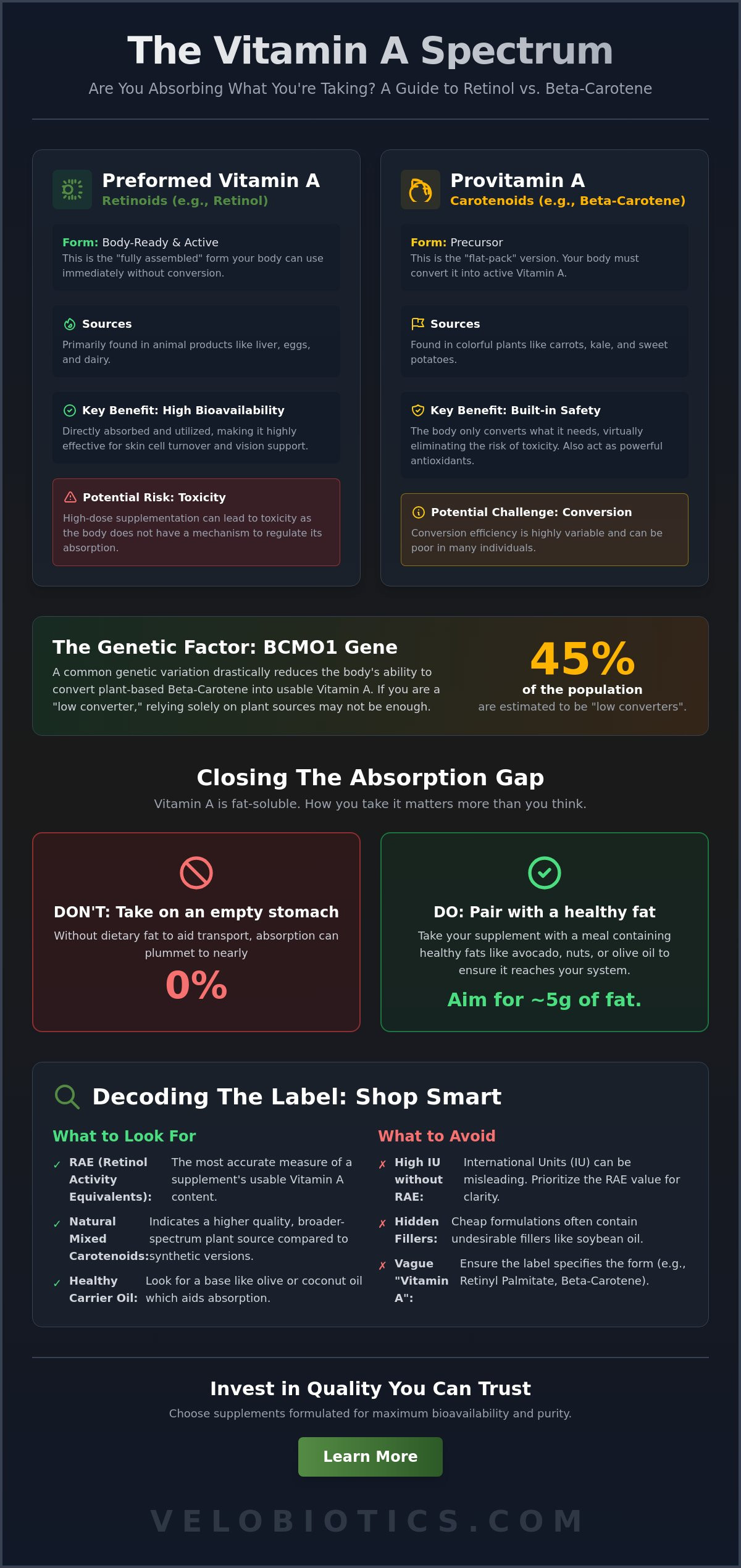
In my clinical practice, I see patients confuse retinol with beta-carotene almost every single day. While both are technically forms of vitamin a, they function very differently once they enter your system. Think of it like the difference between a fully assembled piece of furniture and a flat-pack box from a warehouse. One is ready to use immediately, while the other requires a bit of manual labor before it provides any value to your home.
To better understand this concept, watch this helpful video:
The term Vitamin A actually describes a group of fat-soluble retinoids. Preformed Vitamin A, known as retinoids, comes from animal sources like liver, eggs, and dairy. This form is highly bioavailable, meaning your body can use it for vital functions right away. On the other hand, Provitamin A, or carotenoids, are plant-based pigments found in colorful vegetables like carrots and kale. Your body must convert these into active retinol before they can do their job.
Conversion efficiency is where things get tricky. Research shows that up to 45% of the population carries a genetic variation in the BCMO1 gene, which reduces their ability to convert plant-based carotenoids into active vitamin a. If you are a "low converter," relying solely on salads for your intake might leave your levels lower than you expect.
The Role of Retinyl Palmitate and Retinol
Retinyl palmitate and retinol are the gold standard for direct absorption. These forms are essential for maintaining the 28-day skin cell turnover cycle and supporting the protein rhodopsin, which allows you to see in low-light conditions. When reading a label, you will notice measurements in International Units (IU) or Micrograms (mcg) of Retinol Activity Equivalents (RAE). For reference, 1 mcg RAE is equal to 3.33 IU of retinol, a conversion factor that helps doctors like me ensure you aren't reaching toxic levels.
The Beta-Carotene Advantage
Plant-based sources offer a significant safety advantage because your body has a built-in "off switch." It will only convert as much beta-carotene as it needs, which virtually eliminates the risk of toxicity that can occur with high-dose animal-based retinoids. Beyond being a precursor, carotenoids act as powerful antioxidants that quench singlet oxygen and protect your cells from oxidative stress. When choosing a supplement, look for "natural mixed carotenoids" on the label. This indicates a higher quality source than synthetic versions, providing a broader spectrum of protection for your cellular health.
The Absorption Gap: Why Most Vitamin A Supplements Fail
Most people treat their daily supplements like candy, popping them whenever they remember. If you're doing that with vitamin a, you're likely flushing your money away. Vitamin A is fat-soluble. It doesn't dissolve in water; it needs lipids to cross your intestinal barrier. If you take a dry tablet on an empty stomach, your absorption rate can plummet to nearly 0%. I've seen patients surprised by low blood levels despite daily supplementation, and it often comes down to this simple biological barrier.
The Science of Fat-Soluble Delivery
Your body uses a complex system of bile salts and micelles to package retinoids for transport. Without dietary fat, this process never starts. In my research at Velobiotics, we focus heavily on the concept of "survival." We applied the same logic found in our probiotics that survive stomach acid to how we view nutrient delivery. If the active compound doesn't survive the harsh gastric environment and reach the right absorption site, it's useless. It's a common mistake to assume that what you swallow is what you get.
- The Bile Factor: Your gallbladder must release bile to emulsify fats, creating a pathway for vitamins to enter the bloodstream.
- Micelle Formation: These tiny spheres act as transport vehicles, carrying retinoids through the watery environment of the gut.
- Practical Tip: Always pair your supplement with a meal containing at least 5 grams of healthy fats, like avocado, nuts, or olive oil.
Micro-encapsulation and Nutrient Protection
Bioavailability is defined as the percentage of a nutrient that actually enters your bloodstream to do its job. Standard softgels are a step up from dry pills, but vitamin a is incredibly sensitive to light and air. Once exposed, it oxidizes and loses potency before it even reaches your shelf. We use advanced micro-encapsulation to create a protective shield around each molecule. This technology ensures the vitamin remains stable and potent until it hits the small intestine. For more details on recommended daily amounts and deficiency signs, you can check the Vitamin A Fact Sheet from the NIH.
There's also a fascinating synergy between your gut microbiome and your vitamins. Your beneficial bacteria help regulate the immune signaling pathways that vitamin a triggers. It's a two-way street; a healthy gut helps you use the vitamin, and the vitamin helps keep the gut lining strong. This is why delivery technology matters so much. If you want to optimize this process and ensure your body actually uses what you take, consider exploring our high-absorption vitamin A solutions to bridge the gap.
Decoding the Label: What to Look for When You Shop
Stop fixating on the price tag when you're browsing the supplement aisle. A lower price often hides poor bioavailability and ingredients that don't belong in a health product. Look for Retinol Activity Equivalents (RAE) on the label instead of just international units. This metric is the most accurate way to determine how much actual vitamin a your body will use, as it accounts for the different absorption rates of retinol and carotenoids.
Cheap brands often use "label dressing" with fillers like soybean oil or artificial dyes such as Red 40. These additives can cause gut irritation and systemic inflammation. I always suggest choosing products that list "Mixed Carotenoids" instead of just isolated Beta-Carotene. Nature provides nutrients in complexes, not in isolation. A blend of alpha-carotene, lutein, and zeaxanthin provides superior antioxidant coverage compared to a single, synthetic molecule.
Finally, check for third-party testing from organizations like NSF or USP. Because vitamin a is fat-soluble and accumulates in your tissues, you need 100% certainty that the potency matches the label. You don't want to guess when it involves a nutrient that stays in your system for weeks.
Dosage Safety: The "Sweet Spot"
The Recommended Dietary Allowance (RDA) for adults typically ranges from 700 to 900 mcg. Many retail supplements provide 3,000 mcg, which sits right at the Upper Limit (UL) established to prevent toxicity. According to the Linus Pauling Institute, chronic intake above this 3,000 mcg limit can lead to liver abnormalities and reduced bone mineral density. You should distinguish between a maintenance dose, meant for daily health, and a therapeutic dose, which is a high-potency intervention used only under medical supervision to correct a clinical deficiency.
Synergistic Ingredients
Vitamins rarely perform as solo acts. Vitamin A requires Vitamin D and Zinc to unlock its full potential. Zinc is the essential co-factor for the protein that carries the vitamin from your liver to your tissues. If you're zinc-deficient, your levels will remain low regardless of how much you swallow. Absorption is also a factor of gut health. If your intestinal lining is inflamed, you won't absorb fat-soluble nutrients efficiently. Using Velo16 Probiotic Digestive Capsules helps maintain the microbial diversity needed for optimal nutrient transport. Be careful with "antagonistic" pairings; for instance, extremely high doses of Vitamin E can sometimes interfere with how your body utilizes other fat-soluble compounds.
Matching Vitamin A to Your Health Goals
Choosing the right supplement starts with understanding that your body doesn't use nutrients in a vacuum. I categorize the benefits of this nutrient into "The Three Pillars of A." Whether you're looking to sharpen your night vision, clear up your complexion, or build a fortress around your immune system, your strategy must align with your specific biological needs. Vitamin a isn't a one size fits all solution; it's a precision tool for systemic health.
Vitamin A for Skin and Anti-Aging
Retinoids are famous in the beauty world for a reason. They stimulate the "Retinoid-Collagen" link, which is the biological signal telling your skin to maintain its elasticity and structure. While topical creams work on the surface, oral supplementation supports skin health from the inside out. This internal approach is particularly effective for managing acne by regulating oil production in the sebaceous glands. Many of my female patients pair their regimen with Femina Probiotic Capsules to ensure their systemic wellness and microbiome balance are optimized alongside their skin goals. This combination addresses both the visible surface and the internal environment that feeds it.
Immune System Support
Vitamin A is the gatekeeper of the immune system. It acts as a powerful "anti-infective" agent by strengthening the mucosal barriers in your gut and lungs. These barriers are your first line of defense, consisting of epithelial cells that physically block pathogens from entering your bloodstream. For children, this is vital for healthy growth and development. I often recommend BioKid Chewable Probiotics as a companion to support a healthy gut environment. A robust microbiome works in tandem with vitamin a to bolster a child's natural defenses, ensuring those mucosal walls remain impenetrable to common seasonal threats.
Ocular Support and the Rhodopsin Cycle
We can't ignore the eyes when discussing this nutrient. Retinol plays a critical role in the rhodopsin cycle, which is the process that allows you to see in low-light conditions. Rhodopsin is a protein in the rod cells of the retina that absorbs light. When light hits these cells, it triggers a chemical reaction that sends a signal to your brain. Without sufficient levels, the 11-cis-retinal cannot regenerate quickly enough, leading to night blindness. By maintaining adequate levels, you ensure your eyes can adapt to darkness and recover from bright glares efficiently.
Ready to support your vision, skin, and immunity with a professional grade formula?
Shop our Doctor-formulated Vitamin A selection here.The Velobiotics Vitamin A Collection: Quality You Can Trust
I founded Velobiotics to bridge the gap between clinical research and your kitchen cabinet. When I look at a supplement, I'm not looking at the marketing; I'm looking at the Retinol Activity Equivalents (RAE). Our collection prioritizes high-potency, bioavailable vitamin a because your body shouldn't have to work overtime just to absorb what's on the label. We focus on clean labels, meaning zero unnecessary binders or synthetic fillers that interfere with absorption. Every formulation in our shop must pass my personal clinical standards before it reaches your door. I've spent years studying how nutrients interact with the body, and I've ensured our products deliver the exact molecular forms that your cells recognize.
Standout Products in Our Collection
Our high-potency Retinyl Palmitate is designed for those who need direct, "ready-to-use" support. Unlike precursors that require conversion, this form goes to work immediately to support vision and immune function. For those seeking a wider net of protection, our Mixed Carotenoid blends provide a spectrum of 5 to 7 different phytonutrients. These blends offer broad-spectrum antioxidant defense, mimicking the variety found in a diet rich in colorful vegetables. We also offer specialized gender-specific multivitamins. These are precisely calibrated; for instance, our formulas for women balance vitamin a with Vitamin D to support bone density and hormonal health based on current clinical guidelines.
How to Start: Your Daily Protocol
Starting a new supplement shouldn't feel like a guessing game. If you're using a high-dose Retinyl Palmitate, such as a 3,000 mcg RAE capsule, I often recommend an intermittent schedule of three times weekly to prevent storage overload. For standard maintenance, a daily low-dose protocol of 700 to 900 mcg RAE is typically the "sweet spot" for most adults. You need to be patient with your biology. Skin cell turnover takes approximately 28 to 40 days, so you won't see a "glow" the next morning. Most of my patients report noticeable changes in skin clarity and evening energy levels after 30 days of consistent use. Consistency is the key to moving the needle on your health markers.
Ready to upgrade your supplement routine with doctor-vetted formulas? Take the first step toward better vision, immunity, and skin health by choosing a professional-grade solution.
Take Control of Your Nutritional Future
Choosing a supplement shouldn't feel like a high-stakes chemistry exam. I founded Velobiotics to ensure you don't waste resources on products that never actually reach your cells. Remember that preformed vitamin a and provitamin A serve distinct biological roles, but neither provides value if your body fails to absorb them. We bridge this gap using our advanced bioavailability technology, which protects delicate nutrients from harsh gastric acids. Every single formula in our collection is medical doctor formulated and undergoes rigorous third-party lab testing to verify that 100% of the potency stated on the label is present.
You're looking for measurable results, not just a hopeful list of ingredients. By selecting a supplement backed by this level of clinical rigor, you're taking a practical, science-based step toward supporting your vision, immune system, and skin health. It's about giving your body the exact tools it needs to flourish every day. You have the knowledge now; it's time to put it into practice for a more vibrant life.
Shop the Doctor-Curated Vitamin A Collection
Frequently Asked Questions
Can I take Vitamin A every day?
You can safely take it daily as long as you stay within the Recommended Dietary Allowance of 700 to 900 mcg RAE for adults. Since it's a fat-soluble nutrient, your liver stores any excess rather than flushing it out. If you consistently exceed the 3,000 mcg upper limit, you risk toxicity. I always tell my patients to check their multivitamin labels first to avoid doubling up accidentally.
What are the first signs of Vitamin A deficiency?
Night blindness is typically the first clinical sign you'll notice. You might find it difficult to see in low light or notice that your eyes take longer to adjust when you enter a dark room. According to 2021 data from the World Health Organization, this deficiency remains a leading cause of preventable blindness in children. Dry, foamy patches on the whites of your eyes, known as Bitot’s spots, often follow if levels aren't corrected.
Is it better to take Vitamin A or Beta-Carotene?
It depends on your genetics; about 45% of the population carries a variation in the BCMO1 gene that makes them poor converters of beta-carotene. Beta-carotene is a precursor that your body turns into active vitamin a only when needed. If you're a poor converter, taking preformed retinol is more effective. I recommend a supplement that provides a 50/50 blend to ensure you get immediate benefits while maintaining a safety buffer.
Can Vitamin A help with hormonal acne?
Yes, specific derivatives have been used by dermatologists for over 40 years to regulate sebum production and skin cell turnover. While high-dose prescriptions like isotretinoin are the gold standard for severe cases, maintaining a daily intake of 900 mcg supports the skin's structural integrity. A 2018 study in the Journal of Clinical Medicine found that individuals with chronic acne frequently show significantly lower serum levels of this nutrient compared to those with clear skin.
Is Vitamin A safe during pregnancy?
You must be cautious because high doses of preformed retinol, specifically over 10,000 IU daily, are linked to birth defects. The daily recommendation for pregnant women is 770 mcg RAE. Most prenatal vitamins use beta-carotene instead of retinol because the body naturally regulates that conversion. It's a vital nutrient for the baby's eye and skeletal development, but balance is the key to safety here.
What happens if I take too much Vitamin A?
Acute toxicity can occur if you take a massive dose of 30,000 mcg or more at once, causing immediate nausea and dizziness. Chronic toxicity is more common and happens when you take smaller, excessive amounts over several months. This leads to liver stress, bone thinning, and even hair loss. Monitoring your total intake from food and supplements is essential to keep your levels within the healthy 20 to 60 mcg/dL blood range.
Does Vitamin A interact with any medications?
Vitamin a interacts with several common drugs, including blood thinners like Warfarin and weight-loss medications like Orlistat. Orlistat can reduce your absorption of fat-soluble vitamins by as much as 30%. If you're taking synthetic retinoids for skin conditions, adding a supplement can push your blood levels into a toxic range very quickly. Always let your doctor know what you're taking to prevent these biological "traffic jams" in your system.
How do I know if my Vitamin A supplement is actually working?
You'll typically see improvements in skin moisture and night vision within 4 to 8 weeks of consistent supplementation. If your eyes feel less gritty or you notice fewer dry patches on your elbows and knees, the supplement is likely doing its job. For a scientific confirmation, a serum retinol blood test can verify your exact levels. I find that patients also report fewer minor infections once their mucosal immunity is properly supported by adequate levels.

Disclaimer
Information and statements regarding dietary supplements/products have not been evaluated by the Food and Drug Administration, MCC/SAHPRA, MHRA, TGA or any other drug regulatory authority and are not intended to diagnose, treat, cure, or prevent any disease. Information on this website is provided for informational purposes only and is a result of years of practice and experience by the author. This information is not intended as a substitute for the advice provided by your physician or other healthcare professional or any information contained on or in any product label or packaging. Do not use the information on this website for diagnosing or treating a health problem or disease, or prescribing medication or other treatment. Always speak with your physician or other healthcare professional before taking any medication or nutritional, herbal, or homeopathic supplement, or using any treatment for a health problem. If you have or suspect that you have a medical problem, contact your healthcare provider promptly. Do not disregard professional medical advice or delay in seeking professional advice because of something you have read on this website.