

The Doctor’s Guide to Probiotics for Menopause Symptoms: How to Choose in 2026
Did you know that over 75% of women between 45 and 60 are currently navigating the disruptive reality of menopause? If you're tired of waking up in a cold sweat or wondering why your favorite jeans no longer fit, you're certainly not alone. It's frustrating when your body feels like it's no longer yours, especially when "menopause belly" and intimate discomfort become the new normal. Finding effective probiotics for menopause symptoms shouldn't feel like a guessing game based on vague wellness promises.
I've spent my career bridging the gap between complex laboratory breakthroughs and your daily routine. The key to reclaiming your vitality lies in your "estrobolome," the specific set of gut bacteria that metabolizes and recycles your estrogen. In this guide, I'll explain how to select clinically-validated strains that target hot flashes and weight management. You'll discover the science of biological viability and learn how to choose a system that ensures these beneficial bacteria actually survive your stomach acid to do their job. We're moving beyond generic supplements to a targeted, 2026 approach for metabolic health and total vaginal comfort.
Key Takeaways
- Learn how your "estrobolome" functions as a hormonal thermostat, regulating the estrogen your body needs to stay balanced and vibrant.
- Discover the specific strains of probiotics for menopause symptoms that clinically target visceral weight gain and help cool down frequent hot flashes.
- Uncover the truth about the "CFU Myth" and why proprietary micro-encapsulation is the only way to ensure active ingredients survive the stomach's acid bath.
- Find out how to match your unique symptoms, from vaginal dryness to metabolic shifts, with the right targeted formulation for maximum biological impact.
- Master the practical timing and dietary habits that turn a daily supplement into a high-performance routine for long-term comfort.
The Estrobolome: Why Your Gut Holds the Key to Menopause Relief
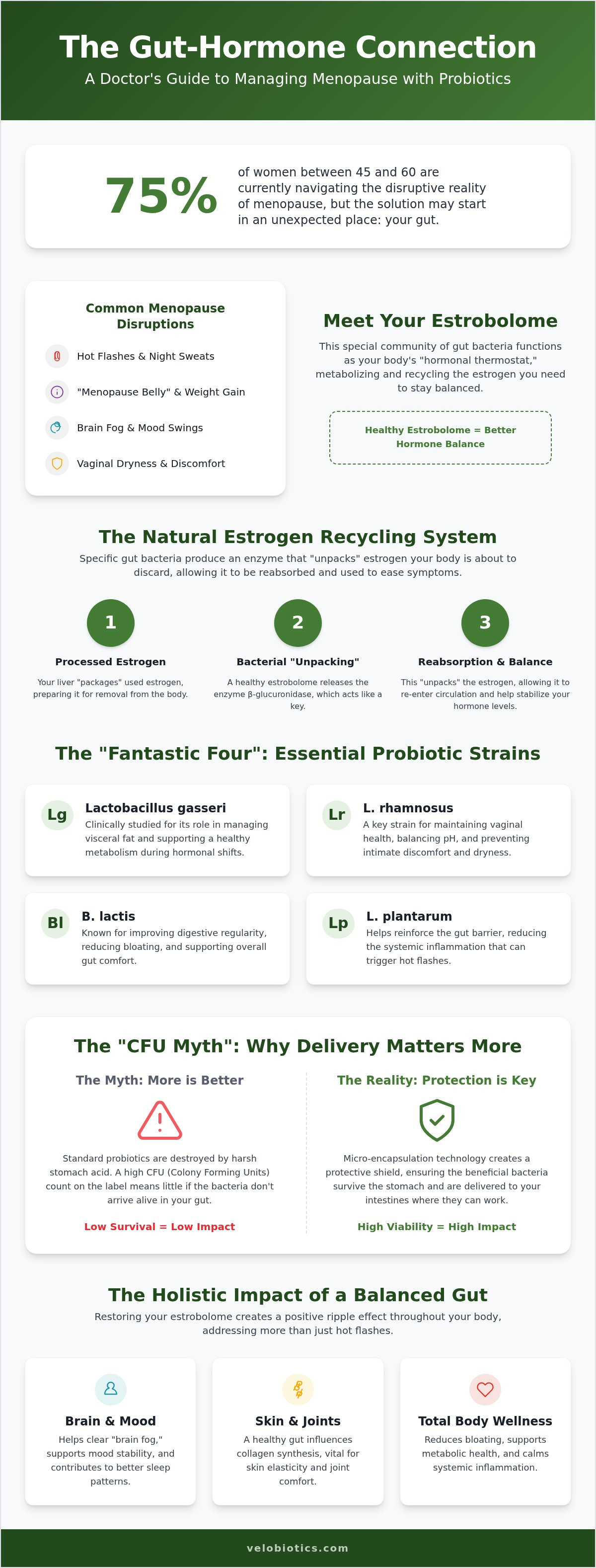
Most people think of Menopause as purely an ovarian event. As a doctor, I see it differently. It's a systemic shift where your gut microbiome plays a starring role. We call this specific community of bacteria the "estrobolome." These microbes are responsible for metabolizing and circulating estrogen throughout your body. When your estrogen levels begin to decline, your gut diversity often follows suit, creating a feedback loop that intensifies your symptoms. I've seen it thousands of times in my clinical practice. A survey of nearly 5,000 women in early 2026 found that over 75% experienced these disruptive symptoms, yet very few were told about the gut-hormone connection.
To better understand this concept, watch this helpful video:
I often tell my patients that gut health is essentially hormone health. If your estrobolome is out of balance, you'll likely experience more than just hot flashes. You might notice persistent bloating, unpredictable mood swings, or sudden changes in your skin's elasticity. This happens because a stagnant gut can't process hormones efficiently. Using targeted probiotics for menopause symptoms helps restore this delicate microbial balance. It ensures your body makes the most of every picogram of estrogen it still produces by keeping the "recycling" system active.
How Probiotics Influence Estrogen Levels
The secret lies in an enzyme called beta-glucuronidase. When your liver processes estrogen, it "packages" it for excretion. However, a healthy estrobolome produces this enzyme to "unpack" some of that estrogen, allowing it to be reabsorbed into your bloodstream. It's a natural recycling system. By introducing specific strains, you effectively turn your gut into a secondary endocrine organ. This helps mitigate the sharp hormonal drops that lead to vasomotor symptoms. It's not just about adding bacteria; it's about optimizing your internal chemistry to maintain stability during a time of flux.
The Gut-Brain-Skin Axis in Menopause
We can't ignore the connection between your gut and your head. The "brain fog" and sleep disturbances many women report are often rooted in gut-derived inflammation. Additionally, your gut microbiome influences collagen synthesis, which is vital for maintaining skin thickness and joint health. This is why I often recommend a formulation like the 16 Strains Probiotics Collagen Peptides. It addresses the gut lining while providing the building blocks for skin and hair. If you're feeling "off" both mentally and physically, your gut is likely the culprit. You can identify this by tracking if your "foggy" days coincide with digestive sluggishness or bloating.
Essential Strains: Decoding Probiotics for Hot Flashes and Weight
Not every probiotic on the shelf is designed to handle the complex biological shifts of perimenopause. If you've been grabbing the first bottle you see at the pharmacy, you're likely missing out on the specific "Fantastic Four" strains that do the heavy lifting. In my clinical experience, the right combination of Lactobacillus gasseri, L. rhamnosus, B. lactis, and L. plantarum creates a synergistic effect that generic supplements simply can't match. We aren't just looking for "good bacteria." We're looking for biological tools that can actually interface with your hormones.
A major question I get from patients is whether probiotics for menopause symptoms can actually cool down hot flashes. The answer lies in systemic inflammation. When your microbiome is in dysbiosis, your body's internal thermostat becomes hypersensitive. Specific strains like L. plantarum help reinforce the gut barrier, reducing the inflammatory markers that often trigger those sudden, intense heat waves. It's not about replacing estrogen directly; it's about stabilizing the environment where your remaining hormones operate. This is why a multi-strain approach, like our 16-strain formulas, is far more effective than a single-strain supplement. Diversity in the gut leads to resilience in the body.
Strains for Weight Management and Metabolism
The "menopause belly" isn't a myth. It's a metabolic shift driven by declining estrogen. Clinical evidence shows that L. gasseri specifically targets visceral fat, the stubborn adipose tissue that gathers around your midsection. This strain, along with Bifidobacterium animalis, helps regulate your metabolic rate by interacting with your body's natural GLP-1 pathways. These pathways control hunger hormones and insulin sensitivity. If you want to support your metabolism from the inside out, I recommend looking at the GutSlim Probiotics Tummy Toner, which uses these specific mechanisms to help manage weight during this transition.
Strains for Mood and Night Sweats
Your gut is your "second brain," and it produces a significant portion of your serotonin. This is where "psychobiotics" like B. longum come into play. By supporting the gut-brain axis, these strains help stabilize mood swings and reduce the anxiety that often accompanies hormonal shifts. Regarding sleep, the 2026 clinical consensus confirms that Bifidobacterium infantis significantly improves sleep quality by modulating the body's stress response and reducing night-time awakenings. When you sleep better, your body regulates temperature more efficiently. You can achieve this by ensuring your supplements use advanced probiotic delivery to reach the gut intact.
Beyond the Label: Why Delivery Technology Matters More Than CFU Count
If you've ever stood in a supplement aisle, you've likely seen bottles screaming about "100 Billion CFUs." It's the biggest marketing trap in the industry. As a doctor, I'm here to tell you that Colony Forming Units (CFU) are a measure of quantity, not quality or viability. If you are investing in probiotics for menopause symptoms, you deserve to know if those bacteria actually reach their destination alive. Most standard capsules are "dead on arrival" because they lack the armor needed to survive the journey through your digestive tract.
Think of your stomach as an acid bath. It's a biological graveyard designed to kill invading bacteria with a pH as low as 1.5. This is great for preventing food poisoning, but it's catastrophic for delicate probiotic strains. When an unprotected capsule hits that hydrochloric acid, the bacteria inside are incinerated long before they reach your lower intestine. This is why many women feel like their supplements aren't working. They aren't. They're simply providing expensive, neutralized debris to your stomach lining. To see real results, we have to talk about survival, not just starting numbers.
The Science of Micro-encapsulation
We solved this problem by borrowing a concept from high-tech pharmaceuticals: micro-encapsulation. Instead of just dumping bacteria into a gelatin shell, each individual microbe is shielded in a protective matrix. This technology acts like a biological "seal" that remains locked in acidic environments and only dissolves when it reaches the neutral pH of your gut. You can read more about how we pioneered this approach in the Velobiotics Story. Unlike standard or even "delayed-release" capsules, micro-encapsulation ensures that 100% of the active ingredients are delivered to the estrobolome where they can actually begin recycling your estrogen.
Shelf Stability vs. Refrigeration
There's a common myth that "good" probiotics must be refrigerated. In reality, needing refrigeration is often a red flag. It means the strains are so fragile and unstable that they begin dying the moment they hit room temperature. If they can't survive on a shelf, they certainly won't survive the 98.6-degree heat of your body. When choosing probiotics for menopause symptoms, always look for "potency at expiry" rather than "potency at manufacture." A viable product uses advanced delivery technology to remain shelf-stable and biologically active until the moment you swallow it. If a brand can't guarantee survival at room temperature, it's a sign that their delivery system is fundamentally flawed.
The Doctor’s Selection: Matching Products to Your Menopause Symptoms
Generic "women's probiotics" often fail because they don't account for the specific hormonal shifts occurring in your 40s and 50s. When choosing probiotics for menopause symptoms, you need a formula that addresses your unique symptom profile rather than a one-size-fits-all solution. I've categorized our most effective formulations based on the clinical needs I see most often in my patients, ensuring you get the right strains for the right job. By matching the delivery system to the symptom, we ensure the active ingredients reach the specific biological site where they are needed most.
Her-Biotics: The Daily Foundation
Think of Her-Biotics Probiotics Original Multivitamin as your nutritional Swiss Army Knife. It's designed for women who want to cover all their bases in one go. This formulation combines a broad-spectrum 16-strain probiotic with essential vitamins tailored for bone density and immune support. It's an excellent foundational choice because it supports the estrobolome while addressing the micronutrient gaps that often occur as estrogen levels fluctuate. It ensures your gut stays resilient enough to handle the systemic changes of perimenopause every single day.
Femina Line: Targeting Intimate Comfort
Intimate wellness often takes a hit during this transition. The drop in estrogen can lead to thinner tissues and a rise in vaginal pH, which often triggers "menopause-related BV" or persistent dryness. To maintain daily balance, Femina Probiotic Capsules with Cranberry help keep the urogenital tract protected. However, if you're dealing with acute odor or pH shifts, I recommend Femina Probiotic COOKIE FRESH Suppositories. These work locally to reset the environment and restore comfort much faster than oral supplements alone.
GutSlim: Managing the "Menopause Belly"
If your primary frustration is metabolic sluggishness or unexplained weight gain, we need to focus on how your gut processes energy. The GutSlim Probiotics Tummy Toner is specifically formulated to combat the inflammatory markers that cause bloating and midsection weight gain. It works by optimizing nutrient absorption and stabilizing the gut-metabolism axis. For those with active lifestyles who want an extra edge in energy expenditure, the GutSlim Probiotics Fat Burner provides dual-action support for both your microbiome and your metabolic rate.
Ready to reclaim your vitality with a targeted routine? Explore our full doctor-founded range here to find the right support for your journey.
Building Your Routine: A Practical Guide to Menopause Wellness
Once you've selected the right formulation, the focus shifts to consistency and optimization. I always tell my patients that starting a course of probiotics for menopause symptoms is like planting a high-tech garden. You've chosen the best seeds, but your daily habits determine how well they take root. To maximize biological viability, I recommend taking your capsules about 20 to 30 minutes before breakfast. This ensures the bacteria move through the stomach while acidity levels are at their lowest morning baseline, even with our protective micro-encapsulation technology.
You must also consider the "Prebiotic Connection." Probiotics are living organisms that require specific fuel to colonize your gut effectively. I advise incorporating fiber-rich foods like leeks, asparagus, and oats into your diet. These fibers act as fertilizers for your new beneficial bacteria. Without proper "food," even the most advanced strains will struggle to establish a permanent presence. If you find it difficult to get enough greens through diet alone, a supplement like GutSlim Probiotics Supergreens can bridge that nutritional gap while supporting your microbiome.
The 30-60-90 Day Roadmap
Managing expectations is a vital part of the clinical process. You won't feel a total transformation on day two. Instead, follow this biological timeline to monitor your progress:
- Days 1-30: This is the colonization phase. You'll likely notice a reduction in "menopause bloating" and improved digestive regularity as the new strains displace harmful bacteria.
- Days 31-60: As the estrobolome stabilizes, you may see improvements in vaginal pH balance and skin clarity. Night sweats often begin to lose their intensity during this window.
- Days 91+: This is the maintenance phase. Long-term metabolic and hormonal stabilization occurs here, leading to better weight management and sustained energy levels.
Lifestyle Synergies for Menopause
Your gut doesn't exist in a vacuum. Movement and hydration are non-negotiable for success. Water is essential for the mucosal lining where probiotics live, so aim for at least two liters daily. I also encourage my patients to identify "probiotic killers" in their lives. Excessive refined sugar, chronic unmanaged stress, and the unnecessary use of antibiotics can decimate your progress. Keeping a simple "Symptom Journal" to track your hot flash frequency and mood will help you see the quantifiable impact of your new routine. When you're ready to start your journey, you can shop the full Menopause Support Collection here to find your perfect match.
Your Path to Hormonal Harmony Starts in the Gut
We've explored how your estrobolome acts as a vital command center for estrogen recycling and metabolic health. You now know that high CFU counts are meaningless without the technology to survive your stomach's acid bath. By selecting targeted probiotics for menopause symptoms and prioritizing biological viability, you're not just taking a supplement; you're intervening in your body's internal environment to restore balance. It's about giving your system the specific tools it needs to thrive during this transition, often complemented by specialized nutritional support from Evabiotic.
In addition to these clinical options, Artemis Curated offers a specialized range of wellness supplements designed to support women through menopause and various health needs, helping you build a comprehensive and personalized wellness routine.
As a doctor, I've seen how the right 16-strain formulation can transform the menopause experience from one of disruption to one of vitality. Our clinically formulated solutions utilize proprietary micro-encapsulation to ensure 1000x better survival compared to standard capsules. It's time to stop guessing and start supporting your body with the scientific precision it deserves. Browse the Menopause Support Collection for Targeted Relief and take the first step toward reclaiming your wellness. You have the power to navigate this transition with confidence and comfort.
Frequently Asked Questions
Can probiotics really help with menopause hot flashes?
Yes, probiotics can help mitigate the frequency and intensity of hot flashes by stabilizing your internal thermostat. By supporting the estrobolome, these bacteria help recycle estrogen, which prevents the sharp hormonal drops that trigger vasomotor symptoms. Since gut health directly influences systemic inflammation, a balanced microbiome makes your body less reactive to temperature shifts. It's a biological way to cool the system from the inside out.
How long do I need to take probiotics before I see weight loss results?
You should expect to see metabolic changes within 60 to 90 days of consistent use. While initial bloating often subsides in the first month, the "menopause belly" requires longer for the strains to influence your GLP-1 pathways and fat storage. Clinical evidence suggests that the most significant shifts in visceral fat occur after three months of daily colonization. Consistency is the key to turning your gut into a metabolic ally.
Is it safe to take menopause probiotics along with HRT?
It is generally safe and often beneficial to take probiotics for menopause symptoms alongside Hormone Replacement Therapy (HRT). Probiotics don't replace HRT; instead, they optimize how your body metabolizes the hormones you're receiving. By ensuring your gut can process and circulate estrogen efficiently, you're actually making your therapy more effective. I always recommend consulting your primary physician before starting any new supplement routine to ensure it fits your specific clinical profile.
Do these probiotics need to be refrigerated?
Our formulations do not require refrigeration because we use advanced micro-encapsulation technology. This proprietary seal protects the sensitive strains from heat and moisture, keeping them shelf-stable at room temperature. If a probiotic requires a fridge, it's often a sign that the bacteria are too fragile to survive the 98.6-degree environment of your own body. Our goal is biological viability from the bottle to your gut.
Can probiotics help with vaginal dryness during menopause?
Yes, specific strains like L. rhamnosus are excellent for restoring vaginal moisture and pH balance. When estrogen levels drop, the vaginal environment becomes less acidic, which can lead to dryness and discomfort. Probiotics help repopulate the area with healthy lactobacilli, which produce lactic acid to restore the natural protective barrier. This biological reset improves intimate comfort and reduces the frequency of recurring infections or "menopause-related BV."
What is the best time of day to take my Her-Biotics supplement?
The most effective time to take Her-Biotics is 20 to 30 minutes before your first meal of the day. Taking them on an empty stomach allows the micro-encapsulated bacteria to pass through the stomach quickly when acid levels are at their lowest. This timing ensures the highest number of live microbes reach your lower intestine. If you forget your morning dose, taking it later with a light meal is a perfectly acceptable secondary option.
Will probiotics help with the "brain fog" I feel during menopause?
Probiotics can significantly clear "brain fog" by modulating the gut-brain axis and reducing neuro-inflammation. Your gut produces neurotransmitters like serotonin and GABA that directly influence your mood and cognitive clarity. When your microbiome is balanced, it sends fewer "stress signals" to the brain, which helps improve focus and memory. It's about calming the systemic noise so your mind can function with its usual sharpness and speed.
Should I take a prebiotic with my menopause probiotic?
I highly recommend pairing your probiotics for menopause symptoms with a prebiotic to ensure the new bacteria have the fuel they need to thrive. Prebiotics are specialized fibers that act as "food" for your microbiome, helping the beneficial strains colonize your gut faster. You can find these naturally in foods like garlic and leeks, or use a targeted supplement to provide comprehensive support for the gut lining and bacterial growth.

Disclaimer
Information and statements regarding dietary supplements/products have not been evaluated by the Food and Drug Administration, MCC/SAHPRA, MHRA, TGA or any other drug regulatory authority and are not intended to diagnose, treat, cure, or prevent any disease. Information on this website is provided for informational purposes only and is a result of years of practice and experience by the author. This information is not intended as a substitute for the advice provided by your physician or other healthcare professional or any information contained on or in any product label or packaging. Do not use the information on this website for diagnosing or treating a health problem or disease, or prescribing medication or other treatment. Always speak with your physician or other healthcare professional before taking any medication or nutritional, herbal, or homeopathic supplement, or using any treatment for a health problem. If you have or suspect that you have a medical problem, contact your healthcare provider promptly. Do not disregard professional medical advice or delay in seeking professional advice because of something you have read on this website.