

The Doctor’s Guide to the Benefits of Taking Collagen and Probiotics Together in 2026
What if your expensive morning supplement routine is actually fighting against itself? As a doctor, I see patients every day who are tired of the "supplement shuffle," feeling frustrated by persistent bloating and skin that seems to be losing its elasticity despite their best efforts. You likely already suspect that what happens in your gut shows up on your face, and you're right. It's completely normal to feel overwhelmed by conflicting advice on timing and absorption. You want a routine that works without requiring a PhD to manage.
In this guide, we'll dive into the clinical synergy of the gut-skin axis and the specific benefits of taking collagen and probiotics together. With the global nutraceuticals market projected to reach 1.1 trillion dollars by 2035, the focus in 2026 has shifted toward biological viability and high-efficacy hybrid formulations. I'll show you how combining these two powerhouses creates a biological force multiplier for your health. You will learn the exact mechanisms that lead to a "quiet" gut and a more radiant, resilient complexion, all while simplifying your daily habits for maximum results.
Key Takeaways
- Understand the "Gut-Skin Axis" connection where probiotics act as site managers using collagen as raw building material to repair your body from the inside out.
- Explore the core benefits of taking collagen and probiotics together, specifically how this pairing creates a "seal and heal" effect for your gut lining and skin.
- Learn to bypass the "expensive urine" trap by identifying delivery systems that protect active ingredients from harsh stomach acid for maximum biological viability.
- Identify specific metrics for success, such as choosing a 10-16 strain probiotic and opting for peptides over whole collagen for superior cellular absorption.
- Discover how to simplify your morning routine with advanced all-in-one formulations that offer higher efficacy and convenience than traditional powders.
The Dynamic Duo: Why Collagen and Probiotics are Better Together
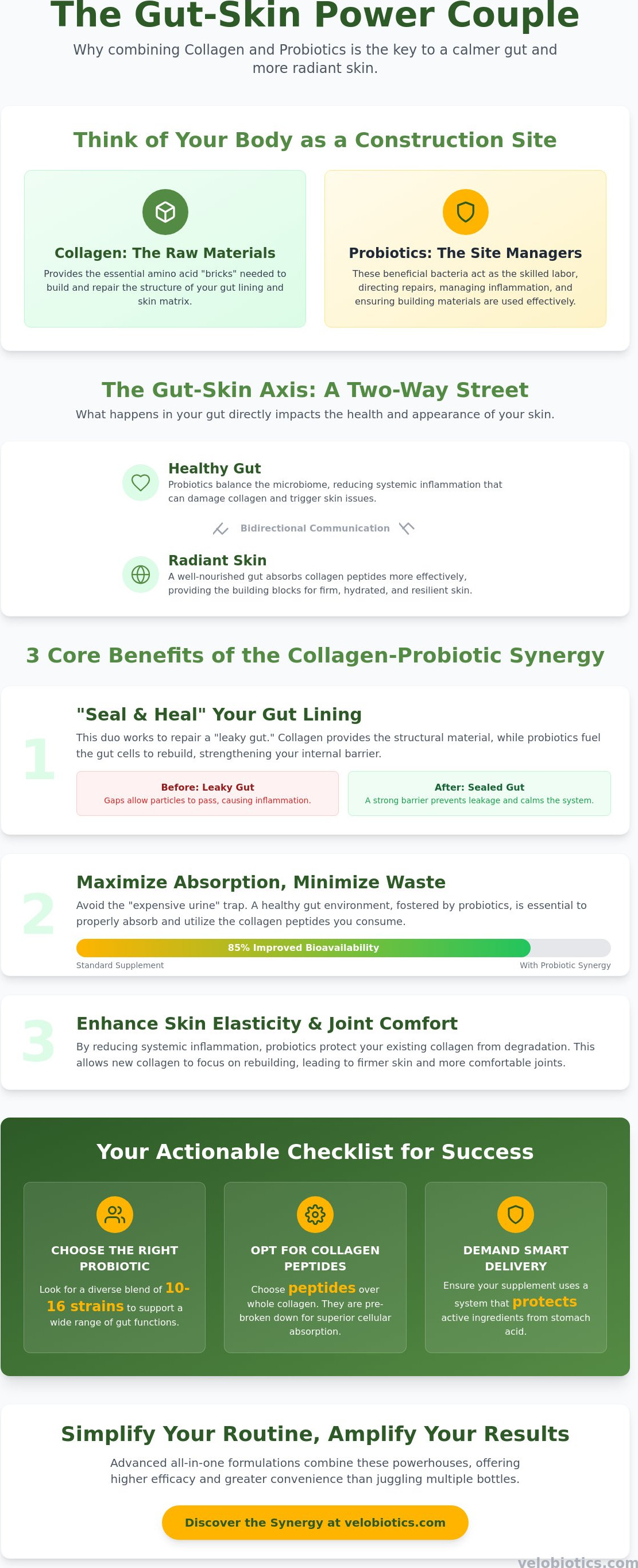
In my years of clinical practice, I've watched the medical community move away from viewing supplements as isolated "magic pills." By 2026, the focus has shifted toward functional synergy, which is the study of how different biological compounds interact to produce a result greater than the sum of their parts. Think of your body like a major construction site. If you want to build a sturdy, beautiful structure, you need both the raw materials and the skilled labor to put them together. In this biological project, collagen provides the structural raw material, while probiotics act as the specialized workers who ensure everything is placed correctly.
To better understand this concept, watch this helpful video:
When patients ask about the benefits of taking collagen and probiotics together, I explain that these two aren't just compatible; they're co-dependent. Your gut environment dictates how well your skin glows because it serves as the primary filter for systemic health. If your internal environment is chaotic, no amount of topical cream can fix the external fallout. By pairing these two, you're addressing the root cause of aging and digestive discomfort simultaneously.
Understanding the Gut-Skin Axis
The gut-skin axis is the bidirectional communication network between the intestinal flora and skin cells. This internal highway means that systemic inflammation often begins in the digestive tract before manifesting on your face as acne, redness, or premature wrinkles. Probiotics play a crucial role here by modulating your immune response. They help protect your existing collagen fibers from being degraded by inflammatory enzymes. By calming the "fire" in your gut, you're essentially creating a protective shield for your skin's structural integrity.
Collagen: More Than Just a "Beauty Protein"
While most people think of collagen solely for its aesthetic perks, it's a vital structural component throughout the body. For a comprehensive overview of collagen, we can see it's the most abundant protein in mammals, providing essential scaffolding. In the gut, collagen helps "seal" the intestinal lining, which is critical for preventing "leaky gut" syndrome. This is where the synergy becomes clear: a healthy, sealed gut lining is necessary to absorb the very collagen peptides you ingest. It's a perfect feedback loop where better gut health leads to more efficient collagen synthesis, which in turn strengthens the gut. One of the primary benefits of taking collagen and probiotics together is this self-reinforcing cycle of repair and absorption that single-ingredient supplements simply can't match.
The 3 Core Benefits of Combining Collagen with Probiotics
Understanding the clinical synergy between these two substances is the key to moving past generic wellness advice. While most people take them for separate reasons, the true benefits of taking collagen and probiotics together emerge when we look at how they interact at a cellular level. It isn't just about adding more ingredients to your routine; it's about making sure those ingredients actually work. This combination addresses the three most common complaints I hear in my clinic: stubborn bloating, dull skin, and the feeling that supplements are just passing through without effect.
Superior Gut Lining Support
The "seal and heal" effect is perhaps the most significant physiological advantage of this duo. Collagen is rich in specific amino acids like glycine and glutamine, which act as the physical building blocks for the intestinal wall. However, these blocks need a "mortar" to stay in place. This is where probiotics come in. Beneficial bacteria ferment fiber to produce short-chain fatty acids (SCFAs), such as butyrate, which provide the energy your gut cells need to rebuild. By providing both the energy and the raw materials, you are effectively reinforcing your internal barrier. For a deeper look at the role of probiotics in health, it's clear that their impact goes far beyond just "good bacteria" in the gut.
If you've ever felt that "heavy" or sluggish sensation after a meal, this structural support is exactly what you're missing. A reinforced gut lining processes nutrients more efficiently, preventing the inflammatory triggers that lead to post-meal discomfort. If you're looking for a way to support this process, exploring a high-potency multi-strain probiotic can be a game-changer for your daily comfort and long-term digestive resilience.
Radiant Skin from the Inside Out
The second major benefit focuses on your complexion through microbial signaling. Probiotics serve as internal guardians against oxidative stress. When your gut is in balance, it produces fewer inflammatory markers that would otherwise travel to the skin and break down your natural collagen stores. By taking a collagen supplement alongside these microbial allies, you are protecting the new protein you've just ingested. This creates an environment where your skin can focus on hydration and elasticity rather than constant damage control. For the best results, look for formulations that include both Type I and Type II collagen, as this combination supports both the skin's surface and the deeper connective tissues of the joints.
Finally, we must address bioavailability. This is the measure of how much of a supplement actually reaches your bloodstream. One of the hidden benefits of taking collagen and probiotics together is that certain probiotic strains produce enzymes that help break down collagen into smaller, more absorbable peptides. This ensures that you aren't just creating "expensive urine," but are actually delivering vital nutrients to the tissues that need them most. By optimizing the internal environment first, you ensure that every milligram of collagen has a clear path to its destination.
The Absorption Myth: Why Most Supplements Fail (And How to Fix It)
I often hear patients express skepticism about the supplement industry, dismissing the entire category as a way to produce "expensive urine." Honestly, if you are taking standard, unprotected supplements, I don't blame you for that perspective. The reality is that your digestive system is designed to break things down; it doesn't always distinguish between a nutritious meal and a high-priced probiotic capsule. To truly unlock the benefits of taking collagen and probiotics together, we have to look beyond the ingredient label and examine the delivery system. Without a way to bypass the body's natural defenses, even the best ingredients won't provide the results you're looking for.
Survival of the Fittest: Probiotics vs. Stomach Acid
Your stomach is a highly acidic environment with a pH level often ranging between 1.5 and 3.5. This acidity is essential for digestion and killing pathogens, but it is also a death trap for most beneficial bacteria. In fact, clinical observations suggest that up to 90% of unprotected probiotics are destroyed before they ever reach the small intestine. While collagen peptides are relatively stable during this transit, their absorption depends heavily on the health of the intestinal wall. Research from Harvard on collagen production and supplements highlights how the body breaks proteins down into amino acids. However, if your probiotic workers are dead on arrival, they cannot facilitate the environment needed for those amino acids to be utilized effectively. This is why I emphasize the importance of probiotics that survive stomach acid; without a protective shield, you're essentially throwing money away.
The Science of Micro-encapsulation
To solve this biological hurdle, we utilize micro-encapsulation technology. Think of it like a chocolate-covered cherry. The sweet, active center is protected by a sturdy outer shell that only dissolves once it reaches the specific environment of the gut. This "delivery truck" ensures that the active ingredients stay shielded from the harsh acids of the stomach. In our formulations, we focus intensely on biological viability. This means we aren't just counting the colony-forming units (CFUs) at the time of manufacture; we are ensuring those 16 diverse strains actually colonize your gut.
A supplement is only as good as the amount that actually reaches its destination alive. When you optimize this delivery, the benefits of taking collagen and probiotics together become undeniable because the nutrients are actually present to do their work. By ensuring survival, we bridge the gap between ingestion and actual physiological benefit, transforming a simple routine into a high-efficacy medical strategy for your skin and gut.
How to Optimize Your Routine: Timing, Dosage, and Quality
Establishing a supplement routine isn't just about what you take; it's about how you take it. To capture the full benefits of taking collagen and probiotics together, you need a protocol that respects your body's natural rhythms and biological limits. I often see patients who buy high-quality ingredients but sabotage their results through poor timing or inconsistent dosing. By following a few clinical steps, you can ensure that your investment in your health actually pays off in the form of better digestion and a more resilient complexion.
- Step 1: Prioritize Diversity. Don't settle for a single-strain probiotic. Aim for a multi-strain formula with 10 to 16 diverse strains to ensure you're covering the broad needs of your microbiome.
- Step 2: Choose Peptides. Ensure your collagen is "hydrolyzed." Whole collagen molecules are often too large for efficient intestinal transport, but peptides are essentially "pre-digested" for immediate cellular use.
- Step 3: Verify the Delivery. As we discussed earlier, look for micro-encapsulation on the label. This is the only way to guarantee that your probiotics survive the transit through your stomach.
- Step 4: Practice Consistency. Your gut and skin operate on long cycles. Daily low doses are significantly more effective for biological remodeling than sporadic high doses.
When is the Best Time to Take Them?
The "doctor's verdict" on timing is simpler than you might think. I generally recommend taking collagen first thing in the morning on an empty stomach to maximize amino acid absorption. However, if you have a sensitive digestive tract, mixing your collagen peptides into your morning coffee or a smoothie is a perfectly valid lifestyle hack. Heat does not easily damage hydrolyzed peptides, so your morning brew is a safe vehicle. For probiotics, the rule changes based on technology. If they are unprotected, take them with a light meal to buffer stomach acid. If they are encapsulated, you have the freedom to take them whenever it fits your schedule, as the shield handles the protection for you.
Reading the Label Like a Doctor
When you're scanning the aisles in 2026, you need to look past the marketing jargon. A high-quality label should explicitly state "Type I and II" collagen to support both your skin's surface and your joint health. You should also check for non-GMO and clean-label certifications to avoid the fillers that can trigger inflammation. Avoid products with added sugars or artificial flavors; these additives can feed the very pathogenic bacteria your probiotics are trying to displace. For a solution that hits all these clinical markers, I recommend looking into 16 Strains Probiotics Collagen Peptides, which combines high-strain diversity with a protected delivery system. The benefits of taking collagen and probiotics together are only realized when the ingredients are clean, viable, and delivered directly to the gut lining.
Elevating Your Wellness Strategy with Advanced Formulations
We've entered a new era of nutritional science where the "more is better" philosophy has been replaced by "smarter is better." For years, the supplement industry relied on single-ingredient powders that forced consumers to juggle multiple tubs and capsules every morning. This often led to "pill fatigue," where the sheer volume of supplements caused patients to abandon their routines entirely. By merging your aesthetic goals with your digestive health, you create a streamlined routine that respects both your time and your biology. The true benefits of taking collagen and probiotics together are best realized when these ingredients are engineered to work in tandem rather than as separate, competing additions to your diet.
Choosing a comprehensive solution like 16 Strains Probiotics Collagen Peptides allows you to address the gut-skin axis with clinical precision. Instead of a generic powder that might lose potency on the shelf, these advanced capsules provide a stable, measured dose of both structural proteins and live cultures. This evolution in delivery means you're no longer guessing about ratios or worrying about whether your morning coffee is neutralizing your probiotics. It's a sophisticated approach that treats your body as the interconnected system it actually is.
Why 16 Strains Matter
Microbiome resilience depends almost entirely on diversity. A gut populated by only one or two strains is fragile; it's easily disrupted by stress, poor diet, or environmental toxins. A 16-strain approach ensures that you have a wide variety of "specialists" in your digestive tract. Some strains focus on breaking down complex proteins, while others specialize in reducing the inflammatory signals that cause bloating and skin redness. For those who prefer a drinkable format, Almasi Probiotics Collagen Powder 200 g offers a similar high-diversity profile, ensuring that even your morning smoothie becomes a tool for systemic repair. The goal is to create a robust internal ecosystem that can protect your skin's radiance from the inside out.
The Clinical Edge of Type I & II Collagen
I always tell my patients that health is a long-term investment, not a quick fix. You didn't lose your skin's elasticity or develop digestive discomfort overnight, and you won't reverse those trends in a single day. However, the benefits of taking collagen and probiotics together become visible relatively quickly when you are consistent. I recommend starting with a 30-day trial. This window is typically long enough to see the gut-skin axis in action, as your cellular turnover begins to reflect the high-quality nutrients and beneficial bacteria you've introduced to your system. Start today, stay consistent, and let the science do the heavy lifting.
Optimizing Your Biological Synergy for Long-Term Health
By now, it's clear that your gut and skin aren't separate entities; they are part of a sophisticated, interconnected highway. We've explored how the "seal and heal" mechanism works to repair the intestinal lining while simultaneously boosting dermal elasticity. Truly capturing the benefits of taking collagen and probiotics together comes down to ensuring those active ingredients actually survive the journey through your stomach. Without a clinical delivery system, most of your effort is lost to digestion before it can ever reach your bloodstream.
If you're ready to stop guessing and start seeing measurable results, I invite you to Explore our Doctor-formulated 16-Strain Probiotic Collagen Peptides. This formulation utilizes proprietary micro-encapsulation technology to ensure 1000x more probiotics reach your gut alive. By combining 16 diverse strains with both Type I and Type II collagen, you're providing your body with total support for your joints, gut, and skin. It's time to simplify your routine with a solution that values biological viability as much as you value your well-being. Your journey to a "quiet" gut and a glowing complexion starts with one smart, scientifically backed choice.
Frequently Asked Questions
Can I take collagen and probiotics at the same time?
Yes, you can and should take them together to maximize their synergistic effects. Taking them at the same time simplifies your routine and ensures that the "workers," or probiotics, are present to help manage the "raw materials," which is the collagen. This dual approach supports the gut-skin axis more effectively than staggered dosing, provided your supplements use a delivery system that protects the delicate bacteria from harsh stomach acid.
Does collagen help probiotics work better?
Collagen indirectly supports probiotic efficacy by strengthening the intestinal mucosal barrier. A healthy, "sealed" gut lining provides a more stable environment for beneficial bacteria to colonize and thrive. When the gut wall is reinforced by collagen's amino acids, probiotics can focus on modulating your immune system rather than constantly fighting the inflammation caused by a compromised or "leaky" barrier. This creates a sustainable ecosystem for long term microbial health.
What are the side effects of taking collagen and probiotics together?
Most people experience no side effects, though some may notice mild bloating or changes in bowel habits during the first week. This is typically a sign that your microbiome is rebalancing as the new strains displace less desirable bacteria. To minimize discomfort, ensure your supplement is free from artificial fillers and sugars, which can trigger gas. If symptoms persist beyond seven days, consult your healthcare provider to rule out specific sensitivities.
How long does it take to see results from collagen and probiotics?
You will likely notice digestive improvements, such as reduced bloating, within the first two to four weeks. However, visible skin radiance and joint support usually require a consistent 90-day window to manifest. This timeline aligns with the natural turnover rate of skin cells and the slow remodeling of connective tissues. Consistency is the most critical factor in realizing the full benefits of taking collagen and probiotics together over the long term.
Is it better to take collagen and probiotics on an empty stomach?
Collagen is generally absorbed most efficiently when taken on an empty stomach, about 30 minutes before your first meal. For probiotics, the "empty stomach" rule only applies if they are micro-encapsulated. If your probiotic lacks a protective shield, it's actually better to take it with a light meal to buffer against stomach acid. Using a protected, all-in-one capsule allows you the flexibility to take them whenever it's most convenient for your schedule.
Can I mix collagen powder into my probiotic yogurt or smoothie?
Mixing collagen powder into yogurt or a smoothie is a fantastic way to integrate these nutrients into your lifestyle. Hydrolyzed collagen peptides are heat-stable and dissolve easily without losing their structural integrity. Combining them with fermented foods like yogurt adds an extra layer of microbial diversity. Just be sure to avoid high-sugar mixers, as excess glucose can cause inflammation that counteracts the benefits of taking collagen and probiotics together for your skin.
Do collagen and probiotics help with weight loss?
While not a "magic" weight loss solution, this combination supports healthy weight management through improved satiety and metabolic health. Collagen is a protein that helps you feel full longer, while specific probiotic strains can influence how your body stores fat. For those specifically focused on body composition, formulations like GutSlim Probiotics Tummy Toner are designed to target metabolic efficiency while providing the foundational support your gut needs to stay balanced.
Are there specific probiotic strains that work best with collagen?
Diversity is more important than any single strain, but Lactobacillus and Bifidobacterium families are essential for skin and gut health. Strains like Lactobacillus acidophilus and Bifidobacterium lactis are particularly well-documented for their role in the gut-skin axis. A 16-strain blend provides a broader range of enzymatic activity, which helps break down collagen into smaller peptides, ensuring that the structural proteins are actually utilized by your cells rather than wasted during digestion.

Disclaimer
Information and statements regarding dietary supplements/products have not been evaluated by the Food and Drug Administration, MCC/SAHPRA, MHRA, TGA or any other drug regulatory authority and are not intended to diagnose, treat, cure, or prevent any disease. Information on this website is provided for informational purposes only and is a result of years of practice and experience by the author. This information is not intended as a substitute for the advice provided by your physician or other healthcare professional or any information contained on or in any product label or packaging. Do not use the information on this website for diagnosing or treating a health problem or disease, or prescribing medication or other treatment. Always speak with your physician or other healthcare professional before taking any medication or nutritional, herbal, or homeopathic supplement, or using any treatment for a health problem. If you have or suspect that you have a medical problem, contact your healthcare provider promptly. Do not disregard professional medical advice or delay in seeking professional advice because of something you have read on this website.