

The Synergy of Glow: Benefits of Combining Collagen with Probiotics in 2026
What if the secret to that elusive "lit-from-within" glow isn't found in a $200 face cream, but in how well your gut microbes talk to your structural proteins? As a physician, I see patients daily who are frustrated by wasting money on supplements that simply don't work. You might be taking the highest quality Type I or Type II collagen, yet your skin remains dull and your bloating persists. Understanding the benefits of collagen with probiotics is the first step in fixing this common struggle, as the real secret lies in biological synergy.
You likely already know that collagen is the scaffolding of your skin and probiotics are the gatekeepers of your gut. I agree that it's exhausting to manage persistent skin issues despite a "good" diet. This article reveals why this pairing is a scientific "cheat code" for radiant skin and a resilient gut. With the probiotics market estimated at $72.2 billion in 2026, it's more important than ever to look past the hype. We will break down the latest clinical insights on nutrient absorption and show you how to finally bridge the gap between what you swallow and what your body actually utilizes.
Key Takeaways
- Discover why probiotics act as the essential "masons" that organize collagen "bricks," ensuring your body actually absorbs and utilizes the structural proteins you ingest.
- Learn how to leverage the benefits of collagen with probiotics to silence "inflammaging" and clear your complexion by optimizing the biological gut-skin axis.
- Understand the specific role of Type II collagen and microbial diversity in maintaining bone density and dampening joint inflammation for better long-term mobility.
- Get practical advice on the "Strain Game," including why 16 probiotic strains provide a more robust biological foundation than standard single-strain alternatives.
- Find out how proprietary micro-encapsulation technology acts as a protective "spacesuit" to help active ingredients survive the harsh environment of your stomach acid.
Understanding the Synergy: Why Collagen Needs Probiotics to Work
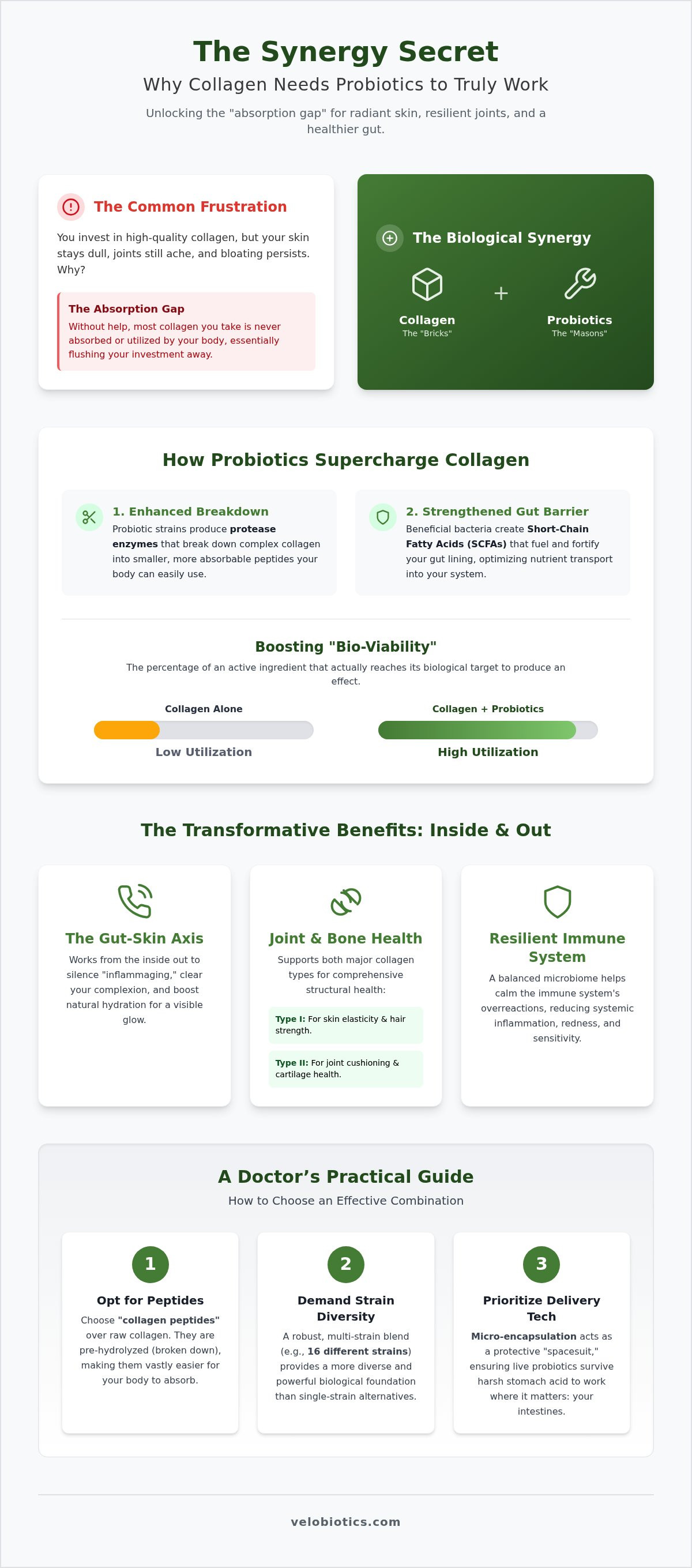
Think of your body as a high-end construction project. Collagen provides the bricks, the structural foundation for your skin, hair, and joints. However, even the most expensive bricks are useless if they're left sitting in a pile on the sidewalk. This is where Probiotics enter the picture. They act as the master masons, ensuring those structural proteins are actually organized and applied. One of the primary benefits of collagen with probiotics is that this combination solves the "absorption gap" that leaves many supplement users frustrated.
Many of my patients come to me confused because their "good" diet isn't yielding the radiant skin they expected. The truth is that an imbalanced microbiome creates a physical barrier to nutrient entry. If your intestinal permeability is compromised, those collagen peptides might never reach your bloodstream. When we discuss the benefits of collagen with probiotics, we are really talking about efficiency. I focus heavily on a metric I call "Bio-Viability." This measures the percentage of an active ingredient that actually reaches its biological target. Without a healthy microbial environment, your collagen's bio-viability drops significantly, essentially flushing your investment down the drain.
The Biological Mechanism of Combined Action
Probiotics don't just sit in your gut; they actively assist in protein metabolism. Certain strains produce proteases, which are enzymes that break down complex proteins into smaller, more absorbable peptides. Additionally, beneficial bacteria produce short-chain fatty acids (SCFAs) like butyrate. These SCFAs provide the primary energy source for your gut lining, strengthening the barrier and optimizing the transport of nutrients into the system. Synergistic supplementation is the practice of pairing structural proteins with microbial catalysts to ensure no ingredient goes to waste.
Type I vs Type II Collagen: Why Both Matter
Not all collagen serves the same purpose. Type I is the gold standard for skin elasticity and hair strength, while Type II is essential for cushioning your joints and maintaining healthy cartilage. A diverse 16-strain probiotic blend is superior because it supports the unique synthesis requirements for both types across different tissues. For the best results, always look for "collagen peptides" rather than raw collagen. Peptides are already partially broken down, making them much easier for your gut masons to put to work. This simple switch can drastically improve solubility and results. Beyond structural support, the broader world of peptide therapy offers unique protocols for various health goals; for instance, PeptivaFit provides in-depth clinical guides on how specific peptides can be utilized within a research-backed framework.
The Gut-Skin Axis: Transforming Your Complexion from Within
Your skin is essentially a biological mirror, reflecting the state of your internal microbial environment through a pathway known as the Gut-Skin Axis. This isn't just a wellness trend; it's a complex bidirectional signaling system where your gut microbiome communicates directly with your dermis. While many people spend a fortune on topical serums, these products often fail to penetrate deep enough to address the root causes of aging. In contrast, the benefits of collagen with probiotics work from the inside out by modulating the immune system and reducing systemic inflammation. Research into probiotics' effects on the body shows they can influence immune responses that, when left unchecked, lead to "inflammaging." This chronic low-grade inflammation is the primary culprit behind the premature breakdown of your natural collagen fibers.
As a physician, I've seen how a healthy gut helps the body retain the moisture that collagen provides. When your microbiome is balanced, your body produces more hyaluronic acid and other natural moisturizing factors. This creates a synergistic effect where the collagen provides the structure and the probiotics ensure that structure stays hydrated. Understanding the benefits of collagen with probiotics is essential for anyone dealing with chronic dryness or loss of elasticity that doesn't respond to traditional lotions.
Reducing Redness and Acne through Gut Health
When your gut lining becomes compromised, a condition often called "leaky gut," it allows metabolic waste to enter your bloodstream. This systemic toxicity frequently manifests as "leaky skin," resulting in redness, sensitivity, and acne flares. Collagen peptides help reinforce the structural integrity of your intestinal tight junctions, effectively sealing the leaks. Meanwhile, specific probiotic strains help calm the immune system's overreaction to these triggers. If you want to see a real change in your complexion, you might want to explore advanced probiotic delivery systems to stabilize your internal environment. By healing the gut, you remove the source of skin irritation before it ever reaches your face.
Boosting Natural Collagen Production
Probiotics act as biological signaling molecules that prompt your fibroblasts to ramp up production. This isn't just about adding more collagen to your system; it's about teaching your body to manufacture its own more efficiently. This process requires co-factors like Vitamin C, but the presence of a healthy microbiome ensures these nutrients are actually bioavailable. To understand more about how these mechanisms work, check out our guide on Probiotics for Digestive Health. When you combine these microbial catalysts with high-quality peptides, you create an environment where your skin stays hydrated and resilient. A balanced gut helps your body retain moisture at a cellular level, giving you that plump look that no amount of topical moisturizer can replicate.
Beyond Beauty: Joint, Bone, and Immune Benefits
While most of the conversation around this "power duo" centers on aesthetics, the clinical reality is that the benefits of collagen with probiotics are essential for structural longevity. If you're an athlete or an aging adult, you aren't just looking for fewer wrinkles; you're looking for joints that don't ache and bones that stay dense. Type II collagen is the specific building block for your cartilage, but its effectiveness is often hampered by systemic inflammation. It's a medical fact that joint pain is often a symptom of systemic inflammation rooted in the gut. By introducing a diverse microbial environment, you help dampen the inflammatory signals that lead to cartilage degradation and chronic discomfort.
We also can't ignore the critical role of the microbiome in bone health. Your bones aren't static; they're living tissue that requires constant mineral turnover to remain strong. A healthy microbiome acts as the "secret agent" in calcium and mineral absorption. Without the right bacteria to maintain an optimal pH in your intestines, even a high-calcium diet won't prevent bone density loss. When you optimize your gut, you're essentially ensuring that the raw materials for bone strength actually reach their destination.
Repairing the "Internal Shield"
Collagen is rich in specific amino acids like Glycine and Proline. These aren't just for skin elasticity; they provide the literal fuel for your gut-associated lymphoid tissue (GALT), which houses about 70% of your immune system. While collagen strengthens the physical barrier of your gut lining, probiotics act as the "drill sergeants" that train your immune cells to distinguish between actual threats and harmless substances. This dual action creates a robust internal shield that protects you from pathogens while maintaining systemic balance, ensuring your immune response is precise rather than overactive.
Recovery and Inflammation Management
If you've ever felt sluggish or bloated after a heavy protein shake, you've experienced the "efficacy gap" in protein digestion. High doses of protein can cause significant gut distress if your microbiome isn't equipped to handle the load. Using a high-potency delivery system like Velo16 Probiotic Digestive Capsules ensures that your body actually breaks down and absorbs those amino acids for muscle repair. This leads to faster post-workout recovery and significantly less muscle soreness. By pairing these structural proteins with microbial catalysts, you maximize the benefits of collagen with probiotics, ensuring your body utilizes every gram for recovery rather than letting it cause digestive turmoil.
A Doctor’s Practical Guide: How to Choose and Use
In my clinic, I often tell patients that even the most advanced supplement is only as good as the way you use it. To truly capture the clinical benefits of collagen with probiotics, you must pay attention to timing and environment. I generally recommend taking your combined supplement roughly 20 to 30 minutes before your first meal. This window allows the probiotics to transit through the stomach while acidity levels are relatively low, ensuring more "live bugs" reach the small intestine. Simultaneously, the collagen peptides are primed for absorption as soon as your digestive enzymes are activated by your breakfast.
One common mistake I see involves the morning coffee ritual. Never mix your probiotics into boiling liquids. Excessive heat denatures the delicate microbial structures and can degrade the functional integrity of the collagen proteins. If you prefer a warm beverage, wait until it reaches a comfortable sipping temperature, typically below 110°F, before stirring in your powder. This simple adjustment preserves the biological viability of the active ingredients, ensuring you aren't just drinking expensive, neutralized powder.
What to Look for on the Label
When reading a supplement label, don't be misled by massive CFU (Colony Forming Unit) counts. A product boasting 50 billion CFUs of a single strain is often less biologically useful than a diverse 16-strain blend that mirrors a healthy human ecosystem. Variety is the key to gut resilience and is one of the essential benefits of collagen with probiotics when properly formulated. Additionally, verify the origin of your peptides. Look for non-GMO and grass-fed bovine sources to ensure you're avoiding residual antibiotics or hormones. Finally, scan for "fillers" like maltodextrin or artificial sweeteners. These additives can unintentionally feed the "bad" bacteria in your gut, contradicting the very work the probiotics are trying to do.
Daily Routine Integration
Consistency is significantly more effective than quantity. Taking a moderate, daily dose of 16 Strains Probiotics Collagen Peptides builds a steady biological foundation, whereas taking a massive dose once a week simply overwhelms your absorption pathways. For a doctor-approved "Morning Glow" smoothie, blend Almasi Probiotics Collagen Powder with a handful of antioxidant-rich berries, half an avocado for healthy fats, and chilled water or nut milk. This provides the co-factors necessary for optimal synthesis. If you're ready to upgrade your daily routine with professional-grade science, you can shop our doctor-formulated solutions to find the right biological match for your needs.
Maximizing Viability: The Velobiotics Delivery Advantage
Standard probiotics often face a brutal journey. Your stomach acid is designed to break down pathogens, but it doesn't distinguish between a harmful virus and a beneficial Bifidobacterium. Research suggests that up to 90% of standard, unprotected probiotics never make it to your intestines alive. This creates a massive efficacy gap where you pay for high-potency ingredients that simply don't survive to deliver the results you expect. When we look at the benefits of collagen with probiotics, the delivery system is just as important as the ingredients themselves.
My goal as a physician and founder was to solve this biological hurdle using proprietary micro-encapsulation. By shielding the active cultures, we ensure they reach the gut in a viable state, ready to facilitate the absorption of your collagen peptides. It's about moving beyond vague wellness promises and focusing on quantifiable biological viability. You aren't just taking a supplement; you're using a delivery system designed to overcome your body's natural defensive barriers.
The Science of Micro-Encapsulation
Think of standard supplement capsules as an open boat on a stormy sea. They might stay afloat for a while, but they're easily swamped by the harsh environment of the stomach. Velobiotics technology acts more like a sophisticated submarine. It provides a protective "spacesuit" for each individual microbe. This technology preserves the potency of our 16-strain blend and protects the structural integrity of the collagen. If you want to understand the technical details of this process, read our full report on Probiotics That Survive Stomach Acid.
Why Velobiotics is the Professional Choice
I've always believed that clinical-grade health solutions shouldn't be reserved for laboratories. Everyday people deserve supplements that actually arrive at their biological destination. The practical takeaway here is simple: you don't necessarily need more supplements; you need supplements that actually work. By focusing on the benefits of collagen with probiotics through a protected delivery system, you're ensuring your body receives the full spectrum of structural and microbial support. To start your journey toward optimized health, explore the Almasi Probiotics Collagen Powder and integrate it into your daily routine. Investing in science is the only way to ensure your supplement routine yields the radiant, resilient results you deserve.
Take Control of Your Biological Viability
Understanding the internal mechanisms that drive nutrient absorption is the first step toward stopping the cycle of wasted supplements. We've explored how the benefits of collagen with probiotics extend far beyond simple skin elasticity; they provide a foundation for joint resilience and a fortified immune system. By addressing the "stomach acid trap" and prioritizing microbial diversity, you can finally bridge the gap between what you consume and what your body actually utilizes. It's about moving away from marketing hype and embracing clinical-grade results that respect your body's complex biological needs.
As a physician, I've seen how the right delivery system transforms a routine from expensive to effective. Our products are formulated by medical doctors and utilize proprietary micro-encapsulation for 10x better survival than standard alternatives. We include both Type I & II collagen peptides to ensure your structural needs are met from your complexion to your cartilage. Stop guessing and start investing in your long-term health with science that actually arrives. Experience the synergy of our 16-Strain Probiotic Collagen Peptides today! You've got the tools to thrive; now it's time to put them to work.
Frequently Asked Questions
Can I take collagen and probiotics at the same time?
Yes, taking them together is actually the optimal strategy for structural health. This combination allows the probiotics to start optimizing the gut environment at the exact moment the collagen peptides are being processed. This synergy ensures that the structural proteins have the microbial support they need for efficient uptake. I suggest using a combined formula like our 16 Strains Probiotics Collagen Peptides to ensure the ratios are clinically balanced for maximum biological viability.
How long does it take to see results from collagen and probiotics?
Most of my patients notice digestive improvements, such as reduced bloating, within the first two weeks of use. However, skin and joint changes typically take longer because cellular turnover in the dermis and cartilage is a slower process. You should expect to see a visible "glow" and increased hydration after 8 to 12 weeks of consistent daily use. Consistency is the most important factor in allowing these nutrients to accumulate and repair your tissues.
Do probiotics help with collagen absorption?
Yes, probiotics are essential catalysts for protein metabolism. They produce enzymes that break down complex proteins into smaller, bioavailable peptides that can actually cross the intestinal barrier. By strengthening the gut lining and balancing the microbiome, probiotics ensure that you aren't wasting your supplement. One of the primary benefits of collagen with probiotics is this increased efficiency, which finally bridges the "efficacy gap" often found in standard, single-ingredient supplements.
Is it better to get collagen from food or supplements?
While bone broth is an excellent source, supplements offer a more concentrated dose of specific Type I and Type II peptides. Food-based collagen contains large molecules that are often difficult for the body to break down. Hydrolyzed supplements are "pre-digested" into smaller fragments, making them much easier for your gut to utilize. For therapeutic results, a high-quality powder or capsule provides the precision and potency that a standard diet usually lacks.
Are there any side effects to taking collagen with probiotics?
Most people tolerate this combination well, though some may experience mild "microbiome shifting" symptoms like temporary gas during the first few days. This is a sign that the beneficial bacteria are successfully colonizing your gut and displacing less desirable strains. If symptoms persist, I recommend starting with a half-dose to allow your system to adjust. Always ensure your collagen is sourced from clean, non-GMO, grass-fed bovine to avoid inflammatory fillers and artificial sweeteners.
Can I put collagen and probiotics in my coffee?
You can add collagen to coffee, but you must be careful with the probiotics. High temperatures can kill live microbial cultures, rendering the probiotic component useless. If you enjoy a morning brew, let it cool to a drinkable temperature, below 110°F, before adding your Almasi Probiotics Collagen Powder. Alternatively, take your probiotics in a micro-encapsulated capsule form to protect them from both the heat of the coffee and your harsh stomach acid.
What is the best time of day to take this combination?
I recommend taking this duo in the morning, approximately 20 minutes before your first meal. This timing allows the probiotics to move through the stomach while it's less acidic, increasing their survival rate. Taking them on an empty stomach also prevents the collagen from competing with other dietary proteins for absorption. Establishing a "Morning Glow" ritual ensures you remain consistent, which is the secret to seeing long-term structural and digestive improvements.
Do I need a prebiotic if I am taking collagen and probiotics?
While not strictly mandatory, prebiotics act as the "fuel" for your probiotics, helping them thrive and multiply. Interestingly, collagen contains amino acids like glycine that support the gut lining, which indirectly helps your microbiome. If your diet is high in fiber from vegetables, you're likely getting enough prebiotics. However, for those with significant digestive issues, adding a targeted prebiotic can further enhance the benefits of collagen with probiotics by creating a more hospitable environment.

Disclaimer
Information and statements regarding dietary supplements/products have not been evaluated by the Food and Drug Administration, MCC/SAHPRA, MHRA, TGA or any other drug regulatory authority and are not intended to diagnose, treat, cure, or prevent any disease. Information on this website is provided for informational purposes only and is a result of years of practice and experience by the author. This information is not intended as a substitute for the advice provided by your physician or other healthcare professional or any information contained on or in any product label or packaging. Do not use the information on this website for diagnosing or treating a health problem or disease, or prescribing medication or other treatment. Always speak with your physician or other healthcare professional before taking any medication or nutritional, herbal, or homeopathic supplement, or using any treatment for a health problem. If you have or suspect that you have a medical problem, contact your healthcare provider promptly. Do not disregard professional medical advice or delay in seeking professional advice because of something you have read on this website.