

Treating BV Without Antibiotics: A Doctor's Guide
Did you know that up to 80% of women who treat bacterial vaginosis with antibiotics see that familiar, frustrating discharge return within just twelve months? It’s a cycle that feels impossible to break. You finish your prescription, only to find yourself dealing with a secondary yeast infection or that lingering "fishy" odor just days later. You're likely tired of the temporary fixes and the anxiety that comes with intimacy when your internal environment feels out of balance. If you've been searching for a sustainable bv treatment without antibiotics, you aren't alone in your frustration with the standard medical merry-go-round.
I understand the feeling that your body’s natural defense system has gone offline. As a doctor, I’m here to show you that long-term relief is a scientific reality rooted in biological viability. In this guide, we’ll move past the "scorched earth" approach of traditional meds. You'll discover how to effectively dismantle stubborn bacterial biofilms and re-seed your microbiome with protective Lactobacilli. We're going to bridge the gap between complex laboratory breakthroughs and your daily routine; providing a methodical "Cleanse and Seed" protocol that restores your pH stability and gives you back your confidence for good.
Key Takeaways
- Shift your perspective from killing "bad" bacteria to restoring an ecological balance that keeps your natural defenses strong.
- Explore the science of a long-term bv treatment without antibiotics by targeting the protective biofilms that cause 50% of infections to return within six months.
- Master the "Cleanse and Seed" protocol to effectively reset your vaginal pH and re-introduce the healthy bacteria your body needs.
- Learn why biological viability is the secret to success, ensuring your probiotics actually reach their target to maintain a stable, odor-free environment.
- Get practical, doctor-led advice on breaking the antibiotic loop and regaining confidence in your body’s natural ability to protect itself.
Moving Beyond the Prescription: Why Antibiotic-Free BV Management Matters
Many women walk into my office feeling like their bodies have betrayed them. They’ve taken the metronidazole, they’ve used the creams, yet the symptoms return like clockwork. We need to stop viewing this as a simple "bug" to be killed. Instead, look at this comprehensive overview of bacterial vaginosis to see it for what it truly is: a delicate ecological imbalance. When we explore options for bv treatment without antibiotics, we aren't just chasing a trend. We're pursuing a scientifically sound way to restore your internal environment from the ground up.
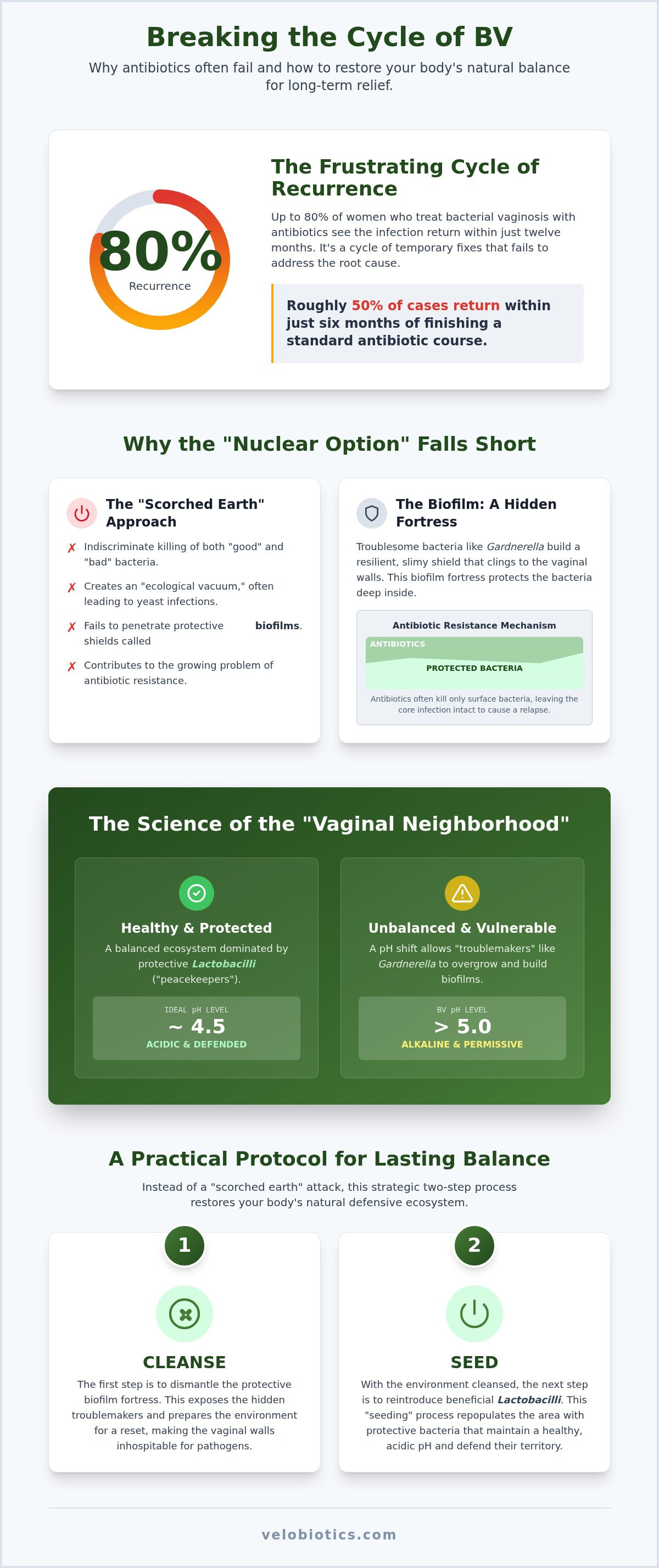
The statistics are sobering. Roughly 50% of women see their BV return within just six months of finishing a standard antibiotic course. This happens because certain strains of Gardnerella vaginalis have learned to build protective shields, called biofilms, which antibiotics often cannot penetrate. Even worse, the bacteria themselves are becoming resistant. By relying solely on prescriptions, we're often just hitting the "snooze" button on a problem that requires a full system reboot. True recovery depends on preserving your "good" Lactobacillus population so they can defend their territory.
The Problem with the "Nuclear Option"
Standard antibiotics are what I call the nuclear option. They don't discriminate. While they kill the "troublemakers," they also wipe out your "peacekeepers"—the beneficial bacteria that produce lactic acid. This ecological vacuum is why so many women find themselves in a "yeast infection spiral" immediately after treatment. Your microbiome doesn't need a total wipeout; it needs a strategic reset. This is why a "cleanse and seed" approach using targeted solutions like Femina Probiotic COOKIE FRESH Suppositories with Boric Acid is so effective. It breaks down those bacterial shields while reintroducing the protective flora you've lost.
When to Choose Non-Antibiotic Alternatives
Choosing a non-antibiotic path is particularly effective for those dealing with recurrent cases where the "standard" meds have clearly failed. By 2026, medical consensus has shifted significantly toward pH-based interventions as a primary strategy for long-term maintenance. A successful bv treatment without antibiotics works by making the vaginal walls too acidic for pathogens to survive. If you're tired of the side effects or concerned about resistance, focusing on acidity and bacterial viability is a practical, science-backed move. It's about taking control of your intimate wellness using tools that work with your body's natural chemistry rather than against it.
The Science of the "Vaginal Neighborhood": Biofilms and pH Balance
To understand why recurrence is so common, we have to look at the "Vaginal Neighborhood." In a healthy state, your Lactobacilli act as the neighborhood peacekeepers. They maintain a strict, acidic environment, ideally a pH of 4.5, that keeps the peace and prevents overgrowth. But when the pH shifts toward 5.0, the environment becomes alkaline. This shift is like turning off the streetlights in a safe neighborhood; it invites "troublemakers" to move in, settle down, and start causing chaos. This transition from a protective to a permissive environment is the root cause of the cycle many women experience.
These troublemakers, specifically Gardnerella vaginalis, don't just move in; they build a fortress. This is what scientists call a biofilm. This architectural advantage is exactly why many women seek a bv treatment without antibiotics. They realize they need a solution that can actually penetrate the slime barrier rather than just floating on top of it. While the official treatment guidelines often prioritize killing the bacteria, they sometimes overlook the mechanical strength of these biological shields.
The Biofilm Barrier
The fortress built by Gardnerella is incredibly resilient. It clings to the vaginal walls, creating a "hidden" infection that antibiotics often can't reach. While the medicine might kill the bacteria on the surface of the shield, the ones deep inside the matrix survive and wait. A biofilm is a protective matrix that resists standard medicine. This is why symptoms often vanish for a few days but return as soon as the treatment ends. The shield remains intact, and the cycle continues. Breaking this cycle requires a strategy that dissolves the matrix, exposing the hidden bacteria to your body’s natural defense systems.
Restoring the Acid Mantle
The ultimate goal of any sustainable bv treatment without antibiotics is to restore what we call the acid mantle. Your peacekeepers produce lactic acid to keep the pH low and hostile to pathogens. However, life happens. Common triggers like semen, menstrual blood, or even alkaline soaps can disrupt this balance. When your pH spikes, the "bad" bacteria flourish.
Practical tip: I often suggest that my patients keep at-home pH test strips in their medicine cabinet. Monitoring your levels after your period or intimacy can help you catch a shift before it turns into a full flare-up. If you notice your pH climbing toward 5.0, it’s time to intervene with a "cleanse and seed" strategy. For those ready to take that step, exploring the Femina Probiotic COOKIE FRESH line is a great way to start the restoration process.
Comparing Non-Antibiotic Options: Boric Acid vs. Probiotics
When patients ask about a sustainable bv treatment without antibiotics, they often focus on either boric acid or probiotics. However, using one without the other is like weeding a garden but never planting new seeds. You might clear the "weeds" (the bad bacteria), but if you leave the soil empty, those same troublemakers will simply move back in. To stop the cycle of recurrence for good, we must combine these two biological tools into a single, cohesive strategy: the "Cleanse and Seed" protocol.
The safety profile of these interventions is another reason I prioritize them. Unlike oral antibiotics, which must pass through your digestive system and can cause systemic side effects, vaginal suppositories provide direct, localized delivery. This targeted approach ensures the active ingredients reach the vaginal microbiome without disrupting your gut health. Recent clinical trial data on antibiotic alternatives supports the efficacy of using non-antibiotic agents to manage the vaginal environment effectively.
Boric Acid: The Biofilm Buster
Think of boric acid as your "Master Reset." Its primary job is to lower the vaginal pH and physically break down the biofilms we discussed earlier. By creating an environment where pathogens cannot "stick" to the vaginal walls, it strips away their defenses. For an effective cleanse, a duration of 7 to 14 days is typically recommended. It’s a powerful tool, but it comes with a critical safety warning: boric acid is strictly for vaginal use. Never ingest it orally, as it is toxic if swallowed. Keep these suppositories in a secure place, away from children or pets.
Probiotics: The Protective Guard
Once the boric acid has cleared the path, you must re-introduce the peacekeepers. This is where vaginal probiotics come in. You want to look for specific, high-potency strains like L. rhamnosus and L. reuteri, which are known for their ability to colonize the vaginal tract. The biggest hurdle here is biological viability. Many off-the-shelf probiotics lose their potency before they even reach you. To truly understand how to select the right strains and ensure they actually work, read my detailed breakdown in Probiotics for BV: A Doctor’s Guide. Re-seeding your microbiome is the only way to prevent the "troublemakers" from returning the moment your pH shifts again.
Your Practical 3-Step Protocol for Restoring Vaginal Health
We've looked at the science of biofilms; now it's time to put that knowledge into a daily routine. Implementing a sustainable bv treatment without antibiotics requires a methodical approach that respects your body's natural rhythms. I've developed this "Cleanse, Seed, and Shield" protocol to help you transition from chronic frustration to long-term stability. By following these steps, you are moving away from temporary fixes and toward a functional restoration of your intimate health.
Phase 1 & 2: The "Cleanse and Seed" Method
This phase is about active restoration. I recommend using your suppositories at bedtime. This allows the active ingredients to stay in contact with the vaginal walls for several hours while you are horizontal, maximizing their biological viability. Whether you are using a dual-action formula or separate steps, the first 14 days are the most critical window for breaking down existing biofilms and re-establishing a dominant Lactobacillus population.
Consistency matters more than anything else during this two-week "reboot." Don't skip nights even if your symptoms seem to vanish after 48 hours; remember, those biofilms are resilient and require steady intervention to fully dismantle. You might experience some watery discharge as the suppositories dissolve and the "bad" bacteria are flushed out. This is perfectly normal. I suggest using a breathable cotton panty liner during this time to stay comfortable and dry while your body resets.
Phase 3: Long-Term Maintenance
Once you've completed the initial 14-day reset, your focus shifts to protection. Think of this as maintaining the "Shield." Your lifestyle choices determine whether your pH remains acidic or climbs back into the danger zone. High-sugar diets can feed the wrong bacteria, while certain laundry detergents can leave irritating residues on your clothes. I advise my patients to wash their intimate apparel in hot water with unscented, hypoallergenic soap.
The "Cotton Rule" is non-negotiable; choose breathable fabrics that prevent moisture buildup and heat. In the shower, fragrance-free is your best friend. Harsh soaps and intimate washes often have an alkaline pH that can strip away your protective acid mantle in seconds. Finally, consider a "maintenance dose" of probiotics after your period or intimacy. These are times when your pH naturally spikes, and a quick re-seeding can stop a flare-up before it starts. For a comprehensive solution that handles both the reset and the maintenance, I recommend starting with Femina Probiotic COOKIE FRESH Suppositories with Boric Acid to ensure your microbiome remains resilient.
The Velobiotics Advantage: Why Femina Cookie Fresh Changes the Game
Most solutions on the market ask you to choose between an antiseptic or a probiotic. I realized that for a truly sustainable bv treatment without antibiotics, women needed a streamlined, dual-action approach. This led to the development of Femina Probiotic COOKIE FRESH Suppositories with Boric Acid. It’s the logical conclusion to the "Cleanse and Seed" protocol we’ve discussed; combining the biofilm-breaking power of boric acid with the restorative strength of probiotics in a single delivery system.
The secret to our success is micro-encapsulation. Standard probiotics are fragile; they often lose their potency due to temperature shifts or environmental factors before they even reach your body. Our proprietary technology acts as a microscopic seal, protecting the bacterial strains and ensuring their biological viability until the moment they are utilized. This means you are getting the full, quantifiable dose required to reset your microbiome and stop the cycle of recurrence.
Why Suppositories Beat Oral Pills for BV
When you take an oral pill, the active ingredients must survive the harsh acidity of your stomach and travel through the entire digestive tract before they can even hope to influence your vaginal flora. Suppositories offer a direct, localized delivery that bypasses the gut entirely. This leads to significantly faster relief for symptoms like odor and itching because the intervention happens exactly where the ecological imbalance exists. You aren't waiting for a systemic process; you're applying the solution to the source.
While many oral supplements offer only one or two strains, our Velo16 technology features a robust profile of 16 distinct probiotic strains. This diversity is essential for creating a resilient "neighborhood" that can withstand future pH fluctuations. By delivering this high strain count directly to the site, we provide a more comprehensive restoration than any oral capsule could achieve. It's about providing a broad spectrum of peacekeepers to ensure no single "troublemaker" can gain a foothold again.
A Message from the Founder
I started this journey in the lab because I was tired of seeing patients trapped in the antibiotic loop. My goal has always been to bridge the gap between complex breakthroughs and your everyday wellness. I want to empower you with the medical knowledge and tools necessary to take control of your intimate health without the dry clinical lectures. You can learn more about our mission and the Velobiotics story to see how we've turned research into practical care.
Your body possesses an incredible natural defense system; sometimes, it just needs the right support to get back on track. You don't have to settle for temporary fixes or the anxiety that comes with recurrent infections. With the right protocol and science-backed tools, you can regain your confidence and live free from the cycle of BV. Your body knows how to heal; we're just here to give it the most advanced tools to finish the job.
Taking Control of Your Intimate Ecological Balance
Breaking the cycle of recurrent BV requires a fundamental shift from aggressive "wipeouts" to strategic restoration. We've explored how a successful bv treatment without antibiotics depends on two critical phases: dismantling the protective biofilm and re-seeding the environment with robust, healthy bacteria. By focusing on biological viability and maintaining an acidic pH, you can finally stop the "fishy" odor and discharge from returning every month. It’s about working with your body’s natural chemistry to build a resilient defense system that lasts.
If you're ready to move past the temporary fixes, I invite you to experience the result of our MD-founder led innovation. Our dual-action formula combines the power of boric acid and probiotics, utilizing micro-encapsulation technology that ensures 10x better bacterial survival compared to standard market offerings. You don't have to navigate this journey alone or settle for the frustration of the antibiotic loop. Shop Femina Cookie Fresh: The Doctor-Formulated Solution for BV and start your journey toward long-term pH stability today. Your body is designed to be healthy; we're just giving it the high-tech tools it needs to thrive.
Frequently Asked Questions
Can I really get rid of BV without antibiotics?
Yes, it's entirely possible to manage your vaginal health through ecological restoration. While antibiotics target specific pathogens, a sustainable bv treatment without antibiotics focuses on lowering the pH and breaking down the protective biofilms that pathogens use as shields. By utilizing a "cleanse and seed" protocol, you address the root cause—the imbalance—rather than just the symptoms. This method encourages your natural Lactobacillus population to reclaim their territory and prevent future overgrowth.
How long does it take for boric acid to work for BV?
Most women notice a significant reduction in odor and discharge within the first 48 to 72 hours of using boric acid. However, a complete reset of the vaginal microbiome typically requires a 7 to 14-day course. Stopping too early allows the "troublemakers" deep within the biofilm to survive and multiply. For the best results, consistency is vital; use the suppositories every night at bedtime to ensure the active ingredients have maximum contact time.
Is it safe to use boric acid suppositories every day?
Boric acid is safe for short-term daily use during an active 14-day "cleanse" phase. For long-term health, it's better used as a targeted maintenance tool rather than a daily requirement. Many of my patients find success using a single suppository after their period or intimacy to prevent pH spikes. If you find yourself needing it every single day indefinitely, it's time to focus more heavily on the "seed" phase to restore your natural flora.
What are the best probiotic strains for vaginal health?
The most effective strains for intimate wellness include Lactobacillus rhamnosus, Lactobacillus reuteri, and Lactobacillus crispatus. These specific peacekeepers are known for their ability to produce lactic acid and hydrogen peroxide, which keep the vaginal environment acidic and hostile to pathogens. When selecting a supplement, look for high-potency options that prioritize biological viability. This ensures the bacteria are alive and ready to colonize the vaginal walls upon delivery, creating a long-term shield against infection.
Can I have sex while treating BV without antibiotics?
I generally recommend abstaining from intercourse during the initial 14-day treatment phase. Semen is naturally alkaline, which can spike your vaginal pH and counteract the work your suppositories are doing to restore acidity. Additionally, the friction of intimacy can irritate the vaginal walls while they are in a sensitive state of repair. Taking a short break allows your microbiome to stabilize without external disruptions, ensuring your "cleanse and seed" protocol is fully effective.
Why does my BV keep coming back after treatment?
Recurrence happens because traditional treatments often fail to address the biofilm; a microscopic slime shield that bad bacteria hide under. When you only kill the surface bacteria, the survivors under the shield wait for your pH to shift before they multiply again. To stop this cycle, you must use a strategy that dissolves the biofilm while simultaneously re-seeding the area with protective bacteria. This prevents the "neighborhood" from being left empty and vulnerable to a takeover.
What is the difference between BV and a yeast infection?
These two conditions require different approaches. Bacterial vaginosis is caused by an overgrowth of bacteria and is characterized by a "fishy" odor, thin gray or white discharge, and an alkaline pH above 4.5. A yeast infection is a fungal overgrowth that usually results in thick, "cottage cheese" discharge, intense itching, and no odor. Knowing the difference is crucial because antifungal meds won't help BV, and a bv treatment without antibiotics won't clear a fungal infection.
Can diet changes help treat bacterial vaginosis?
Diet plays a supportive role in your overall microbiome health. Reducing your intake of refined sugars is helpful, as sugar can fuel the overgrowth of certain pathogens. Incorporating fermented foods like kimchi or kefir can also support your systemic bacterial balance. While diet alone rarely clears an active flare-up, it provides the internal foundation your body needs to maintain the results of your "cleanse and seed" protocol. Practical habits and targeted suppositories work together for lasting relief.

Disclaimer
Information and statements regarding dietary supplements/products have not been evaluated by the Food and Drug Administration, MCC/SAHPRA, MHRA, TGA or any other drug regulatory authority and are not intended to diagnose, treat, cure, or prevent any disease. Information on this website is provided for informational purposes only and is a result of years of practice and experience by the author. This information is not intended as a substitute for the advice provided by your physician or other healthcare professional or any information contained on or in any product label or packaging. Do not use the information on this website for diagnosing or treating a health problem or disease, or prescribing medication or other treatment. Always speak with your physician or other healthcare professional before taking any medication or nutritional, herbal, or homeopathic supplement, or using any treatment for a health problem. If you have or suspect that you have a medical problem, contact your healthcare provider promptly. Do not disregard professional medical advice or delay in seeking professional advice because of something you have read on this website.