

Vaginal Health: Suppositories vs. Oral Probiotics (2026)
What if the probiotic pill you're swallowing every morning is taking the "long way" to a destination that needs an express delivery? If you're trapped in a cycle of recurring BV or yeast infections, you've likely spent hours comparing probiotic suppositories vs oral probiotics for vaginal health. It's exhausting to navigate medical jargon like "CFU counts" and "strains" while your body is signaling for urgent help. I've seen many women feel defeated by slow-acting supplements that don't address the immediate irritation they're experiencing.
You deserve a clear, scientific roadmap to reclaim your comfort and biological balance. This article explains the physiological differences between localized and systemic delivery, helping you understand how to use both for maximum viability. We'll look at why oral capsules provide the foundational support your gut-vagina axis needs; meanwhile, suppositories offer the rapid pH restoration required during acute flare-ups. You'll learn how to choose the right delivery system for your specific needs, ensuring long-term prevention and the fastest relief possible.
Key Takeaways
- Understand why Lactobacillus acts as the essential "police force" to maintain an acidic pH and keep vaginal discomfort at bay.
- Compare probiotic suppositories vs oral probiotics for vaginal health to see why "direct flights" work faster for acute issues than the "scenic route" through the gut.
- Learn how to bypass the harsh environment of stomach acid to ensure your probiotics actually survive and colonize where they matter most.
- Identify whether you're in a "flare-up" or "maintenance" phase to pick the delivery method that offers the best biological viability for your situation.
- Get a practical, doctor-approved protocol for restoring your internal balance and preventing the frustration of recurring infections.
The Vaginal Microbiome: Why Your "Down There" Needs Good Bacteria
Think of your vagina as a high-end, exclusive neighborhood. For the peace and property values to stay high, you need a dedicated, 24/7 police force. In this biological ecosystem, that force is comprised of Lactobacillus bacteria. The Vaginal Microbiome is a dynamic, self-regulating ecosystem of microorganisms that maintains biological equilibrium through constant environmental monitoring and metabolic production. When the "good guys" are in control, they dominate the landscape, ensuring that opportunistic pathogens don't have the space or resources to cause trouble. However, when this police force thins out, you enter a state called dysbiosis. This is the clinical term for the microbial chaos that manifests as Bacterial Vaginosis (BV) or yeast infections, leaving you with discomfort that just won't quit.
The pH Scale: Your Vagina’s Internal Security System
A healthy vaginal environment is naturally acidic, typically maintaining a pH level between 3.8 and 4.5. This acidity isn't an accident; it's your primary security system. Lactobacillus strains consume glycogen from the vaginal walls and convert it into lactic acid, which lowers the pH and creates a "keep out" sign for harmful bacteria. If your pH climbs above 4.5, the environment becomes hospitable to the wrong crowd. External factors like unprotected sex, the conclusion of your period, or even using harsh soaps act as disruptors that spike your alkalinity. Once the pH stays elevated, you'll likely notice a change in odor and persistent irritation. This shift is often what drives the debate between probiotic suppositories vs oral probiotics for vaginal health, as women look for the most efficient way to reset their internal chemistry.
Lactobacillus: The Superhero of Intimate Wellness
Not all bacteria are created equal, and in the world of vaginal health, specific strains like L. rhamnosus and L. reuteri are the undisputed heavyweights. These superheroes do more than just occupy space; they actively produce hydrogen peroxide. This substance acts as a natural disinfectant, effectively killing off pathogens before they can form a protective biofilm. The ultimate goal of any intervention is colonization. We don't just want the good bacteria to pass through; we want them to move in, multiply, and rebuild the defensive wall. Whether you utilize Femina™ Probiotic Capsules for foundational support or a localized approach, the focus must remain on biological viability. Without a high survival rate, these superheroes can't reach the "neighborhood" to begin the vital work of restoration and long-term protection.
Oral Probiotics: The "Scenic Route" to Vaginal Wellness
When you swallow a capsule, those beneficial bacteria don't just magically teleport to where they're needed. They take what I call the "scenic route." This involves a complex migration from the mouth, through the gauntlet of the gastrointestinal tract, and eventually to the vaginal canal. It sounds like a biology-class trek, but the proximity of the rectum to the vaginal opening allows for a natural cross-migration of flora. This biological pathway is the reason why a healthy gut is almost always the foundation of a balanced intimate environment. It's a systemic approach that treats the whole body rather than just one localized area.
However, this journey is fraught with danger. The primary antagonist in this story is your stomach acid. This highly corrosive fluid is designed to break down food and neutralize invading pathogens; unfortunately, it doesn't always distinguish between "bad" invaders and your expensive probiotic strains. Without a protective barrier, the vast majority of those beneficial bacteria perish before they even reach the small intestine. This massive survival challenge is the main reason many women feel frustrated when comparing probiotic suppositories vs oral probiotics for vaginal health. If the bacteria don't survive the trip, they can't colonize or provide any benefit. Understanding the science behind delivery systems is the first step toward lasting comfort, and you can explore our research-backed approach to see how we tackle these biological hurdles.
This is where specialized technology intervenes. To ensure these microbes reach their destination alive, we utilize micro-encapsulation. This acts like a biological suit of armor, shielding the bacteria from acidic degradation. You can read more about the technical specifics in our guide on Probiotics That Survive Stomach Acid. Remember, oral support is a marathon, not a sprint. It takes time to "seed" the microbiome and establish long-term stability.
The Gut-Vagina Axis: How They Are Connected
The connection between your digestive system and your reproductive health is more intimate than most realize. Clinical observations show that when the gut microbiome is in a state of dysbiosis, the vaginal microbiome usually follows suit. While the CDC Treatment Guidelines often focus on localized antibiotics for active infections, oral probiotics play a crucial role in preventing the "revolving door" of recurring issues. By maintaining a healthy reservoir of bacteria in the gut, you're essentially providing a constant supply of reinforcements for your vaginal defenses.
Pros and Cons of the Oral Approach
The oral route is favored for its convenience and systemic benefits. It's a "set it and forget it" method that supports your overall wellness without the mess of localized applications. It's an excellent choice for daily maintenance. On the flip side, it's slow. You won't see results in 24 hours; it can take weeks for colonization to reach therapeutic levels. Plus, the bacterial loss in the stomach can be significant if you aren't using a high-viability product. If you're looking for a daily foundational supplement, I recommend choosing something specifically formulated for women’s unique physiology, like Femina™ Probiotic Capsules with Cranberry.
Probiotic Suppositories: The "Direct Flight" to pH Balance
If oral probiotics are the scenic route, suppositories are the non-stop direct flight to your destination. When you use a localized delivery system, you aren't crossing your fingers and hoping that enough bacteria survive the acidic gauntlet of your stomach. Instead, you're placing the "good guys" exactly where they need to set up camp. This method ensures nearly 100% bacterial delivery to the vaginal mucosa, providing an immediate intervention for the localized environment. For women debating probiotic suppositories vs oral probiotics for vaginal health, the choice often comes down to speed. While oral capsules build a foundation over weeks, suppositories begin the work of pH restoration and biofilm disruption the moment they dissolve.
Acute issues like a fishy odor or persistent itching require a fast-acting solution. Pathogenic bacteria often create a biofilm; a sticky, protective shield that makes them resistant to standard treatments. Direct delivery allows probiotics to land right on top of these colonies, producing lactic acid and hydrogen peroxide to reclaim the territory. This immediate impact on the vaginal chemistry is why localized treatment is considered the gold standard for managing active flare-ups rather than just daily maintenance.
The Boric Acid Advantage in Suppositories
Boric acid is the secret weapon in modern vaginal care. Its primary job is to act as a mild antiseptic that specifically targets the protective biofilm mentioned above. Think of it as "weeding" the garden so the probiotics can "seed" the soil. By breaking down the shield of bad bacteria, boric acid creates a clean slate, allowing the new Lactobacillus colonies to take root without being crowded out. I recommend using a dual-action tool like Femina Probiotic COOKIE FRESH Suppositories. This combination ensures you're attacking the problem from two angles: removing the pathogens and replenishing the defenders simultaneously.
When to Choose Local Delivery
Timing is everything when it comes to biological balance. You should reach for localized support during specific "high-risk" windows or at the very first sign of a shift in your baseline. Common scenarios include:
- Post-period refresh: Menstrual blood is slightly alkaline and can spike your vaginal pH.
- After intimacy: Semen has a high pH that can disrupt your internal security system.
- Early symptoms: That "off" feeling that signals BV or a yeast infection is starting.
Most women report a noticeable difference in comfort and odor within 24 to 72 hours of the first application. For the best results and to minimize any natural leakage, always apply your suppository at bedtime. This allows the product to remain in contact with the vaginal walls for the maximum amount of time while you're horizontal, ensuring the highest level of biological viability for the probiotic strains.
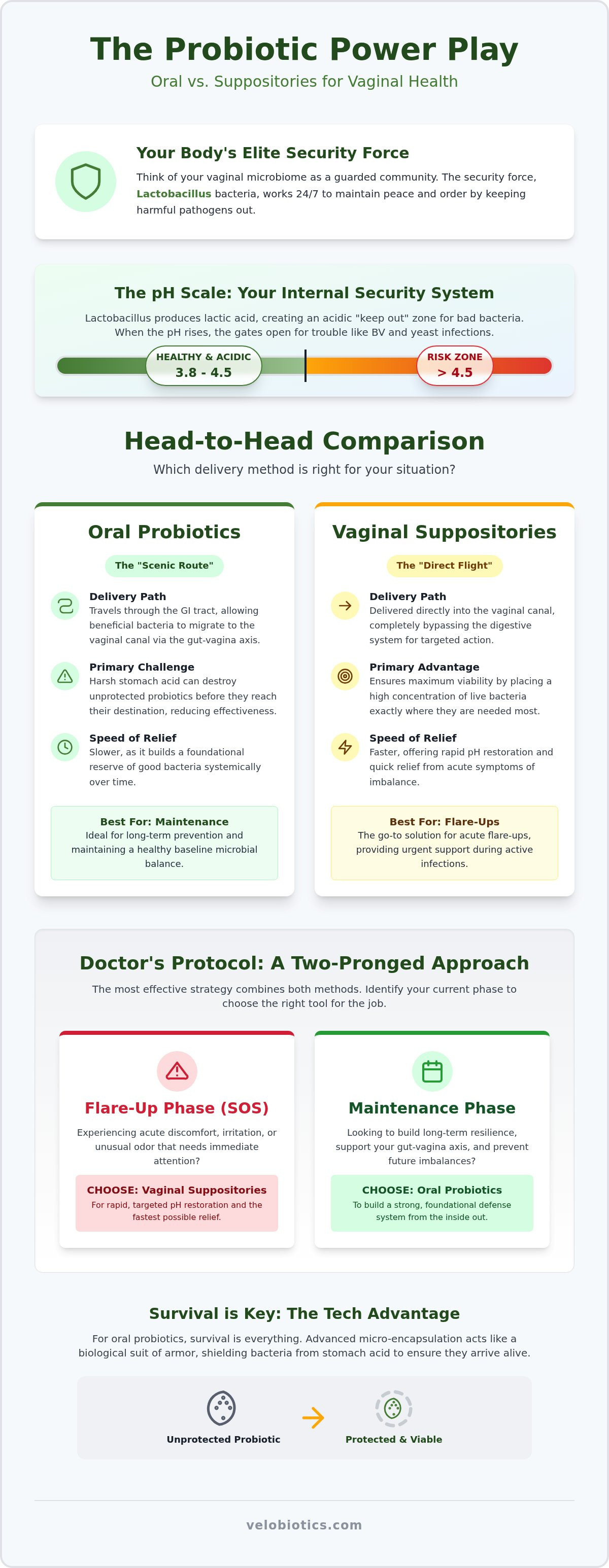
The Head-to-Head Comparison: Which Method Wins for You?
Choosing between probiotic suppositories vs oral probiotics for vaginal health isn't about finding a "superior" product; it's about matching the tool to your current biological fire. If you're dealing with an active flare-up of BV or a yeast infection, you need acute relief. In these moments, speed is the only metric that matters. Conversely, if your goal is to stop infections from returning every month, you're looking for daily prevention. One acts as an emergency responder, while the other serves as the long-term security detail for your microbiome.
We must also address the bio-viability factor. It's a common industry secret that the CFU (Colony Forming Unit) count on a supplement label is often a "marketing number" rather than a "delivery number." If an oral probiotic doesn't have a specialized coating, the actual number of live bacteria reaching your system can be near zero. Suppositories bypass this issue entirely by delivering 100% of the active ingredients directly to the site of action. While oral capsules offer the convenience of a "one-and-done" pill, suppositories provide the clinical precision required to break down stubborn biofilms. For a deeper look at which strains actually win the war against pathogens, check out our Probiotics for BV Guide.
Oral vs. Suppository: The Comparison Matrix
To simplify your decision, I break the comparison down into three functional categories:
- Speed of Action: Suppositories are the clear winner here, often providing relief within 24 hours. Oral supplements are slow and steady, usually requiring 2 to 4 weeks for full colonization.
- Target Area: Suppositories focus exclusively on the vaginal canal. Oral probiotics support both the gut and the vagina, offering systemic health benefits.
- Best For: Use suppositories for active odor, itching, or post-intimacy resets. Use oral capsules for ongoing maintenance and general immune support.
Can You Use Both at the Same Time?
For my patients who suffer from chronic, recurring infections, I often recommend the "Double-Down" approach. This strategy uses the strengths of both delivery systems to create an environment where bad bacteria simply cannot survive. You use suppositories to "weed" the environment and oral probiotics to "seed" it for the future. It's the most aggressive way to reclaim your comfort.
A typical actionable protocol involves using Femina Probiotic COOKIE FRESH Suppositories for seven consecutive nights to reset your pH. During this same week, you begin taking Femina™ Probiotic Capsules daily. Once the seven-day suppository "cleanse" is complete, you stay on the oral capsules indefinitely to maintain that protective barrier. This ensures you're covered during "danger zones" like your period or high-stress weeks when your defenses might naturally dip.
Ready to break the cycle of recurring infections? Get started with our dual-action suppositories today.
Designing Your Protocol: Practical Advice from the Doctor’s Desk
Building a protocol shouldn't feel like a confusing chemistry experiment. As a doctor, I prioritize simplicity and biological logic. The debate over probiotic suppositories vs oral probiotics for vaginal health usually ends when we look at your current symptoms. If you're in the middle of a "biological fire," you don't wait for a slow-moving systemic response. You need a direct intervention. However, once the fire is out, you need a long-term security plan to ensure it doesn't reignite. Success comes from knowing when to pivot from "weeding" to "seeding."
- Identify your phase: A flare-up involves active odor, discharge, or itching. Maintenance is that quiet period where you feel fine but want to stay that way.
- Apply the Speed vs. Systemic rule: Choose suppositories for 24-hour localized action. Choose oral capsules for total-body microbiome support.
- Prioritize viability: Look for micro-encapsulated technology. If the bacteria are dead by the time they hit your shelf, they're useless.
- Audit your lifestyle: Support your probiotics by wearing breathable cotton, supporting your mental focus with wellness products from Gara Health, and strictly avoiding douches, which strip away your natural defenses.
The "Cookie Fresh" Routine for Acute Concerns
When you're dealing with recurring BV or a stubborn yeast infection, a 7-day reset is the most effective clinical starting point. Using Femina Cookie Fresh suppositories for a full week provides a dual-action attack. The boric acid dissolves the biofilm while the probiotics reclaim the territory. During this week, expect some watery discharge; this is a normal sign that the suppository is working to flush out pathogens and reset your pH. Once you complete the seven days and the odor has vanished, it's time to stop the localized treatment and transition into a foundational maintenance phase.
Long-Term Maintenance with Femina Capsules
Maintenance is where the real victory happens. To prevent the "revolving door" of infections, you need a daily habit that supports the gut-vagina axis. I recommend Femina™ Probiotic Capsules because they include cranberry extract. This addition provides essential urinary tract support, which is often compromised during vaginal dysbiosis. Consistency is your best friend here. It takes about 3 to 6 months to fully colonize and stabilize your microbiome. Monitor your "Vaginal Vitality" by tracking how you feel after your period or intimacy. If you stay balanced during these high-stress windows, your protocol is working.
Take Control of Your Intimate Wellness
You don't have to live in a cycle of frustration and "off" days. Understanding the science of probiotic suppositories vs oral probiotics for vaginal health is your first step toward true biological freedom. Remember, suppositories offer the fast-acting "weeding" you need during flare-ups, while oral capsules provide the "seeding" required for long-term maintenance. As a doctor, I've seen how proprietary micro-encapsulation and dual-action technology can change the game by ensuring those beneficial bacteria actually arrive alive and ready to work.
Our formulations are scientifically grounded to bridge the gap between clinical research and your daily routine. By combining boric acid with high-viability probiotics, we help you break down stubborn biofilms and restore your natural pH faster than traditional methods. It's time to stop guessing and start using delivery systems that respect your body's complex needs. You've got the roadmap; now it's time to take action and feel like yourself again. You deserve to feel comfortable and confident every single day.
Shop the Femina Cookie Fresh Collection for Targeted Vaginal Support and reclaim your comfort today.
Frequently Asked Questions
Are probiotic suppositories better than oral pills for BV?
Suppositories are often more effective for immediate relief from acute Bacterial Vaginosis symptoms because they bypass the digestive system. While oral pills require weeks to migrate from the gut, suppositories deliver beneficial bacteria directly to the vaginal mucosa. This allows for rapid pH restoration and faster biofilm disruption. For long term prevention, many women find that a combination of both delivery methods provides the most comprehensive protection.
How long does it take for oral probiotics to reach the vagina?
It typically takes between 14 and 28 days for oral probiotics to colonize the vaginal environment effectively. Unlike the direct delivery of a suppository, oral capsules must survive stomach acid and migrate from the rectum to the vaginal canal. This biological journey is a marathon, not a sprint. Consistency is key; you must take your supplement daily to ensure a steady seeding of the microbiome for lasting stability.
Can I use probiotic suppositories while on antibiotics?
Yes, using probiotic suppositories during and after a course of antibiotics is a clinically sound strategy. Antibiotics are designed to kill harmful bacteria. However, they also wipe out the protective Lactobacillus police force in your vagina. By using localized probiotics, you're actively replenishing your defenses before opportunistic pathogens can take over. This proactive approach helps prevent the secondary infections that often follow antibiotic treatments.
Is it safe to use boric acid and probiotics together?
It is absolutely safe and highly recommended for managing recurring issues. Boric acid acts as a gentle antiseptic that weeds out the bad bacteria and breaks down their protective biofilms. Simultaneously, the probiotics seed the environment with healthy flora. Our dual action Femina Probiotic COOKIE FRESH Suppositories utilize this synergy to reset your internal chemistry. This two step process ensures the new bacteria have a clean, acidic environment to call home.
Do oral probiotics actually work for vaginal odor?
Oral probiotics are effective for managing odor, but they work systemically and take longer to show results. Odor is usually a symptom of an elevated pH. By improving the gut vagina axis, oral supplements help establish a permanent reservoir of good bacteria. For faster results with persistent odor, I suggest starting with a suppository reset before transitioning to daily oral maintenance for long term odor control.
Can I have sex while using a vaginal probiotic suppository?
I recommend waiting at least 12 hours after insertion before having sex. This ensures the product is fully absorbed. Suppositories need time to dissolve and coat the vaginal walls to be effective. Engaging in intimacy too soon can lead to increased leakage. Applying your suppository at bedtime is the most practical solution. It allows the formula to work undisturbed while you sleep, keeping the process mess free.
How often should I use a probiotic suppository for maintenance?
For maintenance, most women find success using a suppository once or twice a week, or specifically after triggers like your period or intimacy. These events naturally spike your pH and can invite unwanted bacteria back into the neighborhood. A regular maintenance schedule ensures your lactic acid levels stay high and your defenses remain sharp. If you're in a flare up, a seven day consecutive routine is usually the gold standard for a full reset.
What should I look for on a probiotic label for vaginal health?
When comparing probiotic suppositories vs oral probiotics for vaginal health, prioritize strain specificity and viability. Look for clinically studied strains like Lactobacillus rhamnosus. Additionally, ensure the product uses micro encapsulation technology. This acts as a proprietary seal, protecting the bacteria from stomach acid. It guarantees that the CFU count on the label actually reaches its destination alive. Without high viability, even the best strains won't colonize effectively.

Disclaimer
Information and statements regarding dietary supplements/products have not been evaluated by the Food and Drug Administration, MCC/SAHPRA, MHRA, TGA or any other drug regulatory authority and are not intended to diagnose, treat, cure, or prevent any disease. Information on this website is provided for informational purposes only and is a result of years of practice and experience by the author. This information is not intended as a substitute for the advice provided by your physician or other healthcare professional or any information contained on or in any product label or packaging. Do not use the information on this website for diagnosing or treating a health problem or disease, or prescribing medication or other treatment. Always speak with your physician or other healthcare professional before taking any medication or nutritional, herbal, or homeopathic supplement, or using any treatment for a health problem. If you have or suspect that you have a medical problem, contact your healthcare provider promptly. Do not disregard professional medical advice or delay in seeking professional advice because of something you have read on this website.