

White Clumpy Discharge After Boric Acid: Is It a Yeast Infection or Just the Meds?
What if the very symptom causing you stress is actually just physical proof that your treatment is working? It is incredibly common to feel a surge of panic when you notice a white clumpy discharge after boric acid use, especially when it looks exactly like the yeast infection you are trying to eliminate. As a physician focused on vaginal health, I see this confusion daily; patients often worry the treatment has failed before it even had a chance to start.
I agree that the physical mess of suppositories is far from ideal and the visual similarity to cottage cheese discharge is unsettling. This article will teach you exactly how to distinguish between harmless medication residue and a persistent infection that requires further care. We'll examine the biological process of capsule dissolution, identify the specific red flag symptoms that mean it's time to call a doctor, and provide actionable steps to stay clean and comfortable during your recovery.
Key Takeaways
- Understand why seeing white clumpy discharge after boric acid is often a normal sign of "exit discharge" rather than a treatment failure.
- Learn how the osmotic mechanism of these suppositories draws out moisture and residue to physically clear your system.
- Identify the clear diagnostic differences between medication breakdown and active yeast, including the crucial "smell test" and irritation levels.
- Use the "Night Owl" strategy to manage the physical mess of treatment and maintain your comfort throughout the process.
- Explore why replenishing your vaginal microbiome with targeted probiotics is essential once the boric acid has cleared the path.
Don't Panic: Decoding White Clumpy Discharge After Boric Acid
You wake up, visit the bathroom, and see something that looks exactly like the infection you're trying to cure. It's frustrating. You've been using treatment for days, yet there it is: thick, white clumps. I understand the immediate "ick" factor and the anxiety that follows. However, in my clinical experience, this isn't usually a sign of a worsening infection. It's actually a physical byproduct of the medication doing its job inside your body.
When you use Boric acid (vaginal) suppositories, you're introducing a significant volume of powder into a relatively small, moist space. Unlike a pill you swallow, which is processed by your digestive system and absorbed into the bloodstream, a suppository works locally. Because the vaginal walls have a finite capacity for absorption, anything the body doesn't utilize must eventually come out. This process is a sign of biological viability; the ingredients are present, active, and currently interacting with your internal environment.
To better understand this concept, watch this helpful video:
The 'Exit Discharge' Phenomenon
This "exit discharge" is a predictable physiological event. It typically presents as chalky, white, or slightly pasty clumps. You'll likely notice the heaviest flow between 2 and 12 hours after insertion. These clumps are often nothing more than the undissolved boric acid powder or remnants of the vegetable-based capsule. If you're using a product like Femina Probiotic COOKIE FRESH, the discharge might also include the prebiotic and probiotic carriers designed to stabilize the environment. You'll find that while yeast discharge is often "cottage cheese" in texture and sticky, boric acid residue feels more like wet chalk or grit when rubbed between fingers.
Why Boric Acid Isn't a 'Vanishing' Treatment
The vaginal canal isn't a bottomless pit; it's a dynamic environment with limited surface area. Gravity plays a major role here. When you stand up or move around, the weight of the dissolved and undissolved materials naturally moves toward the vaginal opening. This leakage doesn't mean you've lost your dose. The active ingredients have already begun their work on the vaginal mucosa. The white clumpy discharge after boric acid is simply the "packaging" and excess material being cleared away by your body's natural self-cleaning mechanisms. Think of it as the "Great Exit." Your body is effectively sweeping out the debris after the treatment has done its heavy lifting.
The Science of the Melt: Why Your Body Expels Residue
Understanding the physiological mechanics of your body helps demystify the appearance of white clumpy discharge after boric acid. When you insert a suppository, you aren't just placing a passive object inside; you're initiating a complex chemical and biological interaction. The presence of the acid triggers two primary responses: osmotic draw and glandular stimulation. These processes are essential for the medication to effectively treat vaginal yeast infections by altering the local environment.
Osmosis and Vaginal Moisture
Osmosis is the movement of water from an area of low solute concentration to high solute concentration. Because boric acid is a concentrated crystalline substance, it effectively "calls" for moisture from the surrounding vaginal tissues to balance itself out. This influx of fluid is why many women experience a watery sensation shortly after application. This fluid flush helps "wash out" pathogens by physically rinsing the vaginal canal of debris and excess yeast cells. It's a mechanical cleansing that works alongside the chemical acidification.
Anatomy of a Suppository
A standard suppository consists of the active boric acid powder and an outer capsule shell, often made of vegetable cellulose or gelatin. While the active acid is designed to lower vaginal pH, the capsule shell must first dissolve. Your internal body temperature, which typically rests around 37 degrees Celsius, acts as the primary catalyst for this "melt." If your internal environment is particularly dry, the shell may take longer to break down, resulting in larger, more distinct clumps of undissolved material. This is why you might see white clumpy discharge after boric acid several hours after the initial dose.
Some formulations, such as Femina COOKIE FRESH Boric Acid ONLY Suppositories, are designed to minimize irritation while maintaining efficacy. However, some level of residue remains inevitable. This residue is often a mix of the unabsorbed powder and the binding agents of the capsule shell. It is a sign of medication presence, not a sign that your infection is worsening.
Your vaginal pH also dictates the speed of this process. In a highly alkaline environment, often caused by bacterial vaginosis or even recent intercourse, the boric acid reacts more vigorously to restore acidity. This reaction can stimulate the cervical and vaginal glands to produce more protective mucus. When this extra mucus mixes with the dissolving powder, it creates the specific paste-like consistency that many mistake for a recurring infection. It's a sign that the treatment is actively intervening in your internal ecosystem.
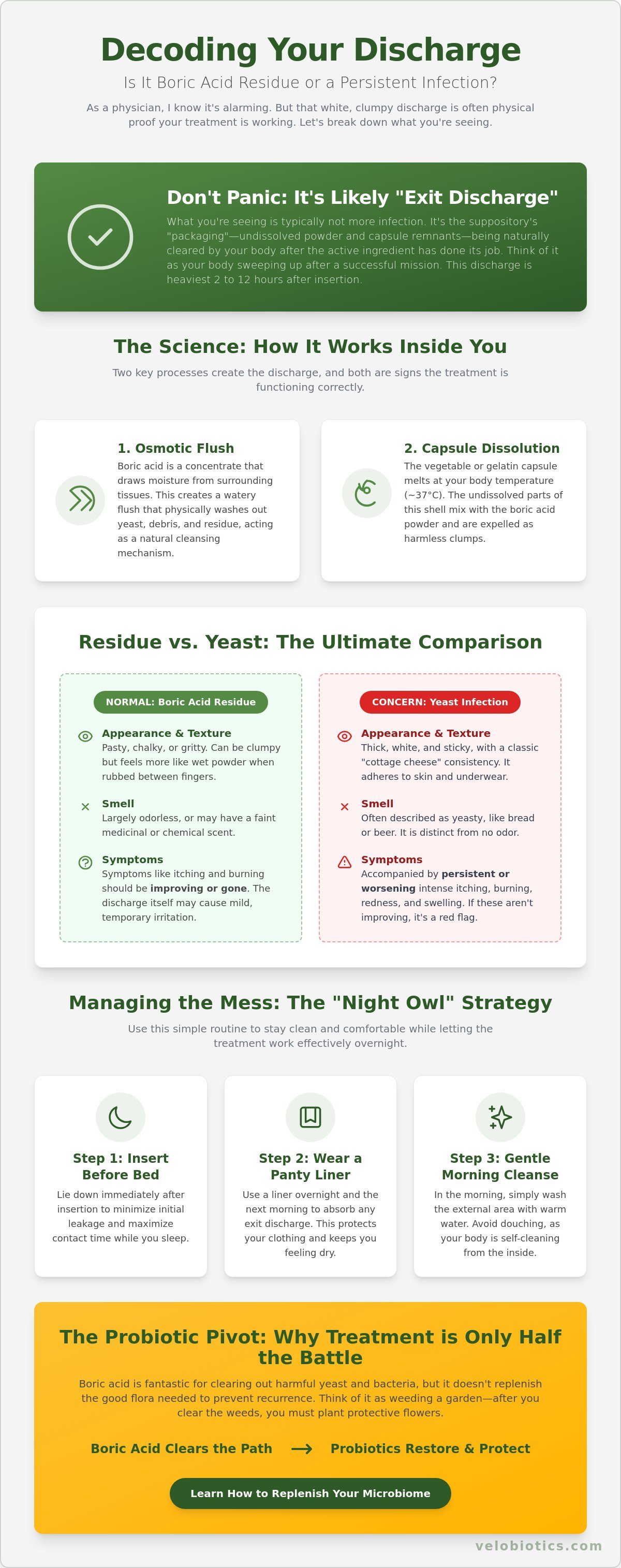
Residue vs. Yeast Infection: The Ultimate Comparison Guide
If you're staring at a tissue and wondering if you're back at square one, the "Wipe Test" is your first line of defense. When you encounter white clumpy discharge after boric acid, try rubbing a small amount between your fingers. Medication residue feels chalky, gritty, or like a thin paste that easily smears. In contrast, yeast infection discharge is protein-heavy; it's sticky, clumps together like cottage cheese, and resists being broken down. This textural difference is a direct result of how minerals behave versus how biological fungal colonies grow.
Next, trust your nose. Yeast infections typically produce a distinct, sweet, bread-like odor caused by the fermentation process of the Candida fungus. Boric acid is an inorganic compound. It doesn't ferment. If the discharge has a mild metallic scent or no smell at all, you're likely looking at the remains of your suppository. If that "bakery" scent persists, the fungus is still active and potentially resisting treatment.
Discomfort is the most deceptive symptom. Boric acid can cause what I call "mechanical irritation." This is a surface-level tingle or slight burning as the acid interacts with your delicate tissues to lower your pH. It's usually temporary. The itch of a yeast infection is deep, maddening, and feels like it's under the skin. If you're using a high-quality formulation like Femina Probiotic COOKIE FRESH, the addition of soothing elements helps minimize this mechanical sting, making it easier to tell if the "real" itch is still there.
The Symptom Checklist
Keep a close eye on these red flags over a 72-hour period. If you notice escalating redness, significant swelling of the labia, or intense burning that makes urination painful, you're likely dealing with an active infection or a hypersensitivity reaction. Mechanical irritation from the powder should remain stable or decrease as the residue clears. A true infection usually gets louder and more aggressive without effective antifungal intervention.
Timing is Everything
Your body is a highly efficient clearing house. Once you stop treatment, any white clumpy discharge after boric acid should vanish within 24 hours as the last of the powder is expelled. If the clumps persist or reappear 48 hours after your last dose, the "Great Exit" is over and the fungus has likely rebounded. I always tell my patients to follow the "Doctor's Rule": if it still looks and feels like a yeast infection on day seven of your protocol, it's time to stop the home care and schedule a clinical swab.
Managing the Mess: Practical Tips for a 'Clean' Treatment
While we've established that white clumpy discharge after boric acid is a biological necessity, managing the physical reality of it requires a strategic approach. You don't have to let the "Great Exit" disrupt your daily life or cause secondary irritation. By understanding the mechanics of gravity and material science, you can stay comfortable while the medication works its magic. Think of this phase as a temporary internal renovation; there's going to be some dust, but the results are worth the cleanup.
Gravity is your most persistent opponent during treatment. If you apply a suppository and immediately head to the gym, the medication will likely exit your body before it has achieved full biological viability. I recommend the "Night Owl" strategy. By applying your treatment immediately before bed, you ensure the medication stays in contact with the vaginal mucosa for the maximum duration possible. This minimizes the daytime mess and maximizes the therapeutic impact on your internal environment.
Protection is vital, but the wrong choice can backfire. Avoid plastic-heavy or scented panty liners, as these trap heat and moisture, creating a breeding ground for the very yeast you're trying to eliminate. Opt for 100% organic cotton liners. These allow for airflow while capturing the chalky residue. If you find the discharge particularly heavy, changing your liner every 3 to 4 hours prevents the "soggy" feeling that often leads to external vulvar irritation.
Application Best Practices
Precision matters. Use an applicator to ensure deep insertion near the cervical fornix. This placement allows the capsule to dissolve in the widest part of the canal, slowing the eventual descent of the powder. Follow the "Horizontal Rule": stay reclined for at least 30 minutes post-insertion. This window allows the capsule shell to begin its melt without the immediate pull of gravity. For a reliable, mess-conscious option, you can buy Femina COOKIE FRESH Boric Acid ONLY Suppositories to maintain your routine with confidence.
Hygiene Without Irritation
When you see white clumpy discharge after boric acid, the urge to "power wash" the area is strong. Resist it. Never douche. Douching forces the residue and potential pathogens deeper into the vaginal canal and disrupts the delicate pH balance the boric acid is working to restore. Instead, use warm water and your fingertips to gently clear any gritty residue from the external vulva. Stick to cotton underwear during your entire treatment course. Cotton is breathable and prevents the "sauna effect" that synthetic fabrics create, which is essential for a healthy microbiome recovery.
Hydration also plays a silent but critical role. The osmotic draw mentioned earlier requires systemic water. If you're dehydrated, your body will struggle to produce the fluid needed to dissolve the medication effectively, leading to dryer, more irritating clumps. Aim for at least two liters of water daily to keep the "flush" moving smoothly and comfortably.
The Probiotic Pivot: Why Boric Acid is Only Half the Battle
Boric acid acts as a powerful "clean slate" for your vaginal health. It is an effective antiseptic that breaks down the stubborn biofilms protecting yeast colonies, but it operates like a non-selective reset button. I often describe this phenomenon as the "Microbiome Vacuum." While the treatment successfully clears the pathogens causing your symptoms, it also removes the protective Lactobacillus strains that serve as your body's natural security guards. If you stop your protocol as soon as the white clumpy discharge after boric acid clears, you leave a biological vacancy. Opportunistic yeast is often more than happy to re-occupy that empty space, leading to the frustrating "rebound" infections so many women experience.
Restoring Your 'Good' Flora
To break the cycle of recurring discomfort, you must transition from "clearing" to "cultivating." High-quality probiotics for bv and yeast recovery are essential because they physically crowd out the bad microbes. These beneficial bacteria produce lactic acid and hydrogen peroxide, which maintain a naturally acidic pH level. Using a sophisticated, dual-action formulation like Femina Probiotics Cookie Fresh with Boric Acid allows you to address the immediate overgrowth while simultaneously seeding the environment with protective flora. This ensures that any white clumpy discharge after boric acid you encounter is merely the temporary exit of medication residue rather than a sign of a failing defense system.
Actionable Daily Routine
A successful recovery requires a structured 7-day "Reset" schedule to ensure long-term stability. I recommend a simple but scientifically sound protocol: use your boric acid suppository at night to maximize contact time during sleep, and take an oral supplement like Femina™ Probiotic Capsules with Cranberry Extract every morning. The most critical factor in this routine is biological viability. Many standard probiotics are destroyed by stomach acid before they can provide any benefit to your system. Look for products engineered with advanced delivery technology that protects the live cultures until they reach their destination. My final doctor's tip is simple: treat the fire with boric acid, then immediately replant the forest with probiotics. By following this gold standard, you move beyond just managing symptoms and start building a resilient, balanced microbiome.
Take Control of Your Vaginal Health Today
Understanding the physiological mechanics of your body is the first step toward reclaiming your confidence. Seeing white clumpy discharge after boric acid is typically a sign of "exit discharge," where your system clears out unabsorbed minerals and capsule materials through osmotic draw. By using the smell and texture tests we discussed, you can easily distinguish this harmless residue from a persistent infection. Long-term success depends on more than just clearing pathogens; you must replant the beneficial flora that keeps your microbiome resilient.
I've spent years perfecting a doctor-founded formula that combines clinical-strength boric acid with proprietary micro-encapsulation technology to ensure probiotic survival. This dual-action approach provides immediate pH balancing while delivering live bacteria to protect your internal environment. It's time to move beyond temporary fixes and embrace a solution that restores your natural defenses. Stop the cycle of infections with Femina Cookie Fresh—Boric Acid + Probiotics in one!
You deserve to feel clean, comfortable, and in command of your wellness. Trust the science, listen to your body, and stay consistent with your recovery.
Frequently Asked Questions
Is it normal to have white clumps after using boric acid?
Yes, it is perfectly normal and expected. This material is simply undissolved boric acid powder and remnants of the capsule shell. Since the vaginal canal has limited absorption capacity, the excess must exit the body. You'll notice white clumpy discharge after boric acid most frequently within 12 hours of application. It's a sign the medication is physically present and interacting with your internal environment.
How long does the discharge last after finishing boric acid treatment?
You should see the discharge taper off within 24 to 48 hours after your final dose. Your body is a highly efficient clearing house and will naturally flush out any remaining mineral residue. If you continue to see thick, cottage cheese like clumps beyond this window, it's likely the infection has returned rather than being simple medication residue. Consistency in tracking this timeline is key for a proper self-diagnosis.
Can boric acid actually cause a yeast infection?
Boric acid cannot cause a fungal infection, but it can leave your system vulnerable. Because it's an antiseptic, it clears out both harmful yeast and beneficial Lactobacillus. This "microbiome vacuum" can lead to a rebound infection if you don't replant the good bacteria. This is why I always recommend a probiotic follow up to ensure long term biological balance and prevent the cycle from starting over.
Why is my discharge watery and clumpy at the same time?
This dual texture is the result of a process called "osmotic draw." Boric acid is a concentrated solute that pulls moisture from your vaginal walls to balance itself, creating the watery flow. Simultaneously, the solid powder and capsule binders haven't fully dissolved, resulting in the clumps. It's a clear indicator that the "Science of the Melt" is actively occurring as the medication interacts with your natural moisture.
Should I stop using boric acid if I see white clumps?
No, you shouldn't stop your treatment early. Seeing white clumpy discharge after boric acid is a standard part of the process, not a sign of a worsening condition. Stopping prematurely can allow the remaining yeast colonies to develop resistance. Continue the full course prescribed by your healthcare provider unless you experience severe allergic reactions like intense swelling, hives, or pain that prevents daily activity.
Can I have sex while I have boric acid discharge?
I recommend avoiding sexual activity until 24 hours after your last dose has cleared your system. The gritty residue can cause micro abrasions on both you and your partner, leading to irritation or increased infection risk. Additionally, boric acid is toxic if ingested orally. Waiting until the discharge has completely cleared ensures safety and comfort for everyone involved while protecting your delicate healing tissues.
What color should boric acid discharge be?
Normal residue should be white, chalky, or clear. Since most high quality suppositories use pure white powder and clear vegetable capsules, the "exit discharge" should reflect those colors. If you notice discharge that is bright yellow, green, or contains blood, this is a red flag for a different type of infection. These colors may indicate trichomoniasis or a bacterial imbalance that requires a different medical approach.
When should I see a doctor about discharge after boric acid?
Schedule an appointment if you experience escalating pain, foul odors, or fever. While a mild tingle is normal, intense burning or labial swelling suggests a hypersensitivity reaction or a more complex infection. If the symptoms that look like yeast persist after seven days of treatment, it's time to stop the home care. You need a professional swab to get a definitive diagnosis and a targeted treatment plan.

Disclaimer
Information and statements regarding dietary supplements/products have not been evaluated by the Food and Drug Administration, MCC/SAHPRA, MHRA, TGA or any other drug regulatory authority and are not intended to diagnose, treat, cure, or prevent any disease. Information on this website is provided for informational purposes only and is a result of years of practice and experience by the author. This information is not intended as a substitute for the advice provided by your physician or other healthcare professional or any information contained on or in any product label or packaging. Do not use the information on this website for diagnosing or treating a health problem or disease, or prescribing medication or other treatment. Always speak with your physician or other healthcare professional before taking any medication or nutritional, herbal, or homeopathic supplement, or using any treatment for a health problem. If you have or suspect that you have a medical problem, contact your healthcare provider promptly. Do not disregard professional medical advice or delay in seeking professional advice because of something you have read on this website.