

Why Does My Bacterial Vaginosis Keep Coming Back? A Doctor’s Guide to Breaking the Cycle
Did you know that over 50% of women experience a recurrence of BV within just three months of finishing their treatment? It is incredibly frustrating to complete a seven day course of metronidazole only to have that familiar fishy odor and discomfort return a few weeks later. You feel like you are stuck in a revolving door at the clinic, and you are likely asking yourself, why does my bacterial vaginosis keep coming back despite following every medical instruction? I understand that the social anxiety regarding intimacy and the physical discomfort of persistent discharge can take a heavy toll on your daily life.
The truth is that recurrence isn't a failure of your hygiene; it is a failure of your "vaginal security guards," known as Lactobacillus, to dismantle bacterial fortresses called biofilms. Most standard treatments clear the active infection but leave these protective shields intact, allowing bad bacteria to regroup and thrive. In this guide, I will explain the hidden biological reasons behind these relapses and provide a physician backed protocol to restore your microbiome for good. You will discover a practical maintenance plan that moves beyond constant antibiotics to help you achieve lasting balance and restored confidence in your body's health.
Key Takeaways
- Understand how Gardnerella vaginalis creates a sticky biofilm that acts as an invisible shield, allowing bad bacteria to survive even the strongest antibiotic treatments.
- Gain clarity on why does my bacterial vaginosis keep coming back by looking at the biological breakdown of your vaginal security guards rather than your hygiene habits.
- Learn how to use boric acid as a physical desiccant to break down bacterial fortresses and clear the path for healthy flora to take root.
- Discover a physician-backed two-phase protocol designed to dismantle bacterial shields and re-populate your microbiome with high-viability probiotics for lasting protection.
The Revolving Door of BV: Why Your Infection Won't Stay Away
You finish your prescribed course of pills, the symptoms vanish, and you finally feel like yourself again. Then, like clockwork, that familiar discomfort and odor return just a few weeks later. It is a cycle I see every day in my practice, and it leaves patients feeling defeated and asking, "Why does my bacterial vaginosis keep coming back?" The first thing you need to know is that this is not a reflection of your personal hygiene. You aren't "unclean," and no amount of extra scrubbing or scented soaps will fix a biological imbalance. In fact, Bacterial vaginosis is often less about a brand-new infection and more about a persistent one that never truly left; it was just simmering beneath the surface, waiting for the right moment to flare up again.
The 80% Statistic: You are Not Alone
While the statistics can be sobering, they prove you aren't an outlier. Verified data shows that over 50% of women experience a recurrence of BV within just three months of treatment, and some clinical observations suggest that up to 80% of women will see it return within a year. This revolving door creates a heavy psychological burden. I've spoken with many women who develop "smell-anxiety," a constant fear that others can detect their infection, which leads to social withdrawal and a massive hit to intimate confidence. Standard seven-day antibiotic courses are designed to kill the overgrowth of bad bacteria, but they often fail to address the underlying environment that allowed the infection to start in the first place.
Why Antibiotics Are Only Half the Battle
Think of antibiotics as a powerful weed killer. They are excellent at clearing out the unwanted growth, but they don't plant any "new grass." This creates a "scorched earth" effect where both the bad bacteria and your protective Lactobacillus are wiped out. Without these "security guards" to produce hydrogen peroxide and keep the vaginal pH acidic, the bad bacteria have an open field to return even stronger. BV recurrence is often a failure of restoration, not a failure of medication.
To stop this cycle, we have to move beyond just killing the weeds. We need to rebuild the fortress. This is why I focus on solutions like Femina Probiotics COOKIE FRESH with Boric Acid, which focuses on both clearing the path and re-populating the good guys. When you only use antibiotics, you are treating the symptom while leaving the biological door wide open for the next flare-up. Understanding this distinction is the first step toward breaking the cycle for good.
The Science of Biofilms: How Bacteria Hide from Treatment
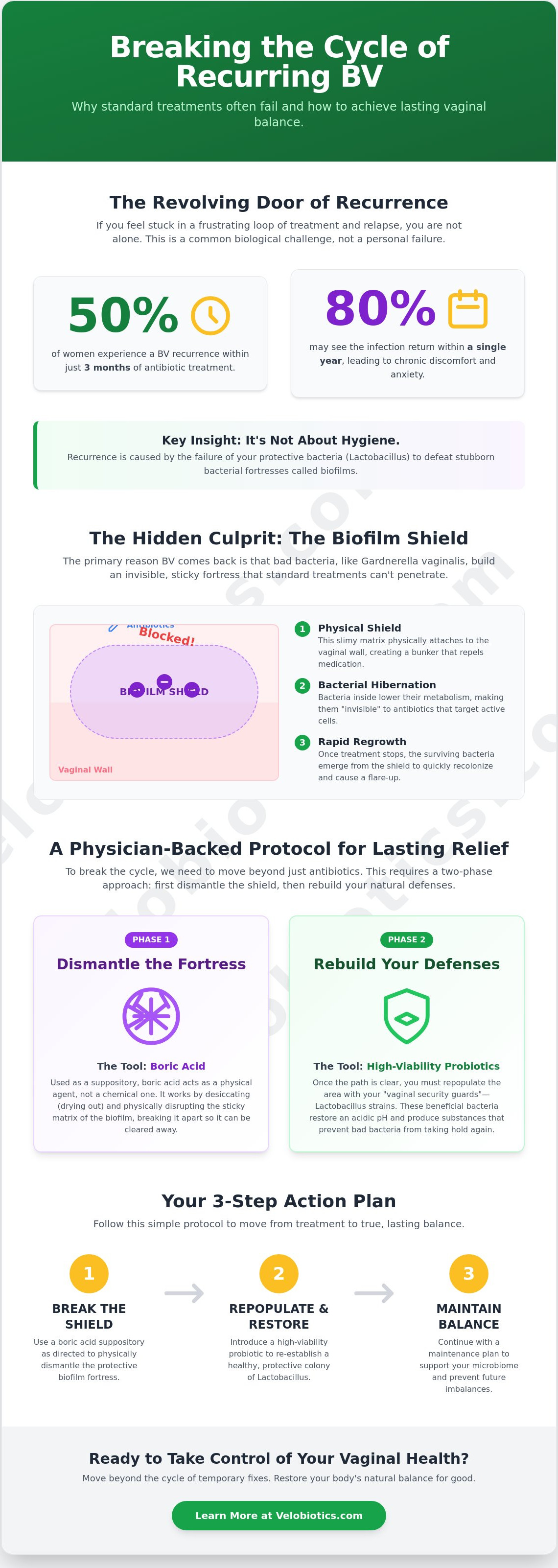
If you’ve ever felt like your treatment only hits the 'pause' button rather than the 'stop' button, you are likely dealing with a biofilm. Think of a biofilm as an invisible, sticky shield that bad bacteria, specifically Gardnerella vaginalis, build over themselves. This isn't just a random clump of germs; it is a sophisticated, multi-species fortress that physically attaches to your vaginal wall. Once this matrix is established, it acts as a biological bunker. This is a primary reason why BV infections come back. Even high-dose antibiotics often cannot penetrate the outer layers of this slime. When patients ask me why does my bacterial vaginosis keep coming back, I often point them toward this concept of microbial hibernation. The bacteria inside lower their metabolic rate so the medicine doesn't even recognize them as active targets.
Understanding this structural defense is the real answer to the question: why does my bacterial vaginosis keep coming back? Standard pills simply wash over the top of the shield, leaving the architects alive and ready to rebuild the moment you stop your medication. This is why treating the bacteria without addressing the biofilm is like trying to put out a fire without removing the fuel.
What is a Vaginal Biofilm?
To put it simply, imagine a bacterial fortress that repels medicine like water off a duck's back. These bacteria use specific 'scaffolding' proteins to weave themselves together into a dense mat. This construction is so effective that your own immune system’s white blood cells can't even see the invaders hiding underneath. They are effectively invisible to your body's natural defenses, which explains why your system doesn't fight back effectively once the biofilm has matured. It is a physical barrier that requires a physical solution to dismantle.
The pH Spiral: Why Alkaline is the Enemy
Your vagina is naturally designed to be acidic, with an ideal pH between 3.8 and 4.5. This acidity is your greatest defense. However, life happens. Semen, menstrual blood, and even certain harsh soaps are alkaline, meaning they raise your pH level. When the environment becomes too alkaline, it sends a chemical signal to bad bacteria that it's safe to start building. A high pH actually makes the biofilm matrix stronger and harder to dissolve. It creates a trap where the environment itself protects the very bacteria causing your symptoms. To break this cycle, you need a way to disrupt that physical shield, which is where targeted boric acid support comes into play as a vital tool for environmental reset.
Breaking the Shield: Why Boric Acid is a Game-Changer
If the biofilm is the bunker we discussed earlier, then boric acid is the demolition crew. While antibiotics are designed to interfere with the internal machinery of a bacterial cell, boric acid works externally. It acts as a desiccant, which is just a fancy medical term for something that dries things out. By physically dehydrating and breaking down the sticky matrix of the biofilm, it exposes the bacteria hiding underneath. This is a major part of the puzzle for women wondering why does my bacterial vaginosis keep coming back; you've been cleaning the floor but leaving the mold behind the wallpaper. Boric acid clears that "mold" so your next steps actually work.
Think of boric acid as a "Biofilm Buster." Its primary job isn't just to kill germs, but to prepare the ground for healthy bacteria to take root. Without dismantling that shield, any probiotics you take are just bouncing off a locked door. Using medical grade boric acid is a staple in recurrent BV protocols because it is incredibly effective at resetting the environment without the same risk of resistance that we see with repeated antibiotic use. One kills, the other dismantles. To truly break the cycle, you need both actions working in your favor.
Boric Acid vs. Traditional Antibiotics
Boric acid is a pH-balancing agent that creates a hostile environment for Gardnerella and other opportunistic pathogens. It is often the "missing link" in chronic cases. When we use it alongside traditional medicine, we see much higher success rates because we are attacking the problem from two different angles.
| Feature | Traditional Antibiotics | Medical-Grade Boric Acid |
|---|---|---|
| Primary Mechanism | Chemical disruption of cell life | Physical dismantling of biofilm |
| Target | Active, metabolizing bacteria | Protective matrix and pH levels |
| Recurrence Prevention | Low (if biofilm remains) | High (prepares environment) |
When to Reach for Boric Acid Suppositories
Timing is everything when you are trying to stop the cycle of why does my bacterial vaginosis keep coming back. You want to use these suppositories when your vaginal pH is most vulnerable to alkaline spikes. These triggers usually include:
- Post-period: Menstrual blood has a pH of about 7.4, which is very alkaline.
- Post-intercourse: Semen typically ranges from 7.1 to 8.0, which can neutralize your natural acidity.
- During a flare: To help break down the biofilm while using other treatments.
Practicality is key here. I often recommend a "Cookie Fresh" approach because it provides a dual-action benefit: it handles the immediate environmental reset while making you feel comfortable again. If you are currently stuck in that frustrating loop, I suggest trying Femina Cookie Fresh with Boric Acid. It is designed to disrupt the shield and help you reclaim your health without the guesswork.
Rebuilding the Fortress: The Essential Role of Probiotics
Once we have dismantled the biofilm and reset the pH, the real work begins. We have to bring back the "security guards" of your vaginal health: Lactobacillus. These tiny organisms are the frontline defense against infection, but their absence is usually the hidden reason why does my bacterial vaginosis keep coming back even after a successful round of antibiotics. Without these guards, the environment remains vulnerable to the next opportunistic pathogen that wanders in. You can't just clear the land; you have to occupy it with the right residents.
These good bacteria don't just occupy space. They actively produce hydrogen peroxide and lactic acid, creating a natural chemical barrier that bad bacteria find intolerable. It is a biological standoff where the good guys keep the peace by maintaining an acidic environment. If your Lactobacillus levels are depleted, the "peace" is broken, and the cycle of recurrence starts all over again. This is why simply killing the bad bacteria is never enough to provide a long-term solution.
Why Your Previous Probiotics Might Have Failed
Many of my patients tell me they have tried probiotics before with zero results. There is a scientific reason for this: the viability gap. Most standard probiotics are extremely delicate. By the time they sit on a warm retail shelf and then hit the harsh, churning acid in your stomach, nearly 90% of the live cultures are destroyed. If they don't survive the journey to your gut, they certainly won't help your vaginal health. They are effectively dead on arrival.
To solve this, we use a proprietary micro-encapsulation technology. Think of it as a microscopic suit of armor that protects each bacterial strain until it reaches the lower intestine. This ensures that the billions of CFUs (colony-forming units) promised on the label actually arrive alive and ready to work. You can read more about the science of probiotics that survive stomach acid to understand why delivery technology is just as important as the strains themselves. It is the only way to ensure the "security guards" actually reach their post.
Specific Strains for Vaginal Microbiome Restoration
When restoring the vaginal microbiome, not all strains are created equal. We look for "VIP" strains like L. rhamnosus and L. reuteri, which have a unique ability to migrate from the gut to the vaginal tract. This "Vaginal-Gut Axis" is a natural pathway that allows your body to re-seed the vaginal environment from within. It's a constant, internal supply chain of health. To maintain this defense daily and stop asking why does my bacterial vaginosis keep coming back, I recommend Femina Probiotic Capsules with Cranberry, which combines these specific strains with cranberry extract for targeted, high-viability support.
Your 3-Step Action Plan for a BV-Free Future
Breaking the cycle requires a strategy that goes beyond the pharmacy counter. If you are tired of wondering why does my bacterial vaginosis keep coming back, it's time to shift from reactive treatment to proactive management. This physician-backed protocol is designed to address the biological gaps left by standard care, ensuring your vaginal ecosystem remains resilient against opportunistic pathogens.
- Phase 1: The Reset. Use medical-grade boric acid to dismantle the biofilm. This step is non-negotiable because it physically breaks down the protective shield that bad bacteria use to hide from your immune system.
- Phase 2: The Re-population. Immediately follow the reset with high-viability probiotics. You must seed the environment with specific Lactobacillus strains that can actually survive the journey to the target site.
- Phase 3: Maintenance. Implement lifestyle tweaks to keep your pH within the healthy 3.8 to 4.5 range. This prevents the "alkaline spikes" that signal bad bacteria to start rebuilding their fortresses.
The Maintenance Protocol: Daily Habits
Your daily choices can either support or sabotage your microbiome. Breathable clothing isn't just a buzzword; it is a clinical necessity. Synthetic fabrics trap heat and moisture, creating a literal petri dish for Gardnerella. Stick to 100% cotton underwear to allow for proper airflow. I also enforce a strict "no-douching" rule. Your vagina is a self-cleaning oven, and douching strips away the very "security guards" we worked so hard to repopulate. Water is the only thing your vulva needs for external cleansing. After intercourse, consider a quick "rinse and reset" to stabilize your pH, as semen is highly alkaline and can disrupt your internal balance for hours.
A Doctor’s Parting Advice on Intimacy and BV
We need to talk about the "Ping-Pong Effect." While BV is not classified as a traditional STI, partners can harbor the bacteria responsible for the infection, leading to a back-and-forth cycle of reinfection. New guidance issued in March 2026 by the New York State Department of Health now emphasizes educating clinicians on partner treatment to reduce recurrence. Using condoms or pH-balanced lubricants during the restoration phase can be life-savers for chronic sufferers. It isn't about stigma; it's about microbial management.
Finally, know your red flags. If you experience pelvic pain, a fever, or if your symptoms don't improve after 14 days of this protocol, stop self-treating and see a specialist immediately. To understand more about how we solve the fundamental problem of bacterial survival, Explore the Velobiotics Story and see how our technology ensures your health stays on track.
Reclaim Your Confidence and Break the Cycle
You now have the scientific blueprint to stop the frustration of recurrent infections. We have identified that the real hurdle isn't your hygiene, but the stubborn biofilms that shield bad bacteria from standard treatments. By shifting to a protocol that dismantles these fortresses and re-populates your vaginal "security guards," you are finally addressing the biological root cause. Understanding why does my bacterial vaginosis keep coming back is the final piece of the puzzle, allowing you to move from temporary fixes to lasting microbiome health.
As a physician, I developed our proprietary micro-encapsulation technology to ensure 1000x better delivery of active ingredients. This doctor-founded, dual-action approach combines the dismantling power of boric acid with probiotics that actually arrive alive. You don't have to stay stuck in the antibiotic loop any longer. Stop the cycle with Femina Cookie Fresh Boric Acid Suppositories and start your journey toward a balanced, BV-free future. Your body is ready to heal; it just needs the right scientific support to get there.
Frequently Asked Questions
Is recurrent BV a sign of an underlying health problem?
Recurrent BV is typically a sign of a disrupted vaginal ecosystem rather than a systemic health crisis. It suggests that your natural defenses, specifically Lactobacillus, haven't fully recovered or that a persistent biofilm is protecting bad bacteria. While it can be linked to conditions that affect the immune system, it is most often a localized biological failure of the "security guards" to keep the peace.
Can my male partner give me BV back after I've treated it?
Yes, male partners can harbor the bacteria responsible for BV, leading to a cycle of reinfection often called the "ping-pong effect." While men don't show symptoms, they can act as a reservoir for Gardnerella vaginalis. Recent clinical guidelines now suggest that treating sexual partners may be necessary to stop the cycle of why does my bacterial vaginosis keep coming back, especially in chronic cases.
How long should I use boric acid for recurrent BV?
For a recurrent flare, I typically recommend using one boric acid suppository nightly for 7 to 14 days. Once the initial "reset" is complete, many women find success with a maintenance schedule of one suppository twice weekly or specifically after triggers like intercourse or menstruation. Always follow the specific protocol provided by your healthcare provider to ensure you aren't over-treating the area.
Why do I get BV every time after my period ends?
You get BV after your period because menstrual blood has a pH of about 7.4, which is significantly more alkaline than your healthy vaginal environment. This shift in acidity provides the perfect window for bad bacteria to multiply and build biofilms. It is the most common biological trigger for women who find themselves asking why does my bacterial vaginosis keep coming back every single month.
Can I take oral probiotics and use vaginal suppositories at the same time?
Yes, you can and often should use both oral probiotics and vaginal suppositories simultaneously. The vaginal suppositories provide an immediate, localized "re-population" of good bacteria, while high-viability oral probiotics support the long-term supply chain through the vaginal-gut axis. Using them together creates a comprehensive defense system that addresses both the immediate environment and your body's internal bacterial reservoir.
Does diet affect how often my BV comes back?
Diet plays a supporting role in your microbiome health, particularly regarding sugar intake. High-sugar diets can potentially feed opportunistic pathogens and yeast, making it harder for your "security guards" to maintain control. While a salad won't cure an active infection, a diet rich in fermented foods and low in processed sugars provides the nutritional foundation your good bacteria need to thrive and defend your system.
What happens if I just leave the BV untreated?
Leaving BV untreated can lead to serious complications, including an increased risk of pelvic inflammatory disease (PID) and a higher susceptibility to STIs like HIV or chlamydia. Chronic inflammation in the vaginal tract weakens your local immune response. It isn't just about the odor or discomfort; it's about protecting your long-term reproductive health and preventing infections from moving higher into the uterus or fallopian tubes.
Is it safe to use boric acid suppositories while pregnant?
No, you should never use boric acid suppositories while you are pregnant. Boric acid is toxic to a developing fetus and can lead to serious developmental issues or pregnancy complications. If you are pregnant and experiencing BV symptoms, it is vital to consult your OB-GYN for pregnancy-safe antibiotic options, as untreated BV during pregnancy is linked to preterm birth and low birth weight.

Disclaimer
Information and statements regarding dietary supplements/products have not been evaluated by the Food and Drug Administration, MCC/SAHPRA, MHRA, TGA or any other drug regulatory authority and are not intended to diagnose, treat, cure, or prevent any disease. Information on this website is provided for informational purposes only and is a result of years of practice and experience by the author. This information is not intended as a substitute for the advice provided by your physician or other healthcare professional or any information contained on or in any product label or packaging. Do not use the information on this website for diagnosing or treating a health problem or disease, or prescribing medication or other treatment. Always speak with your physician or other healthcare professional before taking any medication or nutritional, herbal, or homeopathic supplement, or using any treatment for a health problem. If you have or suspect that you have a medical problem, contact your healthcare provider promptly. Do not disregard professional medical advice or delay in seeking professional advice because of something you have read on this website.